
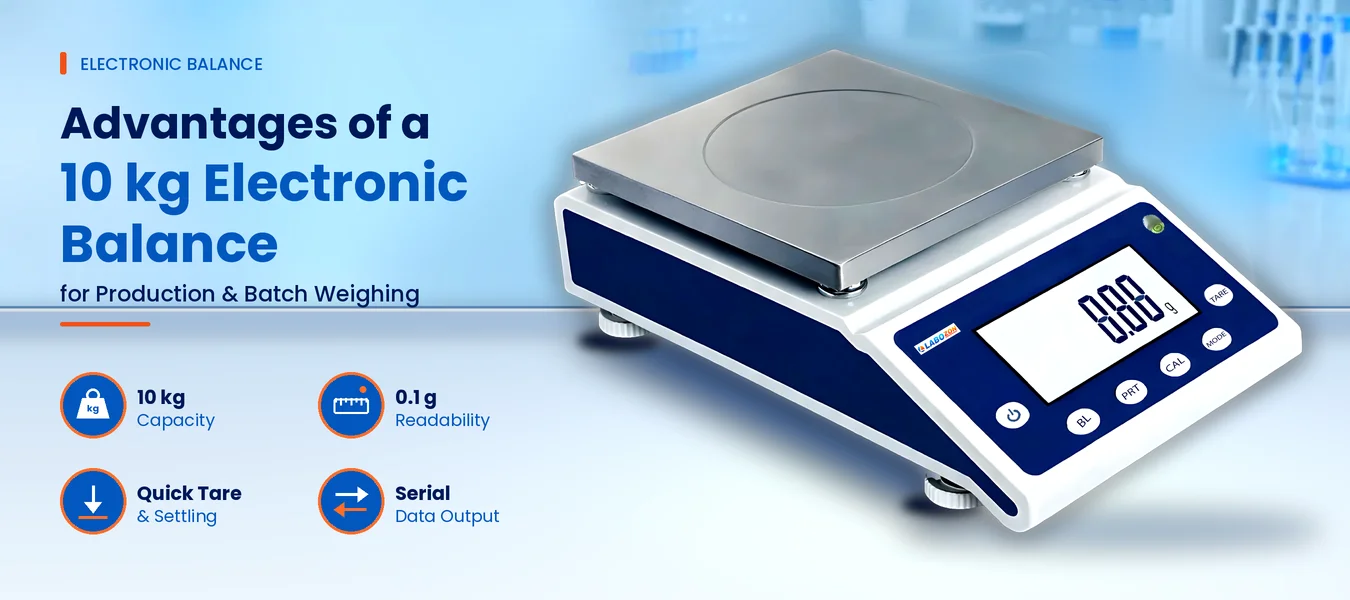
Large portions still call for careful readings. This guide explains how a ten kilogram electronic balance helps laboratories, hospital labs, research centres, and advanced labs keep batch work organized and repeatable.
Where Heavy Loads Meet Fine Readings
Batch work rarely involves a single sample. A technician may fill a container, check it against a target mass, and move on to the next lot within minutes. An analytical instrument cannot hold such loads, while a floor unit may lack the finer reading needed to control each portion.
The Electronic Balance LZ-EB-B140 sits in that gap. Its product page lists a maximum range of ten kilograms, a readability of one tenth of a gram, and a repeatability of plus or minus one hundredth of a gram, so large portions and fine control can share one bench.
How the Weighing Principle Works
Inside the housing, a high precision electromagnetic sensor responds to the load placed on the stainless steel pan. The sensing part is sealed and shielded, and an enlarged aluminum alloy base supports the unit. The processed signal then appears on the display, where the operator reads the mass.
The electronic balance diagram below labels the parts handled most often. Following the path from pan to sensor to display makes the working principle of any electronic balance machine easier to picture.Clear backlit display
The LCD with dual text prompts stays easy to read across a busy bench.
Easy tare, quick settling
Container mass is removed with one press, and readings stabilize quickly between portions.
Counting and unit conversion
A counting function and unit conversion let one unit cover several recording needs.
External calibration
Weight verification and adjustment are carried out from outside, with wind protection built into the design.
Data and power
A serial interface sends readings onward, and the rechargeable design supports portable use.
Practical Use Cases Across Lab and Production Settings
The product page names quality control, research, and production processes as typical areas of use. Each electronic balance application below follows the same rhythm of tare, add, and record, yet the purpose differs.
- Batch preparation: portion raw material into containers and bring each one to its target mass.
- Quality control checks: confirm that filled containers match the planned mass before they move on.
- Research sample preparation: measure larger sample portions ahead of testing.
- Counting by mass: use the counting function to tally identical items without handling them one at a time.
In hospital laboratories and research centres, these electronic balance uses look much the same wherever bulk portions are prepared. Advanced labs often add record keeping on top, which is where the data output becomes useful.
Selection Mistakes Worth Avoiding
Many electronic scales look alike on a shelf, so a few checks before choosing save rework later.
- Choosing capacity from the heaviest load alone. Container mass counts toward the range, so leave margin above the typical filled weight.
- Reading the range without the readability. A wide range only helps when the smallest increment still controls each portion.
- Ignoring pan size. The stainless steel pan here measures two hundred by two hundred millimeters, so confirm that your containers sit fully on it.
- Overlooking the calibration method. External calibration needs a known weight at hand, which is worth planning for in advance.
- Forgetting data needs. If readings must reach other equipment, check for a data interface before deciding.
Looking through the wider laboratory balance range side by side makes these checks quicker.
Comparing Balance Types by Load and Detail
A lab balance is chosen by matching the load to the reading detail. This overview shows where the ten kilogram class sits among common types.
| Balance type | Load handled | Reading detail | Typical bench role |
|---|---|---|---|
| Analytical balance | Light samples | Very fine | Precise sample preparation |
| Precision balance | Moderate loads | Fine | General laboratory weighing |
| Electronic balance, ten kilogram class | Large portions | Fine for bulk work | Batch and production weighing |
| Floor balance | Heavy containers | Broader | Bulk handling |
Habits That Keep Readings Consistent
Good results come from routine. These habits suit any electronic balance scale in daily use.
Tare, then add
Place the empty container first and press tare so the display shows material only.
Let the value settle
Record the reading only after the display stabilizes.
Choose a calm spot
Wind protection helps, yet a draft free bench still improves repeatability.
Wipe between lots
A clean stainless steel pan prevents carryover from one material to the next.
Log through the interface
Sending readings onward reduces transcription mistakes.
Keep it charged
A rechargeable unit is ready for the next batch when charged in advance.
Exploring the Wider Laboratory Balance Family
Electronic Balance LZ-EB-B140 belongs to a family that also includes analytical, semi-micro, beam, floor, and precision balances. Each type serves a different weighing range, and teams usually compare capacity, readability, pan dimensions, calibration approach, display style, and data output when reviewing options.
The full Laboratory Balance category page presents all the types together, and the Labozon home page leads on to the wider catalog of laboratory equipment.
Review the Unit in Detail
Specifications, key features, and applications for this unit are collected on its product page.
Name: Olivia Carter – Labozon
Specialty: Laboratory Equipment, Scientific Technology, and SEO Content Writing
Writing Style: Professional, informative, research-driven, and reader-friendly.
Bio: Olivia Carter is a content writer at Labozon, specializing in laboratory equipment, scientific technologies, and laboratory applications. She creates informative, SEO-focused blog articles that highlight product features, explain key benefits, and explore the practical uses of scientific instruments. Her goal is to present technical information in a clear, accurate, and accessible manner, helping laboratory professionals, researchers, and science enthusiasts make informed decisions.
Related Products


Looking for electronic balance?
Compare available models, review product specifications, and contact the Labozon team for assistance in identifying equipment that matches your laboratory requirements.