
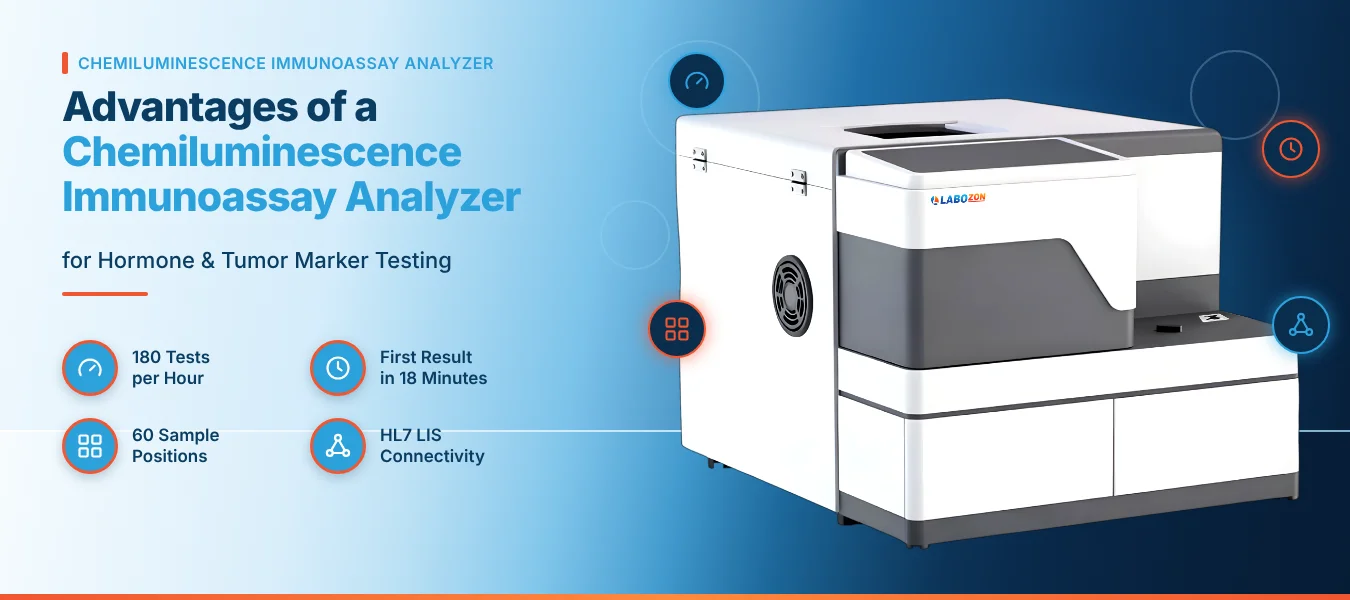
A thyroid panel, a tumor marker follow-up and an urgent hormone request can all land on the bench within the same hour, and each needs a result the physician can act on. A Chemiluminescence Immunoassay Analyzer handles that mix by automating the reaction, the wash and the light reading in one run. This guide explains how it works, where laboratories use it and what to review in the Labozon Chemiluminescence Immunoassay Analyzer LZ-CIA-A100.
How a Flash of Light Becomes a Result
Chemiluminescence immunoassay combines an antibody-antigen reaction with a light-emitting chemical reaction. The sample meets reagents and magnetic particles, a magnet holds the bound complex while unbound material is washed away, and a substrate then triggers light.
A chemiluminescence analyzer measures that light, and the signal tracks the amount of analyte in the sample. Because the process is automated, an immunoassay system removes manual pipetting and keeps timing the same from tube to tube.
Where Hormone and Tumor Marker Work Fits
Chemiluminescence immunoassay analyzer uses cover several departments, and each department leans on a different part of the workflow.
Endocrinology
Hormone testing, thyroid function assays and reproductive markers.
Oncology
Tumor marker testing and marker level monitoring over time.
Emergency Care
Urgent samples run ahead of the routine queue.
Cardiology
Cardiac marker panels run in batch mode.
Reading Results Against Reference Intervals
People often search for a chemiluminescence immunoassay normal range, but the analyzer does not carry a fixed range of its own. The reference interval depends on the assay kit, the patient group, age, sex and the laboratory's own validation.
The instrument reports a value, and the laboratory compares it with the interval printed in the kit instructions or set through its own review. Staff should confirm the interval with the medical director before results are released.
Key Details of the LZ-CIA-A100
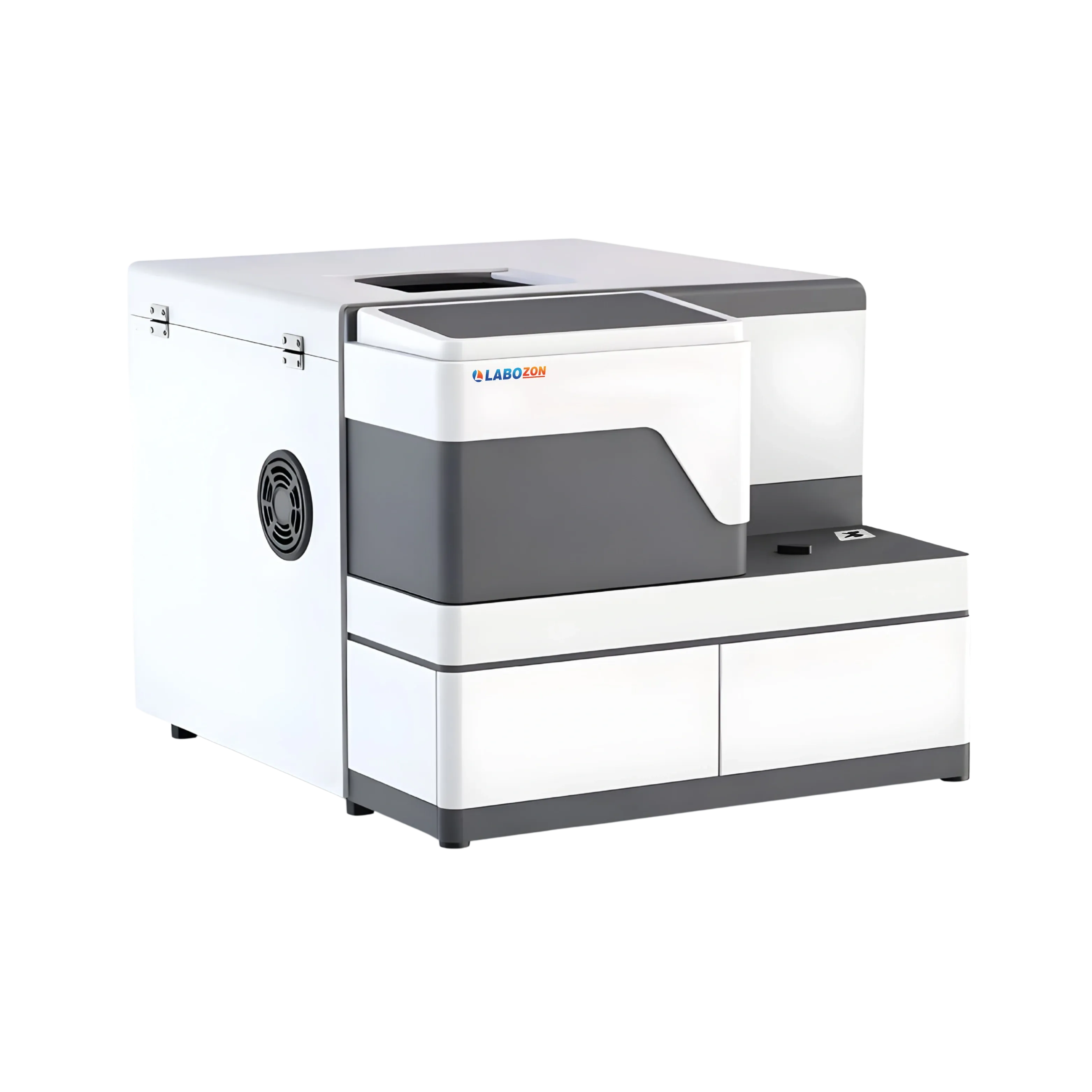
The Chemiluminescence Immunoassay Analyzer LZ-CIA-A100 is a benchtop unit that uses magnetic particle enzymatic chemiluminescence. Its published details are below.
| Feature | Specification |
|---|---|
| Throughput | 180 tests per hour |
| Time to first result | 18 minutes |
| Operation modes | Random, batch and STAT |
| Sample positions | 60, each usable as an emergency position |
| Reagent positions | 25, refrigerated at 2 to 8 °C |
| Incubation positions | 58 |
| Sample volume | 10 to 200 µL |
| Detection precision | CV of 3% or lower |
| Carry-over rate | 10-5 or lower |
| Correlation coefficient | r of 0.99 or higher |
| Calibration | 6 or 7 point, stable for 28 days |
| Separation | Magnetic separation technology |
| Probe functions | Liquid level detection, anti-collision |
| Identification | Sample barcode scanning, reagent radio frequency identification |
| Connectivity | Bidirectional LIS with HL7, TCP/IP network interface |
| Power | AC 220 V, 50/60 Hz; AC 110 V, 60 Hz optional |
| Unit dimensions | 768 × 771 × 568 mm |
| Unit weight | 90 kg |
Chemiluminescence Compared With ELISA
The table below sets two common immunoassay approaches side by side using typical features.
| Factor | ELISA Processor | Chemiluminescence Analyzer |
|---|---|---|
| Signal | Color change read by absorbance | Emitted light read by a detector |
| Run time | Usually longer | Shorter, first result in minutes |
| Access | Batch oriented | Random, batch and STAT |
| Typical fit | Batch screening | Rapid, high-volume panels |
Selection Mistakes That Cause Rework
- Comparing a chemiluminescent analyzer on throughput alone and ignoring menu coverage.
- Overlooking reagent storage capacity for the daily test volume.
- Skipping a check of LIS compatibility before purchase.
- Forgetting bench space, power supply and the weight of a 90 kg unit.
- Asking each supplier for different figures, which makes offers hard to compare.
Teams that want to compare similar instruments can start with the immunoassay analyzer category before shortlisting.
User Tips and Recommended Practices
- Keep reagents in the refrigerated positions and check expiry dates before each load.
- Calibrate within the 28-day window and after a reagent lot change.
- Run control materials at the start of each shift and review trends before reporting.
- Match tube type and sample volume to the assay.
- Check samples for bubbles and clots before loading.
- Follow the maintenance schedule for probes, wash stations and waste lines.
- Place the instrument in a room with steady temperature and clean power.
- Confirm LIS links and data backups after software updates.
- Log calibration dates, control results and service events.
Exploring Wider Immunoassay Analyzer Options
The LZ-CIA-A100 belongs to the immunoassay analyzer category, which covers chemiluminescence, fluorescence and ELISA instruments in several throughput levels. Buyers usually compare throughput, time to first result, sample and reagent positions, calibration stability, connectivity and menu coverage.
The full immunoassay analyzer range shows these instruments together, and the home page opens the other laboratory equipment groups.
See the full specification of the Chemiluminescence Immunoassay Analyzer LZ-CIA-A100.
Explore Chemiluminescence Immunoassay AnalyzerRelated Products
Looking for Chemiluminescence Immunoassay Analyzer?
Compare available models, review product specifications, and contact the Labozon team for assistance in identifying equipment that matches your laboratory requirements.