
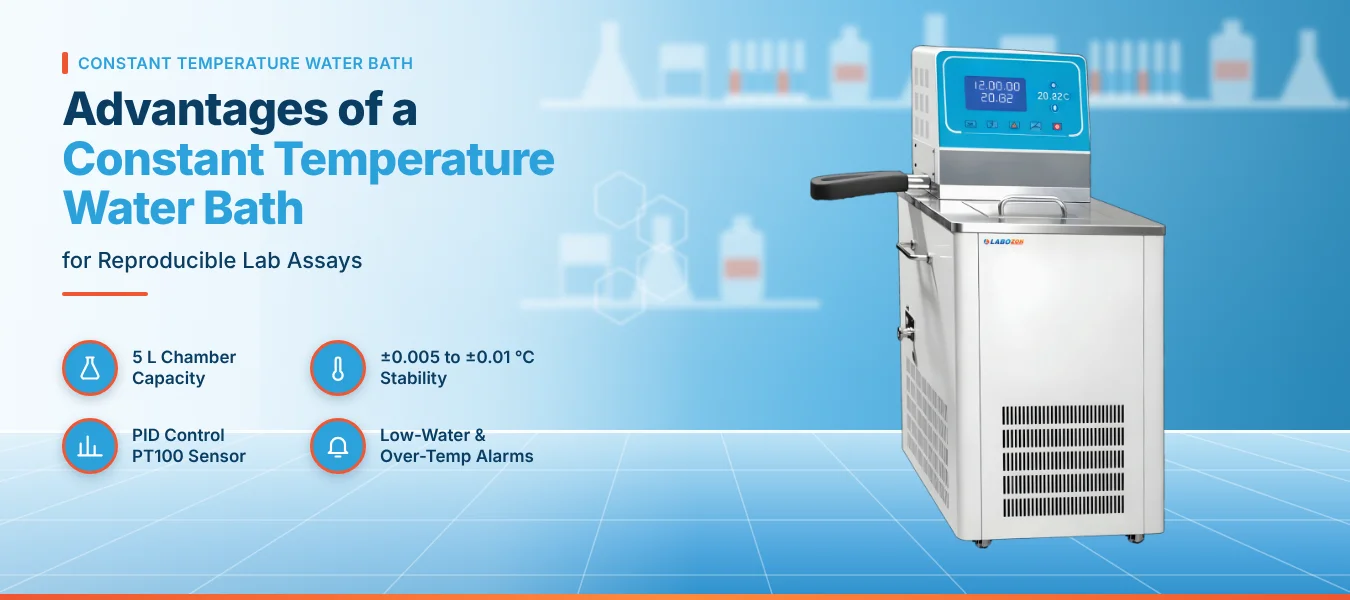
An assay that runs warm on Tuesday and cool on Thursday produces results nobody can compare. A Constant Temperature Water Bath removes that variable by holding a liquid-filled chamber at a set point and moving the liquid so the whole tank stays even. This guide explains how it works, where laboratories use it and what to review in the Labozon Constant Temperature Water Bath LZ-CWB-A105D.
How Heat Moves Through the Tank
A constant temperature bath relies on a heater, a temperature sensor, a controller and a circulation system working together. The sensor reads the liquid temperature, and the controller adjusts heater power to hold the set point.
Water carries heat far better than air, so a laboratory water bath surrounds each vessel on all sides. Forced circulation then evens out warm and cool pockets, which keeps tubes at the edge and the center of the tank under the same conditions.
Why Stable Temperature Protects Results
Constant temperature water bath benefits come down to control, uniformity and repeatability. Enzyme activity, incubation time and reaction rate all change with small temperature shifts, so a drift of a fraction of a degree can move an assay result.
A temperature water bath that holds its set point lets analysts compare runs from different days and different operators. That consistency matters most in assays that are repeated for validation or trend tracking.
Where Laboratories Put the Bath to Work
Constant temperature water bath uses reach across research, clinical, industrial and teaching labs, and constant temperature water bath laboratory use covers several routine tasks.
Enzyme Work
Reagents and enzyme reactions are held at their working temperature.
Thawing
Samples warm gently and evenly before an assay.
Material Tests
Metals, polymers and composites are evaluated at a steady temperature.
Environmental Studies
Water and energy research needs controlled heating over long runs.
A constant temperature water bath in laboratory work is valuable wherever a result depends on holding temperature steady for a set time.
Key Details of the LZ-CWB-A105D
The Labozon Constant Temperature Water Bath LZ-CWB-A105D is a 5 L unit with automatic PID control. Its published details are below.
| Feature | Specification |
|---|---|
| Capacity | 5 L |
| Temperature range | Room temperature to 300 °C |
| Temperature fluctuation | ±0.005 to ±0.01 °C |
| Temperature uniformity | ±0.005 to ±0.01 °C |
| Control | Automatic PID, PT100 sensor |
| Circulation | U-shaped flow path with centrifugal pump |
| Display | LCD |
| Protection | Low-water alarm, over-temperature, anti-dry-burn |
| Interface | RS232 or RS485 |
| Work slot | 180 × 140 mm |
| Inner groove | 275 × 190 × 120 mm |
| Drain | Yes |
Above the boiling point of water, a heating medium such as oil is normally required, so confirm the medium for the upper range with the supplier.
Water Bath, Hot Plate and Heating Block Compared
The table below sets three heating tools side by side using typical features.
| Factor | Hot Plate | Heating Block | Water Bath |
|---|---|---|---|
| Heat delivery | From below | By contact | From all sides |
| Vessel shapes | Flat-bottom items | Fixed tube sizes | Mixed glassware |
| Temperature evenness | Gradient in liquid | Good in the block | Good with circulation |
| Typical fit | Warming, evaporation | Fixed tube format | Incubation, reactions |
Selection Mistakes That Cause Rework
- Comparing a temperature controlled water bath on maximum temperature alone and ignoring stability and circulation.
- Choosing a work slot that cannot hold the largest vessel in the assay set.
- Skipping a check of which heating media the upper range supports.
- Overlooking alarm coverage for low water and over-temperature.
- Asking each supplier of a constant temperature bath for laboratory use for different figures, which makes offers hard to compare.
Teams that want to compare similar baths can start with the bath and circulator category before shortlisting.
User Tips and Recommended Practices
- Keep liquid above the heater, and never run the bath dry.
- Preheat and let the set point settle before loading samples.
- Use distilled water to slow mineral scale on the heater and walls.
- Match the medium to the temperature range.
- Immerse vessels to the same depth each time.
- Compare the display with a calibrated thermometer on a regular schedule.
- Drain, wipe and refill the tank on a regular schedule.
- Cover long runs to reduce evaporation and heat loss.
- Log set point, start time, duration and any alarm events.
Exploring Wider Bath and Circulator Options
The LZ-CWB-A105D belongs to the bath and circulator category, which covers water baths, oil baths, refrigerated circulators and heating circulators in several capacities. Buyers usually compare chamber volume, temperature range, stability, circulation, alarms and data output.
The full Labozon bath and circulator range shows these units together, and the Labozon home page opens the other laboratory equipment groups.
See the full specification of the Constant Temperature Water Bath LZ-CWB-A105D.
Explore Constant Temperature Water BathRelated Products

Looking for constant temperature water bath?
Compare available models, review product specifications, and contact the Labozon team for assistance in identifying equipment that matches your laboratory requirements.