
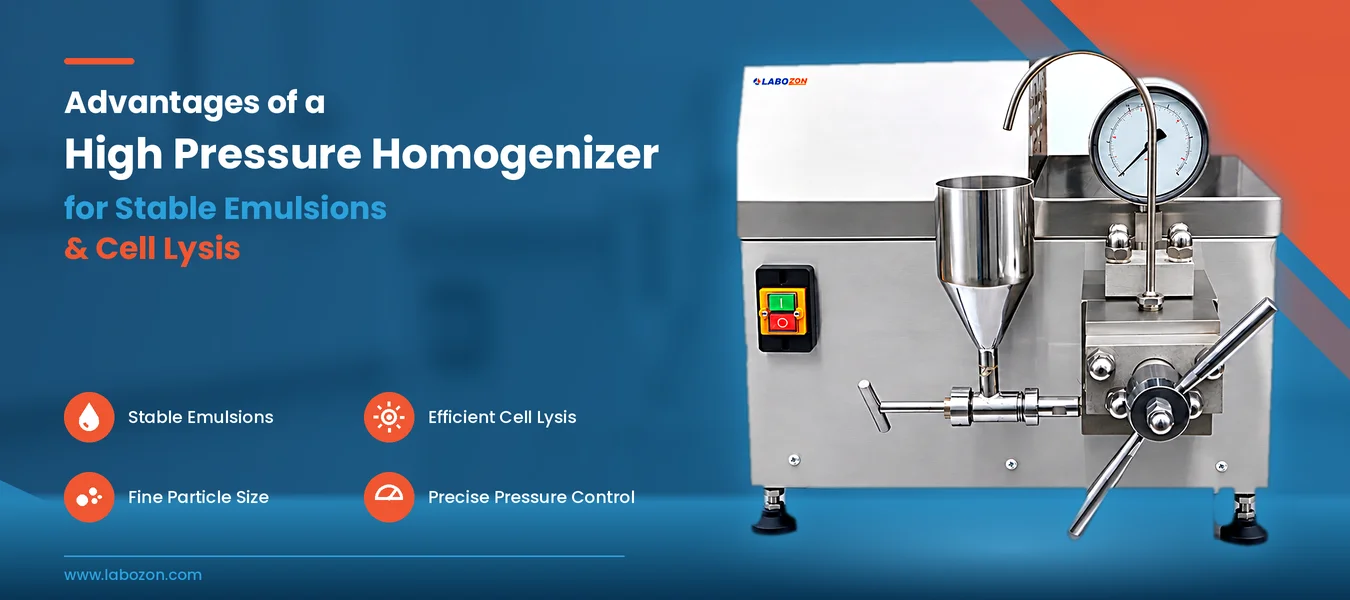
A high pressure homogenizer reshapes liquid samples at a microscopic scale. This guide explains how the technique works, where it sits among lab homogenizer formats, and what laboratories should review before choosing an instrument.
How Pressure Reshapes Liquid Samples
A high pressure homogenizer drives a liquid through an extremely narrow opening at intense pressure. Large droplets and loose clumps leave that opening as fine, uniform particles. Some labs call the instrument a pressure homogenizer, while the wider term lab homogenizer covers mixers, grinders, and disruptors that act in very different ways.
The practical appeal lies in consistency. Each portion of the sample follows the same path under the same conditions, so the first milliliter and the last receive matching treatment. That repeatability matters for emulsions, dispersions, and cell suspensions, where small differences in particle size change how a sample behaves later.
High Pressure Homogenizer Working Principle
A piston pump draws the fluid in and raises its pressure. The pressurized stream then reaches a homogenizing valve, where it squeezes through a narrow gap at high speed. Inside that gap, three forces act together in this high pressure homogenization technique:
- Shear stretches droplets and tears them apart as layers of fluid slide past each other at different speeds.
- Impact occurs when the fast stream strikes the valve surfaces and breaks up what shear has already weakened.
- Cavitation follows the rapid pressure release, as tiny vapor bubbles form and collapse near the gap and disrupt fragile structures.
High pressure homogenizer diagram: coarse feed enters the piston pump, passes the homogenizing valve, and leaves as a fine, stable fluid.
Why Emulsions Hold Together After Treatment
An emulsion stays stable when its droplets are small and similar in size. Smaller droplets drift apart slowly, so creaming and sedimentation develop later and the texture stays smooth. Using high pressure homogenization equipment, a lab can shift droplet size simply by changing the operating pressure, which makes it easier to adapt one process to several formulations.
Oil and water phases also blend far more completely than they do with stirring alone. Microemulsions and nanoemulsions, which are especially sensitive to droplet size, benefit most from this controlled and repeatable step.
Opening Cells Without Beads or Probes
Cell lysis breaks the wall or membrane so that proteins, enzymes, and genetic material can be collected. In a high pressure homogenizer, the opening force comes from fluid dynamics rather than from beads or probes touching the sample. A cell suspension passes through the valve, and the shear and sudden pressure change rupture the cells in a continuous stream.
Two points shape the outcome. The suspension must flow freely, so clumps and coarse debris should be removed first. Pressure release also adds heat, so protein work benefits from a chilled feed and a cooled collection vessel.
Practical Use Cases Across Lab Settings
Laboratories, hospital research units, research centres, and advanced labs apply the technique in several recurring ways:
Formulation development
Preparing suspensions, microemulsions, and nanoemulsions for pharmaceutical research.
Particle refinement
Reducing particle size in liquid materials so that dispersions remain uniform.
Cell suspension processing
Releasing intracellular content from pumpable suspensions ahead of analysis.
Method development
Testing pressure and pass count on small volumes before a method is fixed.
Teams that run several of these workflows often review the instruments in the homogenizer range side by side before settling on one format.
Choosing Between Three Homogenizer Formats
Each format suits a different sample, so the right choice starts with what the sample looks like when it reaches the bench.
| Feature | High pressure homogenizer | Ultrasonic homogenizer | Tissue homogenizer |
|---|---|---|---|
| Sample form | Flowing liquids and suspensions | Small liquid volumes | Solid or soft tissue pieces |
| Main action | Shear and pressure release through a narrow gap | Sound waves that create cavitation | Rotating or grinding element |
| Heat behavior | Rises on pressure release, so pre-cooling helps | Can warm small samples quickly | Friction heat in dense samples |
| Processing style | Continuous stream | Batch, probe in sample | Batch, sample in vessel |
| Typical fit | Emulsions, dispersions, cell suspensions | Quick dispersion of small samples | Preparing tissue before analysis |
Many research teams keep a high pressure homogenizer beside a tissue homogenizer and choose between them by sample type.
Selection Mistakes That Slow Labs Down
- Judging by peak pressure alone. The working pressure range is what the daily method actually uses, so review it before the maximum rating.
- Ignoring sample volume. Compare the instrument's test volume and hourly capacity with the batches the lab really prepares.
- Overlooking maintenance access. Seal design and ease of reaching the valve decide how much time upkeep takes.
- Skipping the facility check. A three phase power supply and bench space should be confirmed before an order is placed.
- Committing without a trial plan. Define the sample, target droplet size, and pass count so early runs produce usable data.
A Closer Look at the LZ-HPH-A100
The High-Pressure Homogenizer LZ-HPH-A100 is a high pressure homogenizer machine for precise blending and emulsification of fluid combinations. It pairs a high pressure piston pump with a downstream homogenizing valve, and its main assemblies are a machine base, electric motor, gearbox, high pressure pump, and homogenizing elements.
- Maximum test volume of one hundred fifty milliliters
- Maximum pressure of one thousand bar, with a working pressure from zero to eight hundred bar
- Capacity of twenty liters per hour with a single plunger
- Sanitary diaphragm pressure gauge for clear pressure reading
- Plunger seal ring packing to help prevent leakage
- Single pole pressure regulator for convenient handling
- Drainage control system for worry-free cleaning
- Automatic shutdown during power failure
The product page describes pharmaceutical use, where the unit reduces particle size and mixes and stabilizes dispersions, including suspensions, microemulsions, and nanoemulsions. Labs planning cell suspensions should confirm sample suitability with the Labozon team before scheduling runs.
Operating Habits That Protect Sample Quality
- Pre-mix oil and water phases coarsely before feeding the instrument.
- Filter or settle out large particles that could block the gap.
- Raise pressure in stages while watching the gauge.
- Chill the feed, and consider a laboratory chiller for temperature control during longer runs.
- Use two or three passes when a narrower droplet range is needed.
- Confirm droplet size with a particle size analyzer after each trial.
- Drain and flush right after each run so residue does not dry on the valve.
- Inspect seals on a routine schedule and keep a log of pressure, pass count, and sample temperature.
Exploring the Wider Homogenizer Category
The LZ-HPH-A100 belongs to the laboratory homogenizer category, a group of instruments that blend, emulsify, disperse, or disrupt samples. Within this group, labs usually compare operating pressure range, sample volume, throughput, seal design, safety features, and the support available after installation. The same review applies when weighing high pressure homogenizer manufacturers against one another.
The full range is easy to scan on the Labozon homogenizer category page. Labozon Scientific Inc. is a USA based manufacturer of laboratory equipment, and its wider catalog begins at the Labozon home page.
Name: Olivia Carter – Labozon
Specialty: Laboratory Equipment, Scientific Technology, and SEO Content Writing
Writing Style: Professional, informative, research-driven, and reader-friendly.
Bio: Olivia Carter is a content writer at Labozon, specializing in laboratory equipment, scientific technologies, and laboratory applications. She creates informative, SEO-focused blog articles that highlight product features, explain key benefits, and explore the practical uses of scientific instruments. Her goal is to present technical information in a clear, accurate, and accessible manner, helping laboratory professionals, researchers, and science enthusiasts make informed decisions.
Linked.in
Plan Your Next Homogenization Run
Review specifications, voltage options, and the downloadable catalog for the LZ-HPH-A100 on its product page.
Explore High-Pressure HomogenizerLooking for high pressure homogenizer?
Compare available models, review product specifications, and contact the Labozon team for assistance in identifying equipment that matches your laboratory requirements.