
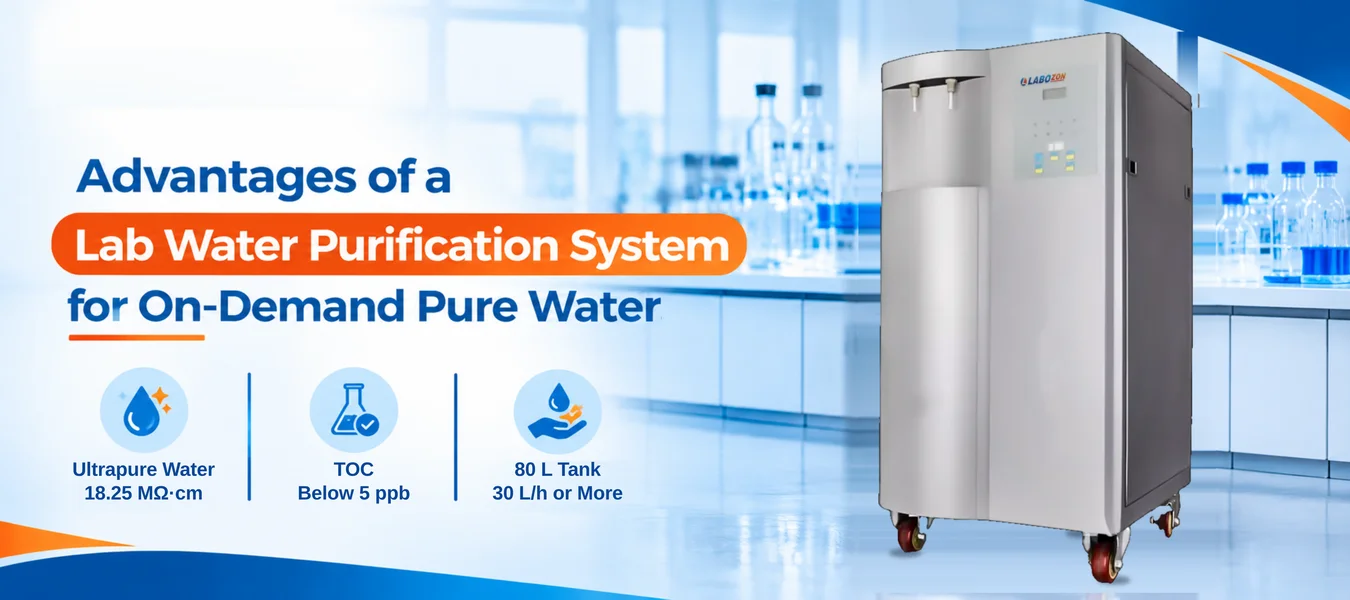
Waiting for a carboy to fill, or using water of unknown purity, slows each experiment and can distort results. A Water Purification System produces pure water when your team needs it, so assays, reagents, and instruments always start from a known baseline. This guide covers how it works, where it fits, and what to review before choosing one.
How On-Demand Water Is Made
A Water Purification System takes tap water and removes ions, organic compounds, particles, and microbes in several steps. Labs also call this equipment a water purifier or a water purification system machine. Pre-filtration protects the membranes, reverse osmosis removes most dissolved salts, UV treatment limits microbes and organic carbon, and a polishing stage raises water quality further.
The Type I And Type III Water Purification System LZ-RWP-A102 from Labozon is a floor-standing unit with double-stage reverse osmosis, a built-in RO membrane, an 80 L tank, and online water quality monitoring, so purified water is ready between uses.
Understanding the sequence of pre-treatment, reverse osmosis, polishing, and monitoring makes it easier to locate cartridges and plan maintenance.
Where Pure Water Matters Most
Laboratories, hospitals, and research centers use pure water in different ways. The product page lists analytical labs, clinical diagnostics, pharmaceutical testing, microbiology, chemistry research, and reagent preparation. Typical tasks include:
- Preparing buffers, mobile phases, and dilutions with ultrapure water filtration
- Rinsing glassware and instrument parts
- Making reagents for clinical and analytical tests
- Supporting cell culture and microbiology work
Water Purification System laboratory use usually involves two quality levels: purified water for washing and general preparation, and ultrapure water for sensitive analysis. A single ultra purified water system can serve both when it is sized for daily demand.
Two Water Outputs Compared
Type II pure water
Suited to general preparation, rinsing, and routine reagent work.
Type I ultrapure water
Suited to sensitive analytical work where low organic and ionic load matters.
| Output | Resistivity | Conductivity |
|---|---|---|
| Type II pure water | 10 to 15 MΩ·cm | Below 0.1 µS/cm |
| Type I ultrapure water | 18.25 MΩ·cm | 0.055 µS/cm |
The page lists Type II pure water in its water quality row, while the product title names Type I and Type III. Confirm the exact output designations with Labozon before ordering.
Published Details of the LZ-RWP-A102
| Parameter | Details |
|---|---|
| Production rate | 30 L/h or more at 15 to 25 ℃ |
| Flow rate | 1 to 1.5 L/min |
| Water tank | 80 L |
| Feed water | Tap water, TDS below 400 ppm, 5 to 40 ℃ |
| TOC | Below 5 ppb |
| Bacteria | Below 1 CFU/mL |
| Particles above 0.22 µm | Below 1/mL |
| Disinfection | UV lamp, 254 nm for bacteria and 185 nm for TOC reduction |
| Control | Microprocessor controller, digital display, online monitoring |
| Power | 450 W, 220 V, 50 Hz |
| Dimensions | 490 × 550 × 960 mm |
| Weight | 75 kg |
The page lists PP and carbonated filters as optional accessories and does not describe the full internal filter sequence. The enquiry forms offer more voltages than the specification table, and the flow rate is not defined, so confirm electrical setup and filter configuration with Labozon.
Common Selection Mistakes
Choosing on output quality alone is the most frequent error. Review daily water volume, tank size, feed water range, cartridge replacement access, monitoring features, and floor space together. A unit matched to your workload avoids both shortages and wasted capacity.
Other mistakes include ignoring feed water TDS, skipping a plan for cartridge changes, and overlooking power supply. When comparing water purification system manufacturers, ask whether an ultra pure water filter or polishing cartridge is included and how spare parts are supplied. If your work needs a different format, review the wider water purification equipment range before deciding.
User Tips and Recommended Practices
- Keep tap water within the stated TDS and temperature range.
- Replace pre-filters and RO cartridges on schedule, before water quality drops.
- Review monitor readings daily and investigate sudden changes.
- Draw ultrapure water fresh for sensitive tests instead of storing it.
- Rinse collection vessels with purified water before use.
- Replace the UV lamp as recommended so disinfection and TOC reduction stay effective.
- Clean the tank and follow the sanitizing steps in the manual.
- Record readings, filter changes, and service dates in a log.
Explore the Water Purification Category
The Type I And Type III Water Purification System LZ-RWP-A102 belongs to a wider group of water distillation and purification equipment, including distillers, RO units, and ultrapure water systems. Buyers usually compare output quality, production rate, tank capacity, monitoring, cartridge access, and footprint. To see the full range, browse the water distillation and purification category.
Labozon supplies scientific equipment across many disciplines, and the rest of its catalog is reachable from the Labozon home page.
Related Products


Looking for water purification system?
Compare available models, review product specifications, and contact the Labozon team for assistance in identifying equipment that matches your laboratory requirements.