
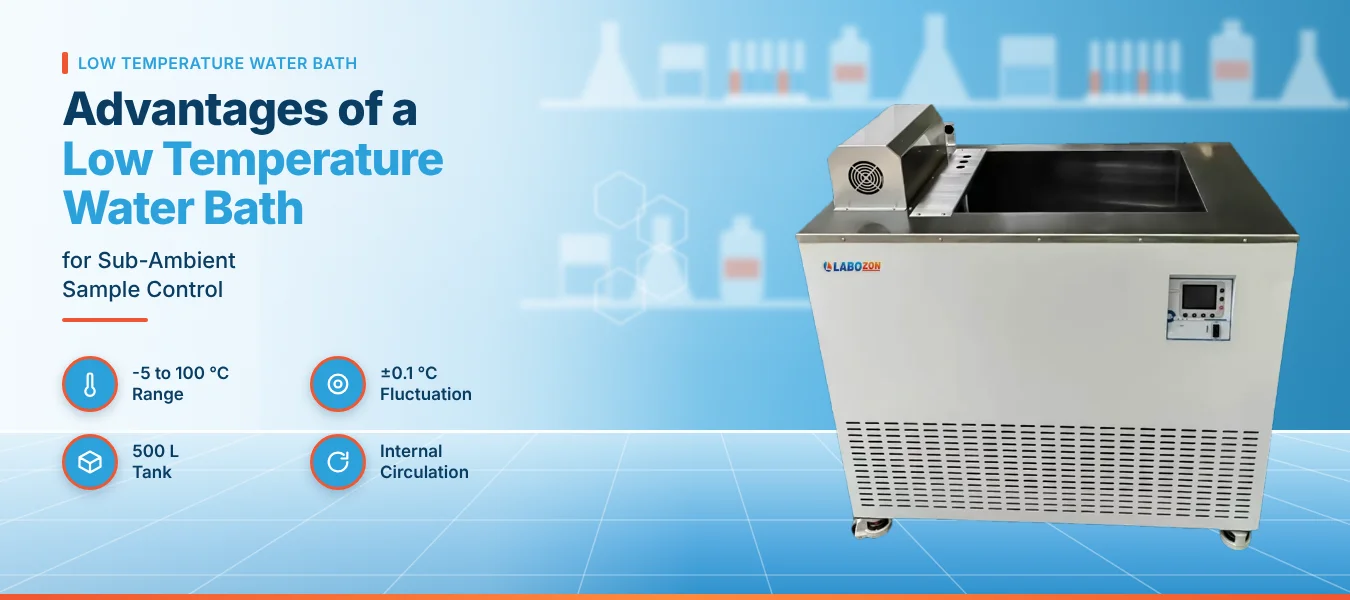
Many samples are happiest below room temperature, and an ice bucket cannot hold a steady number for hours. A low temperature water bath chills and holds a water volume at a set point below ambient, then warms it again when a protocol needs it. This guide explains how it works, where it fits, and what to check when evaluating the Low Temperature Water Bath LZ-LWB-A120.
What Sets a Refrigerated Bath Apart
A plain laboratory water bath can only warm water above room temperature. Adding a compressor and condenser changes that: the same tank can now cool below ambient as well as heat.
Catalogs use several names for this idea. A chilled water bath and a cooling water bath describe the same format, and a low temperature thermostatic bath is another common label. The shared point is one tank, one controller and a steady temperature on both sides of room temperature.
How the Control Loop Holds a Set Point
A temperature controlled water bath relies on a loop. A sensor reads the water temperature, the controller compares it with the set point, and the system either runs the compressor to cool or powers a heater to warm.
Circulation matters just as much. Moving water keeps the whole tank at one temperature, so samples at the edge see the same conditions as samples at the center.
Advantages for Sub-Ambient Work
Compared with an ice bucket or a cold-room shelf, a refrigerated bath adds control where it matters.
Steady Temperature
No creep upward as ice melts.
Repeatable Set Point
The same number on Monday and on Friday.
Uniform Circulation
Matching conditions across a full tank of samples.
Hands-Free Holding
No refilling ice during long runs.
Practical Uses in the Lab
The LZ-LWB-A120 lists biochemical sample processing, petrochemical analysis, clinical sample preparation, industrial material testing and laboratory research procedures as applications.
Typical tasks include holding enzyme reactions below room temperature, chilling reagents before use, cooling samples after a heating step and running material tests at a fixed low temperature. Because the same bath also heats, one tank can run a full profile: cool, hold, warm, hold.
Specifications of the LZ-LWB-A120
The Labozon Low Temperature Water Bath LZ-LWB-A120 is a large-capacity refrigerated bath with an LCD interface. Its published details are below.
| Feature | Specification |
|---|---|
| Capacity | 500 L |
| Temperature range | -5 to 100 °C |
| Stability | ±0.1 °C fluctuation; 0.01 °C display step |
| Circulation | Internal |
| Cooling | Copeland compressor and Kewely condenser; 8 kW cooling power |
| Tank and shell | SUS304 stainless steel tank; galvanized steel shell with spray coating |
| Display | LCD |
| Protection | Alarm and built-in protection system |
Cooling Methods Side by Side
The table below sets three common ways of holding samples cool.
| Factor | Ice Bucket | Heated Bath | Low Temperature Bath |
|---|---|---|---|
| Below room temperature | Yes, but drifts | No | Yes, held at set point |
| Above room temperature | No | Yes | Yes |
| Uniformity | Uneven | Depends on circulation | Circulated |
| Attention needed | Frequent refills | Low | Low |
Setting Up a Sub-Ambient Run
A typical run follows seven steps:
- Confirm the bath fluid for the planned temperature range.
- Fill the tank to the correct level.
- Enter the set point on the controller.
- Wait until the water reaches the set point.
- Place samples in the center of the tank.
- Keep the lid on between checks.
- Log set point, date and operator.
Selection Mistakes That Waste Time Later
- Choosing on minimum temperature alone and ignoring stability and circulation.
- Overlooking tank size, which sets how many samples fit.
- Skipping the supply requirements of the compressor.
- Forgetting that water can freeze near the bottom of the range.
- Ignoring condensation on cold surfaces.
Buyers who want to review similar units can start on the bath and circulator category page before shortlisting.
User Tips and Recommended Practices
- Confirm the bath fluid with the supplier before running near the lower limit.
- Fill the tank to the correct level before powering on.
- Let the bath reach its set point before adding samples.
- Place samples in the center of the tank, away from the walls.
- Keep the lid on between uses to reduce condensation and heat gain.
- Wipe condensation from the outside on humid days.
- Leave space around the unit so the compressor can breathe.
- Log set point, date and operator for each run.
Exploring the Wider Bath and Circulator Range
The LZ-LWB-A120 belongs to the bath and circulator category, which groups heated baths, refrigerated baths and circulators. Buyers usually review temperature range, capacity, stability, circulation, cooling hardware and protection features.
The full Labozon bath and circulator range shows these units together, and the Labozon home page opens the other laboratory equipment groups.
Name: Olivia Carter – Labozon
Specialty: Laboratory Equipment, Scientific Technology, and SEO Content Writing
Writing Style: Professional, informative, research-driven, and reader-friendly.
Bio: Olivia Carter is a content writer at Labozon, specializing in laboratory equipment, scientific technologies, and laboratory applications. She creates informative, SEO-focused blog articles that highlight product features, explain key benefits, and explore the practical uses of scientific instruments. Her goal is to present technical information in a clear, accurate, and accessible manner, helping laboratory professionals, researchers, and science enthusiasts make informed decisions.
See the full specification of the Low Temperature Water Bath LZ-LWB-A120.
Explore Low Temperature Water BathLooking for low temperature water bath?
Compare available models, review product specifications, and contact the Labozon team for assistance in identifying equipment that matches your laboratory requirements.