
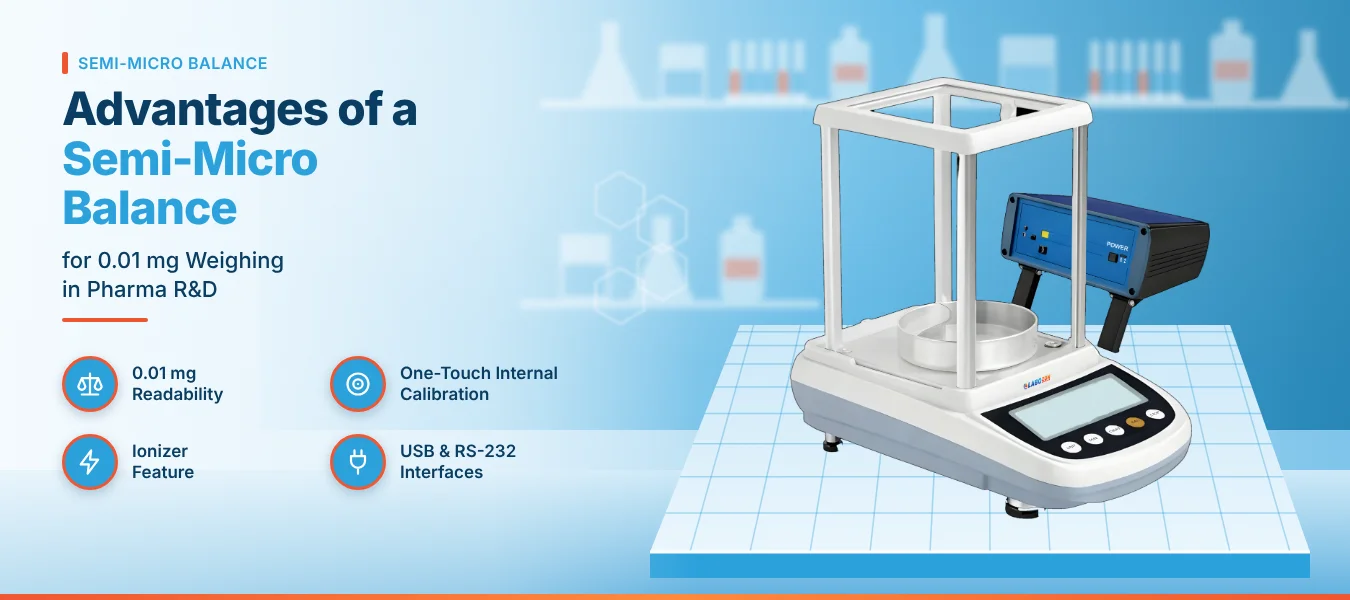
Fine powders, small charges and tight formulation windows leave little room for weighing error. This article looks at how a Semi-Micro Balance supports careful work in pharmaceutical research laboratories.
Why Fine Resolution Matters in Early Research
Early-stage pharmaceutical work often starts with very small amounts of material. When a formulation scientist weighs an active ingredient or an excipient, a tiny reading error can shift the character of an entire trial batch. A Semi-Micro Balance addresses this by reading down to one hundredth of a milligram while still offering a capacity of up to one hundred sixty-two grams, so a single instrument can handle both the small charge and the larger vessel that holds it.
Many laboratories meet this class of instrument while moving from general analytical weighing toward finer work. Understanding what a semi micro analytical balance adds, and where it sits beside a micro analytical balance, helps teams choose with clarity instead of guesswork.
How the Weighing Cell Reaches a Stable Reading
The balance relies on a built-in electromagnetic force restoration weighing system. When a sample rests on the pan, the weighing cell produces a counter force that holds the pan at its zero position. The effort needed to do so is converted into a mass value and shown on a backlit LCD.
Sample placed on the pan
Pan moves slightly under load
Electromagnetic force restores position
Signal converted to mass
Reading appears on the LCD
Simplified path from sample to displayed reading.
A highly integrated weighing cell, a unique pan design that limits placement error, and one touch internal calibration let operators confirm the balance onsite before a session begins.
Practical Uses Across the Research Workflow
Typical semi micro balance uses revolve around work where small portions and repeatable readings matter. The Semi-Micro Balance from Labozon is described for these areas:
- Compound making, where small portions of materials are combined in measured amounts.
- Research sections that need fine readings during early experimental runs.
- Quality control checks carried out at the laboratory bench.
- Density work on solids and liquids, supported by an included density kit.
Results can also be passed on to a computer through the communication kit, which keeps record handling tidy during busy research sessions.
Managing Static and Air Movement
Fine powders cling to spatulas and vials once they pick up charge, and the reading then drifts. The balance includes a built-in portable ionizer that neutralizes electrostatically charged objects immediately, and a desktop static eliminator is available as an optional accessory.
Air movement is the other quiet source of drift. Glass sliding doors on three sides allow easy entry of the sample while shielding the pan, and a plastic cover protects the keypad. Operators who close the doors, wait for the reading to settle and keep the bench level will notice steadier values from one session to the next.
Common Selection Mistakes to Avoid
- Chasing readability alone. A fine readout means little if the minimum weighing amount, listed at one hundred milligrams for this model, is higher than the portions your protocol needs.
- Overlooking repeatability. Repeatability of five hundredths of a milligram tells you how consistently the same sample reads on repeated placement.
- Ignoring vessel fit. The pan is eighty millimeter wide, so check that your weighing boats and vials sit comfortably inside the draft shield.
- Skipping connectivity. USB converter and serial interface options, plus an optional printer, matter when readings must be recorded.
- Treating static as minor. Without ionizer support, dry powders can make semi micro balances appear unstable.
- Mixing up balance classes. Micro balances and semi micro balances serve different sensitivity needs, so confirm the class before comparing models.
Reviewing the full set of options on the laboratory balance range makes these checks easier to complete.
Specifications at a Glance
| Parameter | Detail |
|---|---|
| Capacity | Up to one hundred sixty-two grams |
| Resolution | One hundredth of a milligram |
| Repeatability | Five hundredths of a milligram |
| Linearity | Plus or minus one tenth of a milligram |
| Minimum weighing | One hundred milligrams |
| Pan size | Eighty millimeter |
| Display | Backlit LCD |
| Calibration | Internal, one touch |
| Static control | Built-in portable ionizer |
| Interfaces | USB converter and serial port, optional printer |
| Menu languages | Italian, English, Portuguese, Deutsch, French and Espanol |
Semi Micro Against Neighboring Balance Types
| Balance type | Typical role | Where it fits |
|---|---|---|
| Semi micro | Fine readings on small charges | Compound making and research sections |
| Analytical | General laboratory weighing | Routine sample preparation |
| Precision | Larger sample amounts | Work where coarser readability is acceptable |
| Beam | Manual weighing with beam control | Simple bench routines |
| Floor | Heavy loads | Receiving and bulk handling areas |
Exploring the Wider Laboratory Balance Category
The semi micro model belongs to the broader laboratory balance family, which also covers analytical, beam, electronic, floor and precision instruments. Laboratories evaluating this category usually compare readability, capacity, pan size, calibration method, draft protection, connectivity and static control before shortlisting a model.
To see all models grouped in one place, open the laboratory balance category page. Teams planning a wider equipment purchase can also begin from the Labozon home page to browse other instrument groups.
Related Products


Looking for semi-micro balance?
Compare available models, review product specifications, and contact the Labozon team for assistance in identifying equipment that matches your laboratory requirements.