
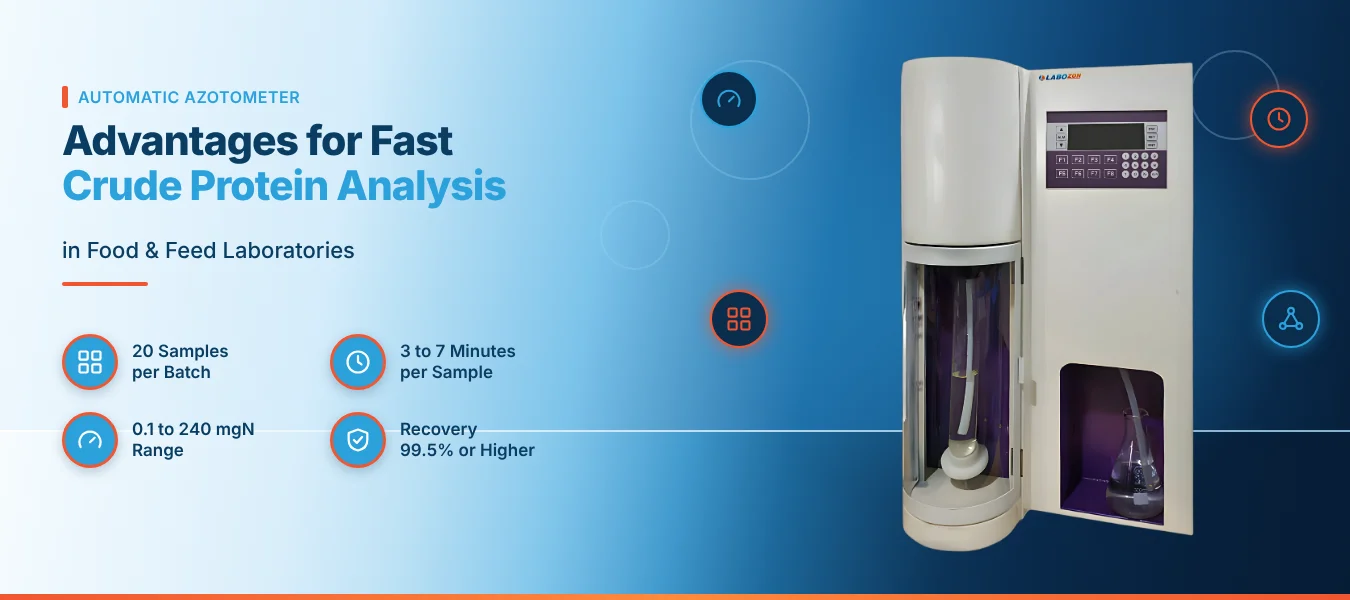
A grain delivery, a dairy batch and a finished feed ration can all arrive at the bench on the same morning, and each needs a protein figure the buyer will accept. An Automatic Azotometer handles that load by automating the distillation and titration steps of the classic nitrogen method. This guide explains how the method works, where laboratories use it and what to review in the Labozon Automatic Azotometer LZ-AA-B120.
From Nitrogen Reading to Protein Figure
Crude protein is calculated, not measured directly. The laboratory determines nitrogen, then multiplies by a conversion factor, commonly 6.25 for many food and feed materials. Kjeldahl nitrogen work has three stages: digestion converts organic nitrogen to ammonium, distillation releases ammonia, and titration measures how much receiving acid it used.
A kjeldahl analyzer takes over the last two stages with timed steam, reagent delivery and endpoint detection. Paired with a digestion furnace, a kjeldahl nitrogen analyzer covers the sequence from sample tube to final reading.
Where Food and Feed Laboratories Apply It
Automatic azotometer use reaches several sample types, and each type puts a different demand on the workflow.
Cereals and Grains
Incoming grain checks and protein grading of milling lots.
Dairy and Beverages
Liquid samples for nutrition labeling and process monitoring.
Feed Rations
Confirming that a finished ration matches its formula.
Soil and Water
Total nitrogen work for environmental and sediment samples.
What Automation Changes at the Bench
An automatic kjeldahl analyzer runs the same chemistry as a manual setup, so the gain lies in handling. Timed steam and reagent steps reduce analyst-to-analyst variation, and less manual transfer of hot, corrosive liquids makes the work safer.
A stored method lets a new operator run the same sequence as an experienced one, which shortens training time. Consistent steps also leave cleaner records, since each run follows the same timing.
Many laboratories keep an automatic azotometer machine as the reference route for protein work and use faster screening tools alongside it for routine sorting.
Key Details of the LZ-AA-B120
The Automatic Azotometer LZ-AA-B120 supports both manual and automatic modes. Its published details are below.
| Feature | Specification |
|---|---|
| Batch size | 20 samples |
| Measuring range | 0.1 to 240 mgN (nitrogen content 0.02 to 95%) |
| Distillation rate | 3 to 7 minutes per sample |
| Sample quantity | Solids up to 5 g, liquids up to 15 mL per unit |
| Recovery | 99.5% or higher |
| Repeatability | Within ±1% |
| Method storage | 20 groups of experimental procedures |
| Cleaning | Automatic cleaning of the titration path |
| Digestion furnace | Digital-display, temperature-controllable furnace available |
| Cooling water | 1 to 2 L/min |
| External dimensions | 775 × 380 × 330 mm |
| Weight | 28 kg |
Automated and Manual Nitrogen Methods Side by Side
The table below sets two common approaches next to each other using typical features.
| Factor | Manual Kjeldahl Setup | Automatic Azotometer |
|---|---|---|
| Distillation | Operator controls steam and timing | Timed steam and reagent steps |
| Titration | Visual or semi-manual endpoint | Automated titration step |
| Throughput | One or few samples at a time | Batch processing |
| Operator effect | Higher variation between analysts | More consistent between analysts |
Selection Mistakes That Cause Rework
- Choosing on sample count alone and ignoring distillation time per sample.
- Overlooking sample size limits for solids and liquids.
- Forgetting the cooling water supply that the instrument needs.
- Assuming a digestion furnace is included without confirming it.
- Ignoring bench space and the weight of a 28 kg unit.
Teams that want to compare similar instruments can start with the organic elemental analysis category before shortlisting.
User Tips and Recommended Practices
- Run blank samples first so reagent background is known.
- Check recovery regularly with a known nitrogen material and record the result.
- Weigh samples carefully and keep them within the stated size limit.
- Keep the cooling water supply steady, since weak flow affects ammonia capture.
- Replace receiving acid, alkali and titrant on a fixed schedule and date each bottle.
- Run the cleaning cycle at the end of each batch and inspect tubing for buildup.
- Digest samples until the liquid is clear and let tubes cool before distillation.
- Confirm the conversion factor for each sample type before reporting crude protein.
Exploring Wider Organic Elemental Analysis Options
The LZ-AA-B120 belongs to the organic elemental analysis category, which covers nitrogen analyzers, digestion units and related instruments in several throughput levels. Buyers usually compare batch size, distillation time, measuring range, stated recovery and repeatability, method storage and available add-ons such as a digestion furnace.
The full organic elemental analysis range shows these instruments together, and the home page opens the other laboratory equipment groups.
See the full specification of the Automatic Azotometer LZ-AA-B120.
Explore Automatic AzotometerRelated Products


Looking for Automatic Azotometer?
Compare available models, review product specifications, and contact the Labozon team for assistance in identifying equipment that matches your laboratory requirements.