
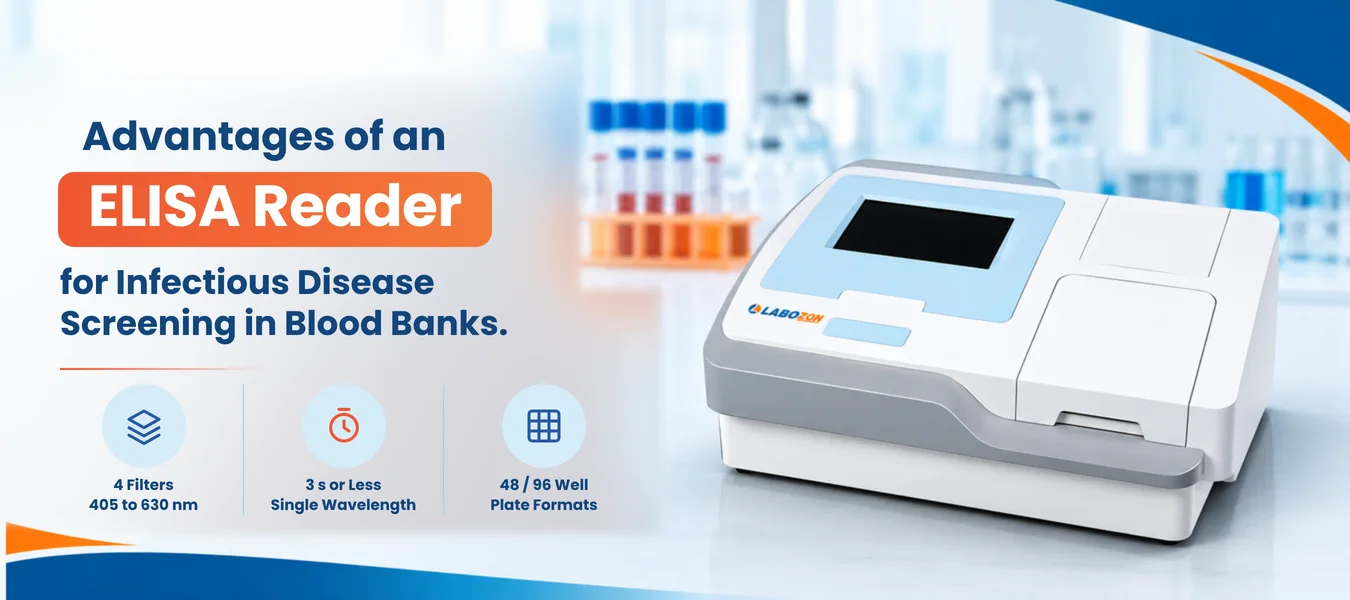
Blood banks screen donations for infectious disease markers before units are released, and that work runs on plate-based immunoassays. An ELISA reader turns the color change in each well into a measured absorbance value, so technicians can classify samples quickly and keep records. This guide covers the ELISA reader principle, where it fits in screening, and what to review before choosing one.
How Plate Reading Works
ELISA stands for enzyme-linked immunosorbent assay. Antibodies or antigens bind to the wells of a plate, an enzyme-linked reagent attaches, and a substrate then produces color. The more target material present, the stronger the color.
The ELISA reader principle is simple: the instrument passes light of a chosen wavelength through each well and measures how much is absorbed. That gives a numeric value per well, which software or the technician compares against assay cutoffs. Because each kit specifies its own wavelength, filter choice matters.
Practical Uses in Blood Bank Screening
Typical ELISA reader uses and ELISA microplate reader uses in a blood bank include:
- Reading screening plates for infectious disease markers
- Measuring control and calibrator wells beside donor samples
- Confirming repeat-reactive samples with a second plate
- Supporting traceable records for each batch
- Reading research and validation plates in the same lab
What Automation Covers
An automated ELISA reader reads each plate and records results with less manual adjustment. An automated ELISA microplate reader does not handle incubation, reagent addition, or washing, so those steps stay with the technician or other equipment. The ELISA Microplate Reader LZ-EMR-A190 from Labozon lists automatic calibration and automatic lamp adjustment, storage for 500 test projects, and the option to run 12 different tests together on one plate.
Washing is a separate stage. An ELISA microplate washer clears unbound material between steps, and the product page lists washers as related products, so review the reader and washer together.
Advantages for Screening Labs
Fast reading
An ELISA plate reader scans a full plate in seconds, which keeps screening queues moving. The specification table lists 3 seconds or less for single wavelength.
Wavelength choice
Four filters at 405, 450, 492, and 630 nm cover common assay wavelengths, with single or dual wavelength reading.
Plate formats
48 and 96 well plates are listed, and linear shaking at 3 speeds mixes samples before reading.
Simple operation
An LCD display and a menu-based layout simplify daily use on a compact 475 × 350 × 210 mm body.
Published Details of the LZ-EMR-A190
| Parameter | Details |
|---|---|
| Filters | 405, 450, 492, and 630 nm; 8 channel |
| Spectral range | 400 to 800 nm |
| Plate type | 48 or 96 well |
| Light source | LED lamp |
| Detector | Silicon |
| Shaking | Linear, 3 speeds |
| Reading range | 0 to 4 A |
| Accuracy | 0.008 A |
| Reproducibility | 0.2% or better |
| Electrical | 100 or 220 V, 50 or 60 Hz |
| Dimensions | 475 × 350 × 210 mm |
| Weight | 11.5 kg |
The page mentions both halogen and LED lamp compatibility, while the specification table lists an LED lamp, and its enquiry forms offer more voltage options than the table. Confirm the lamp and electrical setup with Labozon before ordering.
Single and Dual Wavelength Reading
| Point | Single wavelength | Dual wavelength |
|---|---|---|
| Reading time | 3 seconds or less | 6 seconds or less |
| Filters used | One filter matched to the kit | A measuring filter plus a second reference filter |
| Typical use | Routine plates with clean wells | Plates where background or plate marks may affect readings |
| Throughput | Higher plate turnaround | Slightly slower, with extra correction |
Common Selection Mistakes
Choosing on speed alone is the most frequent error. Review the filters your kits call for, plate formats, shaking options, data storage, and washer pairing together. Matching the reader to daily plate volume helps prevent delays on busy screening days.
Other mistakes include skipping service and filter availability, ignoring bench space and vibration, and overlooking the washer step. If your lab needs a different reader format, review the wider microplate reader and washer range before deciding.
User Tips and Recommended Practices
- Follow the kit instructions for wavelength, and select the matching filter.
- Warm up the reader before the first plate, and run automatic calibration as the manual describes.
- Wipe the bottom of each plate to remove dust and drops before reading.
- Remove bubbles from wells, since they distort absorbance values.
- Read plates promptly after stopping the reaction, within the kit's time window.
- Include blanks, positive controls, and negative controls on each plate.
- Keep the reader on a level bench away from vibration and bright light.
- Log each plate, program, and calibration check for traceability.
Explore the Microplate Reader and Washer Category
The ELISA Microplate Reader LZ-EMR-A190 belongs to a wider group that covers absorbance readers and plate washers for immunoassay work. Buyers usually compare filter sets, plate formats, reading speed, shaking, software and data storage, and washing capability. To see the full range, browse the microplate reader and washer category.
Labozon supplies equipment for many laboratory disciplines, and the rest of its catalog is reachable from the Labozon home page.
Looking for ELISA reader?
Compare available models, review product specifications, and contact the Labozon team for assistance in identifying equipment that matches your laboratory requirements.