
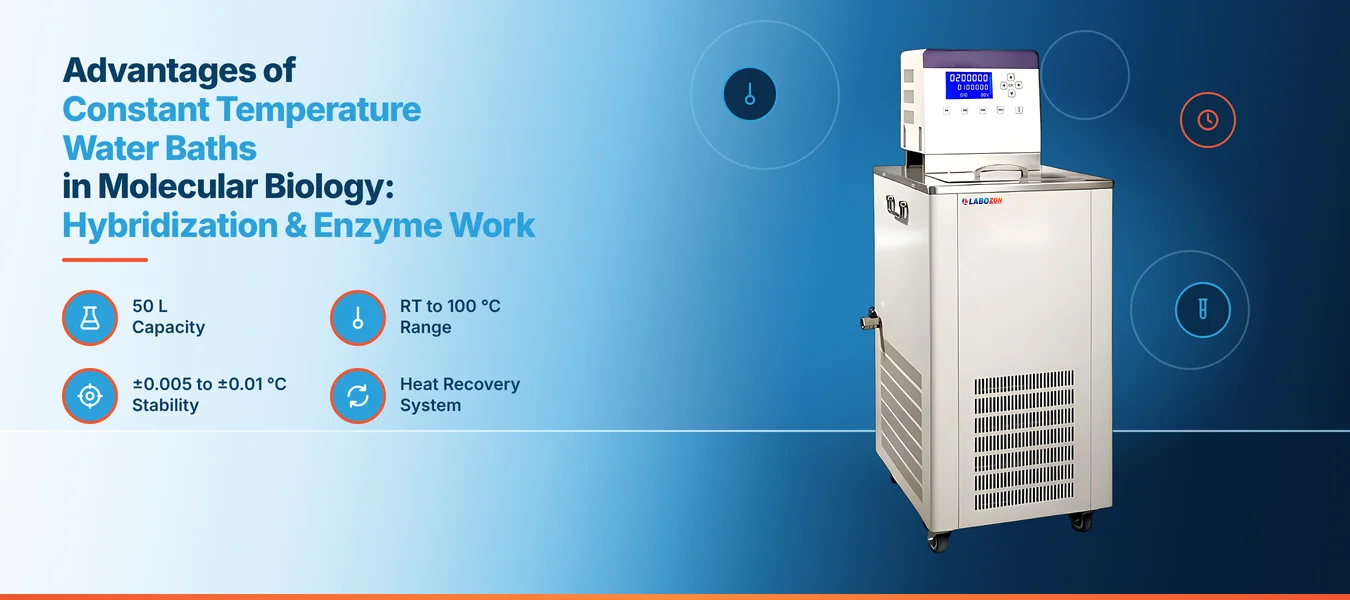
A hybridization step that runs a few degrees too warm loses signal, and an enzyme reaction that drifts cool slows down. A constant temperature water bath removes that risk by holding liquid at a set temperature around tubes, bottles and racks. This guide explains how it works, where research, hospital and advanced laboratories use it, and what to review in the Labozon Constant Temperature Water Bath LZ-CWB-A805.
How Steady Heat Is Delivered
A temperature controlled water bath combines a tank, a heater, a sensor and a controller. The sensor reads the water, the controller compares it with the setpoint, and the heater adds energy only when needed.
Water transfers heat more evenly than air, so a laboratory water bath surrounds each vessel with the same temperature. A constant temperature bath adds a drain for easy emptying and, on many models, protection against dry heating.
Why Hybridization Needs Stable Heat
Hybridization runs for long periods, often overnight, and probe binding depends on holding the buffer at the chosen temperature. A constant temperature water bath in laboratory blot and probe work keeps that temperature consistent from run to run.
Stable Setpoint
Uniformity and fluctuation listed at ±0.005 to ±0.01 °C.
Heat Recovery
Helps return to setpoint after the lid opens.
Tank Capacity
A 50 L tank offers space for several bottles.
Low-Water Protection
Guards against dry heating in long runs.
Enzyme Steps and Temperature Drift
Enzymes have a working temperature range, and small drifts change reaction speed. Constant temperature water bath benefits show up in restriction digests, ligation, reverse transcription, heat shock for transformation and sample digestion.
A steady setpoint also helps documentation. A constant temperature bath for laboratory use makes it easy to record the same conditions across repeated experiments.
Where Laboratories Apply Steady Heating
Constant temperature water bath uses extend beyond molecular biology into clinical, pharmaceutical and industrial work. Typical constant temperature water bath laboratory use includes warming reagents, incubating samples, thawing frozen tubes and supporting reaction steps in sealed vessels.
One unit can serve several teams when the setpoint and rack layout are planned in advance.
Key Details of the LZ-CWB-A805
The Constant Temperature Water Bath LZ-CWB-A805 lists the following published details.
| Feature | Specification |
|---|---|
| Capacity | 50 L |
| Temperature range | Room temperature to 100 °C |
| Temperature uniformity and fluctuation | ±0.005 to ±0.01 °C |
| Drain | Yes |
| Display | LCD |
| Sensor | PT100 |
| Interface | RS232 or RS485 |
| Controller | Programmable |
| Optional additions | Magnetic stirring system, body built-in cooling coil, adjustable immersion platform, horizontal shape |
Water Bath, Dry Block and Air Incubator Compared
The table sets three common heating options side by side using typical features.
| Factor | Water Bath | Dry Block | Air Incubator |
|---|---|---|---|
| Heat transfer | Even, through liquid contact | Through block contact | Through air |
| Vessel fit | Flexible with racks | Limited to block holes | Flexible on shelves |
| Large bottles | Suited to bottles in the tank | Not suited | Suited if space allows |
| Care needed | Clean water and tank | Wipe block | Clean chamber |
Selection Mistakes That Cause Rework
- Choosing on tank volume alone and ignoring uniformity, recovery behavior and sensor type.
- Overlooking low-water protection for overnight hybridization runs.
- Ignoring whether the communication interface is included or optional.
- Skipping a plan for rack layout and bottle size before purchase.
- Forgetting drain access and bench space around the tank.
Teams reviewing options can browse the bath and circulator category to match capacity, range and controller features to the workload.
User Tips and Recommended Practices
- Fill the bath to the marked level before switching on the heater.
- Use clean water and drain the tank on a regular schedule to limit scale and residue.
- Let the bath reach and hold its setpoint before loading samples.
- Keep tubes upright in a rack so the liquid inside sits below the water line.
- Open the lid briefly during use so the heat recovery system has less to recover.
- Check the display against a calibrated thermometer from time to time.
- Cap tubes tightly during hybridization to prevent evaporation and contamination.
- Log setpoint, start time and run length for each experiment.
Exploring the Wider Bath and Circulator Range
The LZ-CWB-A805 belongs to the bath and circulator group, which covers water baths, oil baths, heating circulators and cooling circulators. Buyers usually compare capacity, temperature range, uniformity, sensor type, controller features, drain design and optional accessories such as stirring or cooling coils.
The full range of baths and circulators shows these instruments together, and the Labozon home page opens the other laboratory equipment groups.
See the full specification of the Constant Temperature Water Bath LZ-CWB-A805.
Explore Constant Temperature Water BathRelated Products

Looking for constant temperature water bath?
Compare available models, review product specifications, and contact the Labozon team for assistance in identifying equipment that matches your laboratory requirements.