
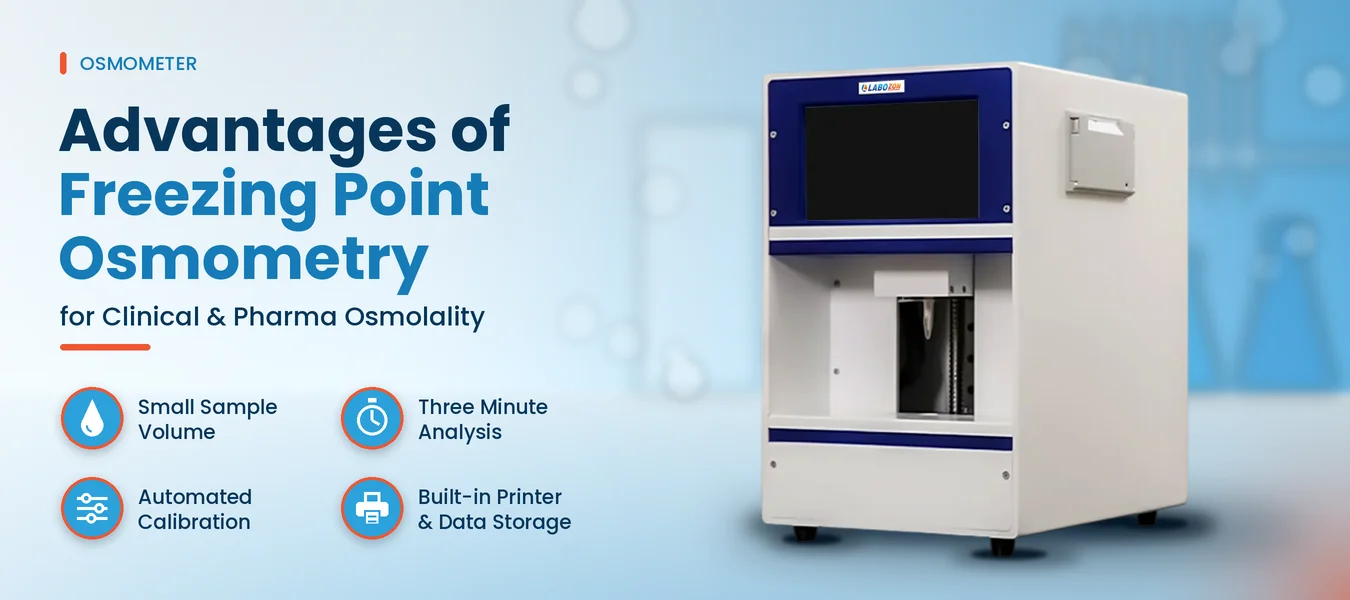
Osmolality describes how many dissolved particles a liquid carries, and laboratories read it during clinical diagnostics, pharmaceutical testing, and research. The Freezing Point Osmometer LZ-FPO-A110 from Labozon measures it by watching how far dissolved particles lower the freezing temperature of a sample. This article explains the method, the advantages it brings to hospital and pharma benches, and the points worth checking before an instrument is chosen.
What Osmolality Reveals About a Sample
Osmolality counts dissolved particles in a liquid, whatever those particles happen to be. Salts, sugars, proteins, and active ingredients all add to the total, so a single number describes the overall concentration of a sample. Clinical laboratories read it as part of diagnostic testing, formulation teams read it to see how a preparation behaves, and research groups read it to keep experimental liquids consistent.
A reading is only useful when the method responds to all dissolved particles alike. A freezing point osmometer does this because the freezing temperature of a liquid shifts in direct proportion to the particles dissolved in it, which makes the measurement a physical response rather than an estimate.
Freezing Point Osmometer Working Principle Explained
The freezing point osmometer principle rests on a simple physical fact. Pure water freezes at one temperature, while a liquid carrying dissolved particles freezes at a lower one, and the gap between the two grows with the particle count. A freezing point depression osmometer measures that gap and reports it as osmolality.
In this freezing point osmometer, a small sample is pre-cooled by an efficient refrigeration system, advanced temperature sensing follows the freezing behavior, and the result appears on a large touchscreen as osmolality, freezing point, and sample concentration together. The flow below shows how a sample moves through the instrument.
Sample path through the instrument
Where Osmometry Adds Value in Laboratories
Freezing point osmometer uses reach across several work areas, and the product page for the LZ-FPO-A110 lists each of them.
Clinical diagnostics
Hospital and clinical laboratories read osmolality as part of diagnostic testing, where a short cycle and consistent results support daily workflows.
Pharmaceutical testing
Formulation teams check osmotic concentration to confirm that a preparation behaves as intended before it moves to the next stage.
Biotechnology research
Research groups track osmotic concentration to keep experimental liquids consistent from one run to the next.
Food and academic laboratories
Food analysis laboratories and academic teaching and research labs apply the same method to measure osmotic concentration in their own samples.
Practical Advantages at the Bench
A Precision Freezing Point Osmometer earns its place through details that matter during routine work. These are the ones listed for the Labozon freezing point osmometer.
Small sample volume
Only one hundred microliters are needed per test, which suits limited samples and repeat measurements.
Wide measuring range
The range runs from zero to two thousand mOsmol, covering dilute and concentrated liquids alike.
Short cycle
Pre-cooling and analysis each take three minutes or less, which keeps routine batches moving.
Consistent readings
Measurement accuracy, repeatability, and linearity are each listed at one percent or better, supporting steady results from run to run.
Flexible calibration
Single-point and multi-point calibration are supported, and calibration is automated, a combination that laboratories seeking a full automatic freezing point osmometer workflow often look for.
Built-in records
Results can be printed on the built-in printer and held in built-in data storage, while an optional audit trail supports secure data management.
Bench tips
- Calibrate before each batch of samples, and use multi-point calibration when readings are expected across a wide range.
- Load the full sample volume each time so that each measurement starts under the same conditions.
- Print or store each result at the time of testing so the record stays with the run.
Specifications to Compare Before Choosing
Laboratories comparing instruments often work from a short checklist. The table pairs each factor with what to look for and the matching detail for the Freezing Point Osmometer LZ-FPO-A110.
| Factor | What to look for | LZ-FPO-A110 detail |
|---|---|---|
| Sample volume | Enough for limited samples and repeat runs | One hundred microliters |
| Measuring range | Coverage from dilute to concentrated liquids | Zero to two thousand mOsmol |
| Cycle time | Short pre-cooling and analysis periods | Three minutes or less for each |
| Accuracy, repeatability, linearity | Close agreement from run to run | One percent or better for each |
| Calibration | Flexible options that match the sample range | Single-point and multi-point |
| Data handling | Records that stay with the run | Built-in printer and data storage, optional audit trail |
| Interface | A clear display of results | Large touchscreen showing osmolality, freezing point, and sample concentration |
| Room conditions | Tolerance that suits the laboratory | Zero to thirty degrees Celsius, with fifteen to twenty-five recommended and humidity at sixty percent or below |
| Power supply | A match to the laboratory supply | Two hundred twenty volts at fifty or sixty hertz, with an optional one hundred ten volt, sixty hertz version |
Selection Mistakes That Slow Laboratories Down
Shortlisting from the wider range of osmometers goes more smoothly when a few common missteps are avoided.
Overlooking sample volume
Choosing an instrument without checking how much liquid each test uses can strain limited samples. A requirement of one hundred microliters per test leaves room for repeat runs.
Ignoring room conditions
Placement matters as much as specifications. This freezing point osmometer lists zero to thirty degrees Celsius, with fifteen to twenty-five recommended and humidity at sixty percent or below.
Treating calibration as an afterthought
Confirm early that both single-point and multi-point calibration are available, so the instrument can follow the range of samples the laboratory actually handles.
Leaving record keeping for later
Printed and stored results are simple to use at the bench, while the audit trail is listed as an option. Decide at the start whether secure data management is needed.
Missing the power supply
The base unit runs on two hundred twenty volts at fifty or sixty hertz. Laboratories on a different supply should choose the optional one hundred ten volt, sixty hertz version.
The Osmometer Category at a Glance
The Osmometer category groups laboratory instruments that measure osmotic concentration in liquid samples. The Freezing Point Osmometer LZ-FPO-A110 is listed here alongside the Osmometer LZ-OM-A100, giving laboratories more than one instrument to review in a single place.
Laboratories reviewing options in this category typically weigh the measurement principle, sample throughput, record keeping, and how the unit fits the bench. The Osmometer category page lets them explore the full range, and the category itself belongs to the wider laboratory equipment lineup offered by Labozon, where instruments for clinical, pharmaceutical, and research work are gathered.
Name: Olivia Carter – Labozon
Specialty: Laboratory Equipment, Scientific Technology, and SEO Content Writing
Writing Style: Professional, informative, research-driven, and reader-friendly.
Bio: Olivia Carter is a content writer at Labozon, specializing in laboratory equipment, scientific technologies, and laboratory applications. She creates informative, SEO-focused blog articles that highlight product features, explain key benefits, and explore the practical uses of scientific instruments. Her goal is to present technical information in a clear, accurate, and accessible manner, helping laboratory professionals, researchers, and science enthusiasts make informed decisions.
Explore the Instrument in Detail
Review the full specifications, key features, and optional accessories on the product page.
Explore Freezing Point OsmometerLooking for Freezing Point Osmometer?
Compare available models, review product specifications, and contact the Labozon team for assistance in identifying equipment that matches your laboratory requirements.