
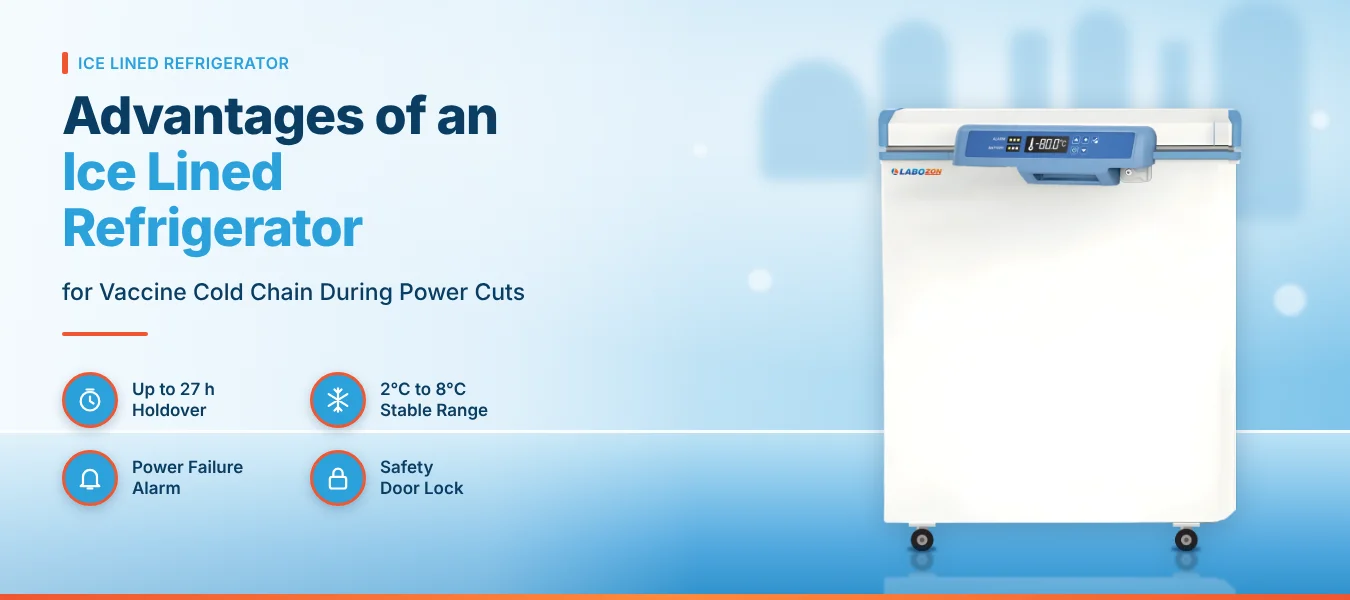
A power cut can push vaccines out of their safe range within hours. This guide explains how an Ice Lined Refrigerator keeps stock cold without power, how it is organized inside, and how to choose and run one with confidence.
Why Power Cuts Threaten Vaccine Stock
Most vaccines must stay between 2°C and 8°C. An ordinary cabinet begins to warm as soon as the compressor stops, and a clinic may not notice until the damage is done. Vials that drift too warm lose potency, and vials that freeze by accident can lose it too.
An ice lined refrigerator for vaccines is designed around that risk. Its thermal reserve keeps the storage space cool for hours after the supply fails, which gives staff time to restore power or move stock.
How the Lining Holds the Cold
An ice lined refrigerator diagram begins with a strong outer shell around a thick insulation layer. Inside that layer sits a lining of ice or frozen water that hugs the walls of the storage chamber. While power is on, the compressor freezes the lining. When power fails, the lining melts slowly and absorbs heat that leaks into the cabinet.
The Labozon Ice Lined Refrigerator LZ-ICR-A100 lists a holdover time of up to 27 hours, with direct cooling and a microprocessor controller.
Inside the Chest Layout
Ice lined refrigerator compartments are simple by design. One main chamber holds vaccine boxes, and coated hanging baskets keep smaller items organized so cold air reaches each box. The LZ-ICR-A100 is a 150 L chest unit with two baskets, which keeps vials off the cabinet floor and makes stock counts easier.
A chest layout suits ice lined refrigerator vaccine storage because it loses less cold air than an upright door when opened, since cold air stays in the chamber instead of spilling out.
Eight Advantages During an Outage
1Long holdover
Up to 27 hours of cold storage can cover many outages without moving stock.
2Stable range
Direct cooling and sensitive sensors hold 2°C to 8°C in normal operation.
3Warm-climate rating
Listed for ambient temperatures from 10°C to 43°C, useful for clinics without air conditioning.
4Layered alarms
Audible and visual alerts cover high and low temperature, power failure, low battery and sensor failure.
5Secure storage
A safety door lock limits access to vaccine stock.
6Easy cleaning
Corrosion-free interior and exterior surfaces wipe clean between stock checks.
7Mobility
Four casters allow the unit to be moved for cleaning or room changes.
8Eco-friendly refrigerant
R290 refrigerant is described as eco-friendly on the product page.
Ice Lined Refrigerator Uses in Health Settings
Ice lined refrigerator uses reach well beyond routine immunization. Epidemic prevention teams, clinics, research institutes, hospitals, blood banks and primary health centers all rely on this equipment.
People often ask what an ice lined refrigerator is used for. The short answer is vaccines, plus pharmaceutical products, reagents and blood bags that must stay at 2°C to 8°C. In remote areas, an ice lined refrigerator used for outreach work may be the only practical cold storage when grid power is unstable.
Choosing Between Cold Storage Types
An ice lined refrigerator and Deep Freezer serve different jobs, and the wrong pairing can damage stock. Most routine vaccines must never freeze, so a vaccine storage refrigerator is built around the 2°C to 8°C range, while a deep freezer suits frozen products and certain samples.
| Aspect | Ice lined unit | Deep freezer |
|---|---|---|
| Typical range | 2°C to 8°C | Far below zero |
| Suited to | Routine vaccines, reagents, blood bags | Frozen products and samples |
| Main risk | Warming during outages | Thawing during outages |
| Role in the cold chain | Routine storage | Frozen reserve |
Specifications to Review Before Ordering
| Parameter | LZ-ICR-A100 |
|---|---|
| Capacity and type | 150 L chest |
| Temperature range | 2°C to 8°C |
| Ambient range | 10°C to 43°C |
| Cooling and defrost | Direct cooling, manual defrost |
| Refrigerant | R290 |
| Power | 220 W, 220 to 240 V, 50 or 60 Hz |
| Internal size | 585 × 465 × 651 mm |
| External size and weight | 811 × 775 × 964 mm, 76 kg net |
Selection Mistakes Worth Avoiding
- Choosing by capacity alone. Holdover time, ambient rating and alarm coverage matter just as much for a vaccine refrigerator.
- Ignoring the room. A warm clinic needs a unit rated for higher ambient temperature.
- Overlooking weight and space. At 76 kg net, the cabinet needs a level floor and airflow around it.
- Skipping lock and alarm checks. Shared storage rooms benefit from a safety lock and clear alerts.
- Forgetting defrost routines. Manual defrost needs a schedule, or frost will reduce space and cooling.
- Not reviewing the wider range. The laboratory refrigerators range shows how other storage layouts differ before a final choice.
User Tips and Recommended Practices
Stable vaccine storage comes from routine, more than from equipment alone.
- Place the unit on a level floor with airflow space, away from direct sun.
- Let the cabinet reach 2°C to 8°C and the lining freeze before loading vaccines.
- Keep the unit for vaccines only, free of food and drink.
- Keep the lid shut during an outage so the holdover time lasts.
- Leave gaps between boxes so cold air can circulate.
- Record temperatures twice daily and note any alarm.
- Test the power failure and low battery alerts before an outage, and keep a backup cold box ready.
Exploring the Wider Laboratory Refrigerator Category
The LZ-ICR-A100 belongs to the laboratory refrigerators category, which groups ice lined, pharmacy, blood bank and general storage units used in clinics, hospitals and research settings. Buyers usually compare capacity, temperature range, holdover or autonomy, alarm coverage, door type and defrost method.
The full Labozon laboratory refrigerators category lists these types together, and the Labozon home page opens the other laboratory equipment groups.
See the full specification of the Ice Lined Refrigerator LZ-ICR-A100.
Explore Ice Lined RefrigeratorRelated Products


Looking for ice lined refrigerator?
Compare available models, review product specifications, and contact the Labozon team for assistance in identifying equipment that matches your laboratory requirements.