
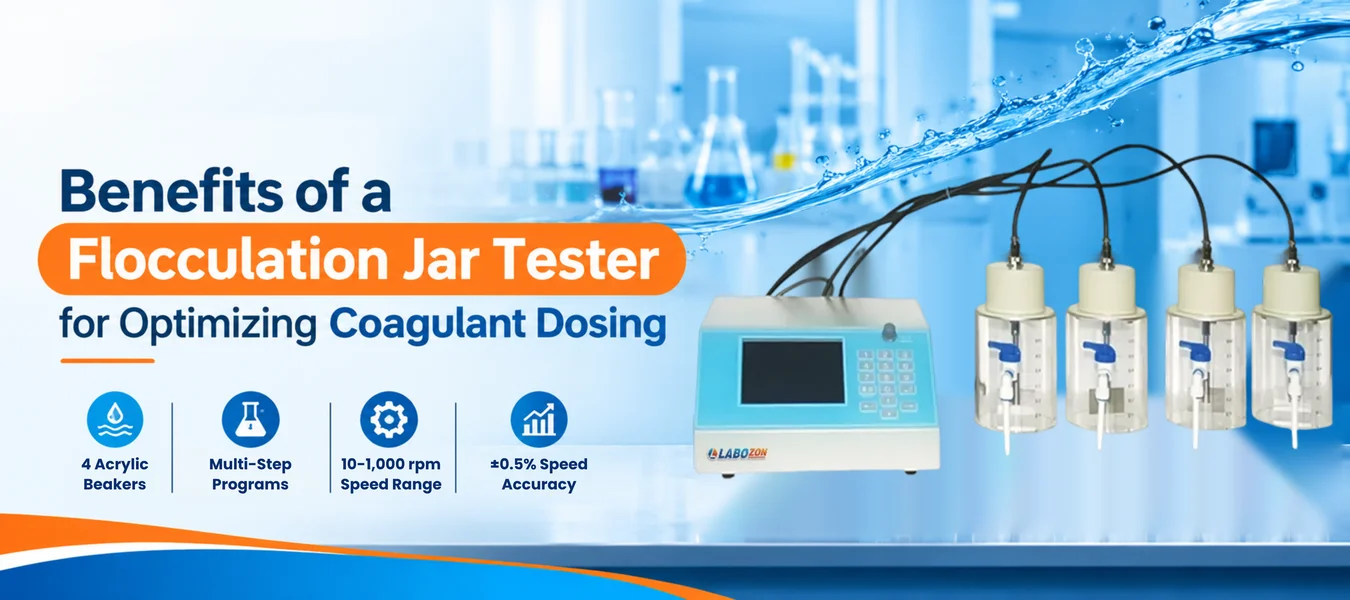
After heavy rain, raw water can arrive at a treatment plant cloudier than it left the day before, and the coagulant dose that worked yesterday may no longer clear it. A Flocculation Jar Tester lets operators test several doses side by side at bench scale before the plant changes anything. This guide explains how the test works, where laboratories apply it and what to review in the Labozon Flocculation Jar Tester LZ-FC-A100.
How the Jar Test Sequence Works
A jar test shrinks a treatment train into a row of beakers. Each beaker holds the same water sample and receives a different coagulant dose. Rapid mixing disperses the chemical, slow mixing lets particles join into flocs, and a rest period lets the flocs settle.
Understanding how a flocculation jar tester work cycle is organized helps operators judge results: the dose with the clearest water and the fastest settling is the starting point for plant adjustment.
Where Laboratories Put Jar Tests to Work
Flocculation jar tester use reaches several settings, and each setting asks for something different from the test.
Drinking Water Plants
Adjusting coagulant dose as raw water turbidity changes.
Wastewater Plants
Choosing flocculant type and dose for clarification.
Chemical Suppliers
Showing how a coagulant performs on a client's water.
Environmental Labs
Pilot studies on mixing intensity and contact time.
What Controlled Testing Adds to Dosing Decisions
A flocculation tester turns dosing from habit into measurement. With several beakers under identical conditions, differences in clarity trace back to dose, not to operator technique.
Finding the lowest effective dose limits chemical waste, and a fast test cycle lets the lab respond when raw water shifts after rain or a seasonal change. Stored step programs make a test easy to repeat and document.
Many teams search for jar testing equipment after a process upset, but regular testing builds a baseline, so the lab already knows a normal dose before conditions change. Jar test equipment also supports pilot work, where a new chemical is tried at bench scale first. Researchers also use a flocculation jar tester machine to study how mixing intensity affects floc size.
Key Details of the LZ-FC-A100
The Flocculation Jar Tester LZ-FC-A100 is a compact bench unit, and teams who search for a portable jar tester should note it is not a field kit. This flocculation jar tester equipment lists the following published details.
| Feature | Specification |
|---|---|
| Beakers | 4 round acrylic beakers, 0.6 L each |
| Beaker dimensions | 95 mm diameter, 130 mm height |
| Speed control | Stepless regulation starting at 10 rpm |
| Speed accuracy | ±0.5% |
| Timer | Up to 99 min 99 s per step, 10 steps per program |
| Stirring modes | Synchronous and independent |
| Temperature measurement | 0 to 50 °C, accuracy ±1 °C |
| Display | LCD |
| Power consumption | 80 W |
| External dimensions | 550 × 390 × 210 mm |
| Gross weight | 11 kg |
Jar Testing Compared With Trial and Error at the Plant
The table below sets two common ways of choosing a dose next to each other using typical features.
| Factor | Adjusting at the Plant | Jar Test Apparatus |
|---|---|---|
| Scale | Full process flow | Small beaker volumes |
| Doses tested | One at a time | Several at once |
| Risk of error | Affects treated water | Contained at the bench |
| Record keeping | Depends on operator notes | Repeatable timed program |
Selection Mistakes That Cause Rework
- Choosing on beaker count alone and ignoring speed range and accuracy.
- Overlooking how many timed steps a program allows.
- Skipping a check of synchronous and independent stirring modes.
- Ignoring beaker size, which limits the sample volume for each dose.
- Forgetting bench space and the gross weight of an 11 kg unit.
Teams that want to compare similar instruments can start with the jar tester category before shortlisting.
User Tips and Recommended Practices
- Collect a fresh, well-mixed raw water sample and test it soon after collection.
- Fill each beaker to the same marked volume so dose per liter is equal.
- Add each coagulant dose to all beakers at the same moment.
- Use the same program for repeat runs and record mixing speeds and times.
- Keep paddle depth and clearance the same in each beaker.
- Note sample temperature and pH before each run.
- Judge floc size and settling by eye, then confirm with a turbidity reading.
- Clean beakers and paddles after use and avoid scratching the acrylic.
Exploring Wider Jar Tester Options
The LZ-FC-A100 belongs to the jar tester category, which covers flocculation testers, multi-position stirrers and related bench instruments in several beaker counts and speed ranges. Buyers usually compare beaker count and volume, speed range, timer steps, stirring modes, temperature measurement and display type.
The full jar tester range shows these instruments together, and the home page opens the other laboratory equipment groups.
See the full specification of the Flocculation Jar Tester LZ-FC-A100.
Explore Flocculation Jar TesterLooking for Flocculation Jar Tester?
Compare available models, review product specifications, and contact the Labozon team for assistance in identifying equipment that matches your laboratory requirements.