
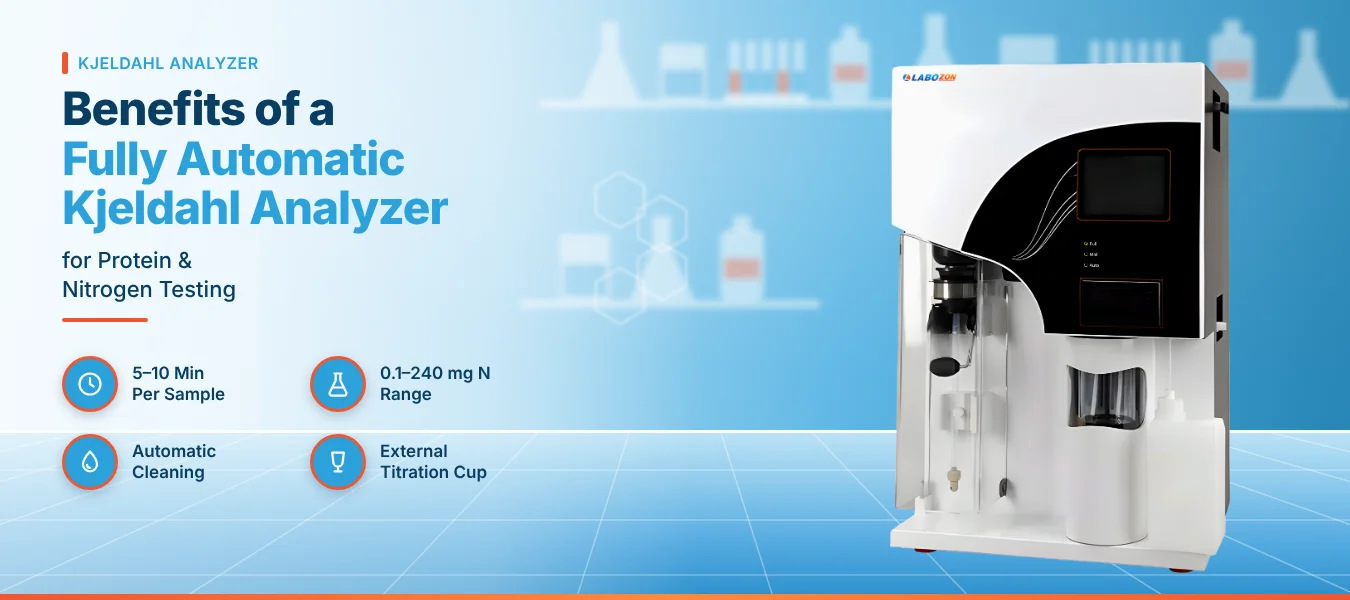
Protein labeling, feed formulation and dairy quality control all rest on one measurement: total nitrogen. A fully automatic Kjeldahl analyzer turns the classic Kjeldahl method into a timed, repeatable bench routine. This guide explains how it works, where it fits and what to check when evaluating the Automatic Kjeldahl Analyzer LZ-KA-A110.
What a Nitrogen Analyzer Measures
A Kjeldahl nitrogen analyzer determines the nitrogen content of a sample. Protein is then calculated by multiplying that nitrogen figure by a conversion factor chosen for the food or feed type.
Catalogs use several names for the same instrument. A kjeldahl analyzer, a kjeldahl auto analyzer and a kjeldahl nitrogen analyzer all describe a unit that automates the distillation and titration stages of the method.
How the Three Stages Fit Together
First, the sample is digested in concentrated sulfuric acid, which converts organic nitrogen into ammonium. Second, kjeldahl distillation adds alkali so the ammonium becomes ammonia gas, and steam carries it into a boric acid receiving cup.
Third, titration with an acid of known strength measures how much ammonia was captured. The analyzer runs the second and third stages, while digestion usually takes place on a separate digestion unit.
Where Automation Pays Off
Manual distillation depends on timing, hand dosing and visual endpoint judgment, and each varies between analysts. Automation removes most of that variation.
Repeatable Runs
Dosing and steam follow a set program.
Operator Safety
Less hand contact with hot steam and reagents.
Shorter Training
New analysts follow the same routine.
Free Bench Time
Technicians prepare the next batch during a run.
Practical Uses in the Laboratory
The product page lists total nitrogen and protein determination in food, feed, agricultural and dairy samples. Typical fully automatic Kjeldahl analyzer use includes flour and grain protein, milk and cheese, meat products, animal feed, fertilizer and soil.
Quality control teams run batch release checks, while research laboratories use the same instrument for method development and regulatory testing. A fully automatic Kjeldahl analyzer machine of this size suits both routine production labs and smaller university or hospital research benches.
Specifications of the LZ-KA-A110
The Labozon Automatic Kjeldahl Analyzer LZ-KA-A110 is a compact unit with an external titration cup and an integrated printer. Its published details are below.
| Feature | Specification |
|---|---|
| Measuring range | 0.1 mg to 240 mg nitrogen |
| Analysis time | 5 to 10 minutes per sample |
| Recovery | 99.5% or higher |
| Reproducibility | ±1% |
| Sample limits | Solid up to 5 g; liquid up to 20 ml |
| Burette step size | 2.0 µL per step |
| Water use during distillation | 1.5 L/min |
| Data storage | 1000 groups of results |
| Power supply | 220 VAC ±10%, 50 Hz |
| Size and weight | 455 x 391 x 730 mm; 38 kg net |
Safety and Cleaning Functions
A distillation unit handles hot steam and concentrated chemicals, so protective features matter. The LZ-KA-A110 monitors the temperature of the distilled water and shuts off if the temperature leaves a set range.
Pre-installed cleaning functions cover the receiving cup, the alkali line, the boric acid line, acid washing and steam bottle evacuation. Automatic cleaning shortens maintenance and limits contact with reagents.
Manual, Semi-Automatic and Automatic Compared
The table below sets three common ways to run the distillation and titration stages.
| Factor | Manual | Semi-Automatic | Fully Automatic |
|---|---|---|---|
| Reagent dosing | By hand | Partly by hand | Programmed |
| Endpoint reading | Visual | Visual or assisted | Titrated by burette |
| Operator attention | Constant | Moderate | Low |
| Cleaning | Glassware washing | Partly manual | Built-in functions |
Selection Mistakes That Cause Rework
- Comparing analysis time alone and ignoring the measuring range.
- Overlooking sample limits for solid and liquid samples.
- Forgetting the water supply needed during distillation.
- Skipping the voltage and frequency check for the lab bench.
- Assuming digestion is included when it is a separate step.
Teams that want to compare similar instruments can start with the organic and elemental analysis category before shortlisting.
User Tips and Recommended Practices
- Run a reagent blank before each batch to correct for nitrogen in the chemicals.
- Verify the analyzer with a nitrogen reference material before routine samples.
- Weigh each sample accurately and record the mass.
- Match sample size to the measuring range.
- Use the correct protein conversion factor for the sample type.
- Keep the alkali and boric acid containers filled and labeled.
- Run the cleaning functions at the end of each day.
- Check the water supply before a long series of runs.
- Log digestion time, sample type and results so trends stay visible.
Exploring Wider Elemental Analysis Equipment
The LZ-KA-A110 belongs to the organic and elemental analysis category, which groups instruments used to determine nitrogen, protein and other element content in samples. Buyers usually compare measuring range, sample capacity, analysis time, safety features and data output.
The full Labozon organic and elemental analysis range shows these instruments together, and the Labozon home page opens the other laboratory equipment groups.
See the full specification of the Automatic Kjeldahl Analyzer LZ-KA-A110.
Explore Automatic Kjeldahl AnalyzerRelated Products

Looking for fully automatic kjeldahl analyzer?
Compare available models, review product specifications, and contact the Labozon team for assistance in identifying equipment that matches your laboratory requirements.