
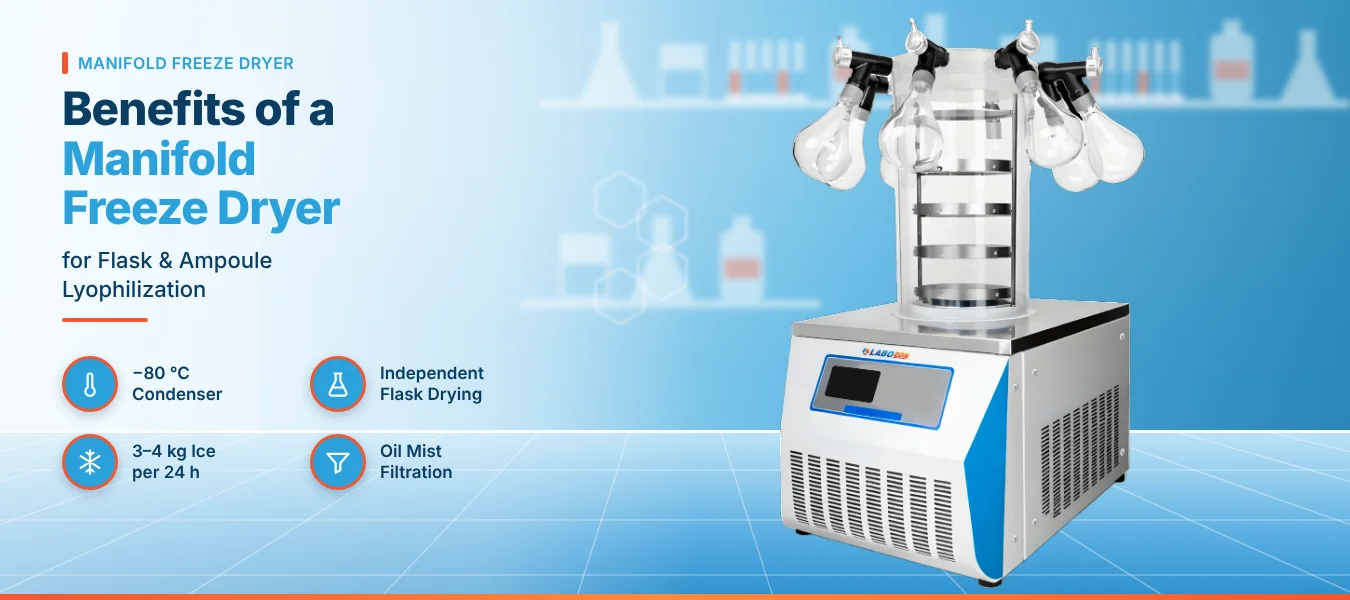
Some samples arrive in a single flask, others in a dozen ampoules, and a few contain solvents that attack ordinary seals. A Manifold Freeze Dryer handles this variety by giving each glass vessel its own connection to the vacuum line, so one finished flask never holds up the rest of the work. This guide explains how the method works, where it is applied and what to review in the Labozon Manifold Freeze Dryer LZ-MFD-A110.
How Sample Vessels Connect to the Vacuum Line
A Manifold Freeze Dryer is a type of laboratory freeze dryer in which flasks, ampoules or vials attach to ports on a vacuum manifold. The sample is frozen first, then the vessel is connected and the chamber pressure drops. Ice turns directly to vapor, and the vapor collects on a very cold condenser.
Because each port works on its own, a lab can start a new vessel while another is still drying. That flexibility is the main reason manifold freeze dryer equipment appears in research settings where sample types change from week to week.
Working Principle
Three parts drive the process. The condenser captures water vapor as ice, the vacuum pump keeps pressure low enough for sublimation, and the vessel supplies the frozen sample. When the sample stays frozen and the pressure stays low, water leaves without passing through a liquid phase.
An oil mist filter and an oil return device protect the pump and keep pressure steady during long runs. A display that shows sample temperature, vacuum and condenser curves lets the operator judge when drying has finished.
Core Benefits for Flask and Ampoule Work
Independent Ports
Flasks can be added or removed without disturbing the others.
Deep Condenser
A cold trap at -80 °C captures vapor from solvent-containing samples.
Pump Protection
Oil mist filtration and oil return limit contamination and leaks.
Clear View
An acrylic door lets staff watch product during processing.
Where It Is Applied
Manifold freeze dryer use covers small to medium-scale lyophilization of several samples at once, including vials, flasks and ampoules. Pharmaceutical, biotechnology and research laboratories use it to preserve heat-sensitive material such as enzymes, peptides, bacterial cultures and plant extracts.
Ampoule work often relies on shell freezing, which spreads the sample in a thin layer on the glass wall. A thin layer shortens drying time and leaves a more uniform dry cake that dissolves again without clumps.
Key Details of the LZ-MFD-A110
The Labozon Manifold Freeze Dryer LZ-MFD-A110 is a compact tabletop manifold freeze dryer machine with a clear drying chamber and a touchscreen. Its published details are below.
| Feature | Specification |
|---|---|
| Condenser temperature | -80 °C |
| Condenser capacity | 3 to 4 kg per 24 hours |
| Freeze drying area | 0.18 m² |
| Bulk capacity | 1.8 L |
| Shelves | 4 to 6 shelves, Φ 200 mm |
| Final vacuum | Below 10 Pa |
| Display | LCD touchscreen |
| Refrigerant | CFC free |
| Electrical supply | 220 V, 50 Hz |
| Dimensions | 970 × 680 × (400 + 460) mm |
| Weight | 180 kg |
What to Confirm Before Ordering
The product page lists no manifold port count and no chamber material, so ask the supplier how many flasks the manifold takes and which glassware sizes fit. The page gives 3 kg in its introduction and 3 to 4 kg in the specification table for condenser capacity, so request one confirmed figure.
The unit also arrives with a vacuum pump, three KF25 adapters and six material trays, which shapes how quickly a lab can start.
Manifold Units and Shelf Units Compared
The table below sets the two common layouts side by side using typical features.
| Factor | Manifold Layout | Shelf Layout |
|---|---|---|
| Typical vessels | Flasks, ampoules, vials | Vials and trays |
| Batch timing | Vessels start and stop separately | Whole load shares one cycle |
| Ideal fit | Mixed research samples | Repeated identical batches |
| Sample handling | Direct connection to each port | Placed on temperature-controlled shelves |
| Typical setting | Research and development | Pilot and routine production |
Selection Mistakes That Cause Rework
- Comparing machines on ice capacity alone and ignoring condenser temperature.
- Choosing a unit without checking which vessel sizes the manifold accepts.
- Overlooking bench strength and doorway width for a 180 kg machine.
- Skipping a check of pump oil handling when samples contain solvents.
- Leaving the electrical supply unchecked against the site.
Teams that want to review a similar freeze dryer machine can start with the freeze dryer category before shortlisting.
User Tips and Recommended Practices
- Freeze each flask or ampoule fully before connecting it, so the sample does not foam when vacuum starts.
- Spread the sample in a thin layer by shell freezing or angled freezing.
- Fill flasks to well under half their volume so vapor can escape.
- Start the condenser first and let it reach -80 °C before opening the vacuum line.
- Check pump oil level and color on a regular schedule.
- Defrost and dry the cold trap between heavy runs.
- Wipe the sealing ring and the ports before each run.
- Log sample type, load, drying time and final vacuum for each run.
Exploring Wider Freeze Dryer Options
The LZ-MFD-A110 belongs to the freeze dryer category, which covers manifold, shelf and floor-standing machines, from a bench-top lab freeze dryer to larger units in several capacities. Buyers usually compare condenser temperature, ice capacity, drying area, vessel types, pump protection and display features.
The full Labozon freeze dryer range shows these machines together, and the Labozon home page opens the other laboratory equipment groups.
See the full specification of the Manifold Freeze Dryer LZ-MFD-A110.
Explore Manifold Freeze DryerRelated Products


Looking for manifold freeze dryer?
Compare available models, review product specifications, and contact the Labozon team for assistance in identifying equipment that matches your laboratory requirements.