
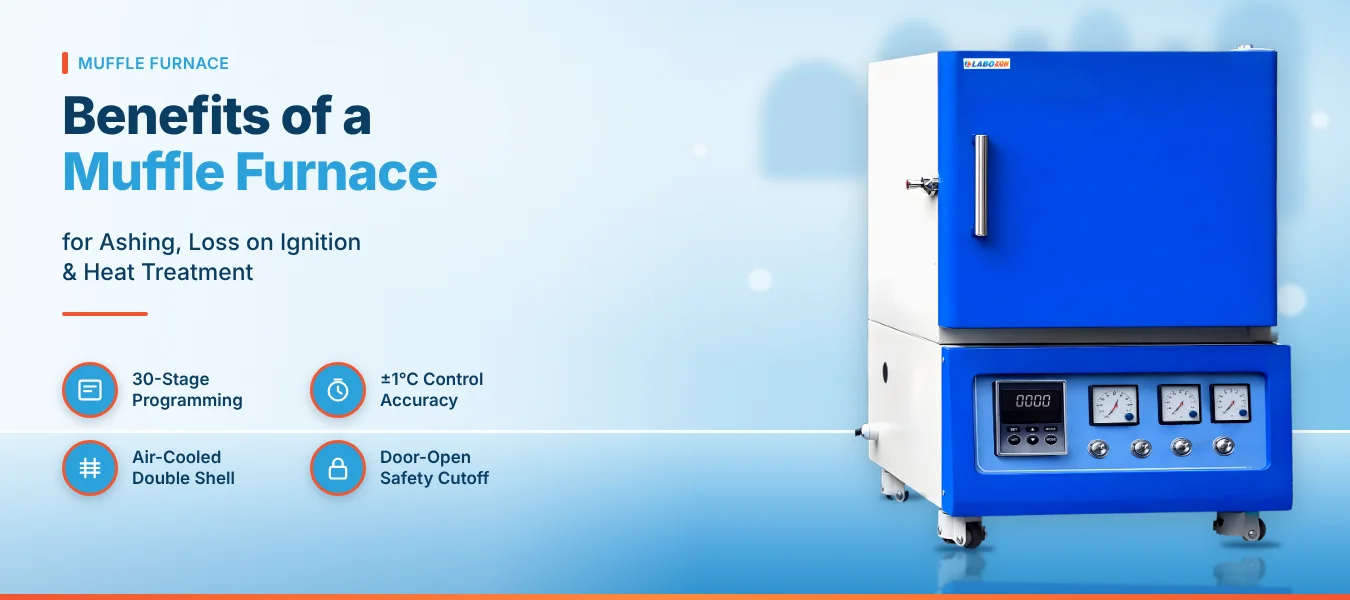
Many laboratory tests begin with one question: what remains after a sample is heated hard? A muffle furnace answers it in a clean, closed chamber. This guide covers how it works, where it is applied, and what to check when choosing the Muffle Furnace LZ-MFF-A402.
Why Heating Without Flame Matters
Direct flame adds soot, gas and uneven heat to a sample. A closed chamber removes those variables, so the only change in the crucible comes from temperature and time. That is why heating muffle chambers sit at the center of ash testing, material research and quality control in hospitals, universities and industrial labs.
The benefit is repeatability. When the same program runs on the same load, results from Monday and Friday can be compared with confidence.
Working Principle and Main Parts
The muffle furnace working principle is simple. Electric elements heat an insulated chamber, and the sample sits inside on a crucible or ceramic block. Because the elements stay outside the sample space, combustion residue never reaches the load. A thermocouple reads chamber temperature, and the controller adjusts power to hold the set value.
A basic muffle furnace diagram shows five parts: an outer shell, an insulation lining, the elements, a thermocouple, and a controller with door safety switch. An electric muffle furnace can also run a timed program of ramp, hold and cool steps.
Ashing and Loss on Ignition in Practice
Ashing burns off the organic part of a sample and leaves the mineral part, called ash. Loss on ignition measures the weight lost during that burn. Together they answer practical questions, and these muffle furnace uses appear daily in food, soil, cement, coal, polymer and pharmaceutical work.
Food and Feed
Ash content shows the mineral level in a batch.
Soil and Coal
Loss on ignition shows organic matter, carbon or volatile content.
Pharmaceutical
Residue on ignition checks inorganic impurities in raw materials.
In each case the crucible is weighed before and after, so the muffle furnace is used for turning a heat cycle into a single, recordable number.
Heat Treatment and Materials Work
A muffle furnace application reaches well beyond ash testing. Heat treatment changes how a material behaves, and the same chamber can support several processes:
- Annealing softens metal and relieves internal stress.
- Sintering bonds powders into a solid body.
- Calcining drives water or gas out of a mineral.
- Ceramic and glass firing tests how a material holds up under heat.
Research centers and medical laboratories rely on this muffle furnace equipment alongside metallurgical groups for such tasks.
Specifications of the LZ-MFF-A402
The Labozon Muffle Furnace LZ-MFF-A402 is a microprocessor-controlled lab furnace with an 8.0 L chamber. Its published details are below.
| Feature | Specification |
|---|---|
| Maximum temperature | 1700°C |
| Chamber | 8.0 L; 200 × 200 × 200 mm; alumina polycrystalline fiber |
| Control | 30-stage program with PID adjustment; ±1°C accuracy; B type thermocouple |
| Heating rate | Up to 30°C per minute; 15°C per minute or less recommended |
| Cooling and surface | Air-cooled double shell; surface at or below 45°C |
| Safety | Door-open power cutoff, over-temperature, over-current and power-off protection |
| Monitoring | Built-in ammeter and dual voltmeters; RS485 interface and software |
| Power | Single phase, 220 V, 5 kW |
| Outer size | 564 × 530 × 930 mm |
| Supplied accessories | Thermocouple, crucible tongs, alumina crucible, cushion block, furnace floor brick, high temperature gloves, data cable |
Chamber Size, Control and Insulation Options
Furnace formats differ in ways that shape daily work. The overview below separates the points buyers weigh most often.
| Choice | Suited to | Trade-off |
|---|---|---|
| Small chamber | Single crucibles and quick checks | Limited batch size |
| Larger chamber | Multiple crucibles in one run | More bench space and power needed |
| Fiber insulation | Fast heating and cooling | Needs gentle handling of the lining |
| Programmable control | Long cycles with several steps | Requires setup time for each method |
Selection Mistakes That Waste Time Later
- Choosing by maximum temperature alone and ignoring chamber size, ramp control and insulation type.
- Selecting a chamber that fits one crucible today but not the batch size planned for next year.
- Overlooking the power supply, which must match what the muffle furnace laboratory can supply before the unit arrives.
- Skipping safety features such as a door switch and over-temperature cutoff.
- Ignoring data connection, although recorded runs make audits and repeat tests easier.
When two models look close, the furnace category page lets buyers read their specifications side by side before deciding.
User Tips and Recommended Practices
- Dry samples at low temperature before a hard burn.
- Use ceramic or alumina crucibles rated for the target temperature.
- Cool crucibles in a desiccator before weighing.
- Follow the recommended heating rate to protect the chamber lining.
- Ventilate the room, since burning samples release smoke and gas.
- Wear high temperature gloves and use tongs at all times.
- Let the chamber cool before opening the door fully.
- Log program, load and result for each run.
- Inspect the thermocouple on a regular schedule.
Exploring the Wider Furnace Category
The LZ-MFF-A402 belongs to the furnace category, which groups muffle, tube, ashing and high temperature units used in clinical, research and industrial laboratories. Buyers usually review temperature range, chamber volume, heating element type, controller stages and safety features.
The full Labozon furnace range shows these units together, and the Labozon home page opens the other laboratory equipment groups.
Name: Olivia Carter – Labozon
Specialty: Laboratory Equipment, Scientific Technology, and SEO Content Writing
Writing Style: Professional, informative, research-driven, and reader-friendly.
Bio: Olivia Carter is a content writer at Labozon, specializing in laboratory equipment, scientific technologies, and laboratory applications. She creates informative, SEO-focused blog articles that highlight product features, explain key benefits, and explore the practical uses of scientific instruments. Her goal is to present technical information in a clear, accurate, and accessible manner, helping laboratory professionals, researchers, and science enthusiasts make informed decisions.
Linked.in
See the full specification of the Muffle Furnace LZ-MFF-A402.
Explore Muffle FurnaceRelated Products


Looking for muffle furnace?
Compare available models, review product specifications, and contact the Labozon team for assistance in identifying equipment that matches your laboratory requirements.