
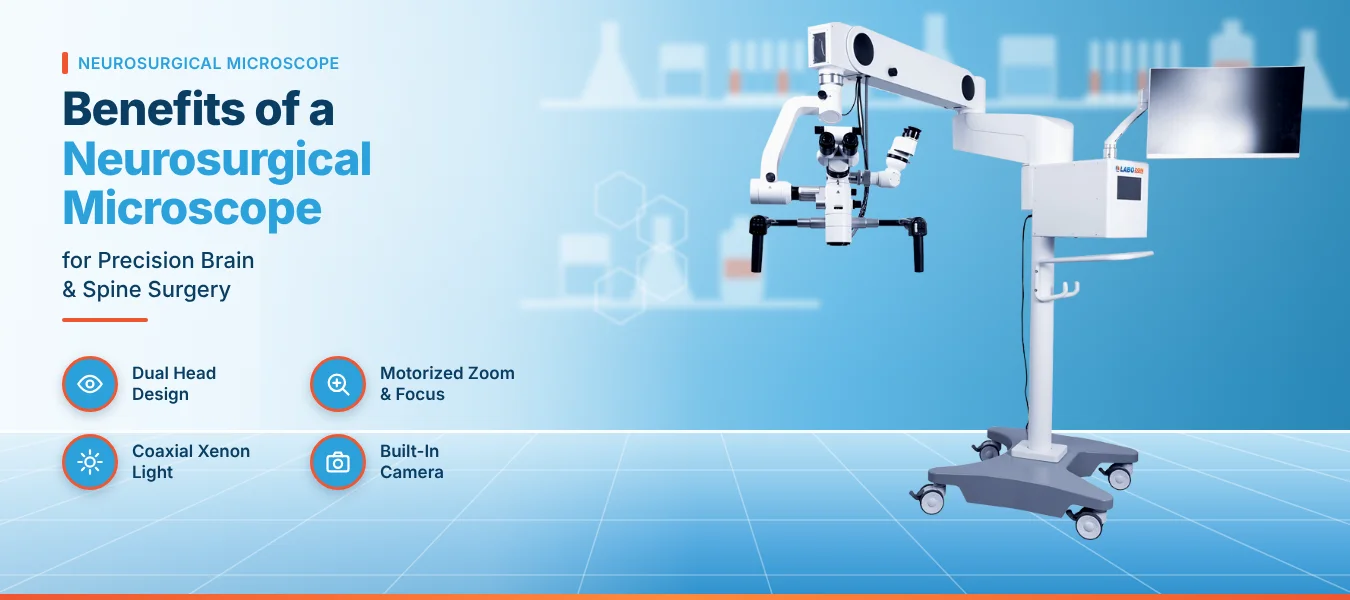
A few millimeters decide the outcome in brain and spine surgery. Nerves, vessels and tumor margins sit close together, and the unaided eye cannot separate them with confidence. A neurosurgical microscope gives the surgeon a bright, magnified, three-dimensional view of that tight space. This guide explains how the instrument works, where it is used and what to review in the Labozon Operating Surgical Microscope LZ-OSM-A110.
What the Instrument Does
A neurosurgical microscope is a stand-mounted optical instrument that magnifies the operative field and delivers strong light along the same path as the view. Buyers first meet it under the broader name operating microscope, and both terms describe the same family of equipment.
What sets the neurosurgical type apart is arm travel, focusing range and illumination suited to long procedures near the brain and spine.
Working Principle and Layout
Operating microscopes work by combining three systems. The optics include an objective lens, a zoom body and eyepieces. The light source sends a beam through optical fibers, so illumination lands on tissue without shadows from the surgeon's head.
The third system is the stand, a balanced arm that holds the head in place after the surgeon moves it. Reading a diagram of these parts shows why arm range and balance matter as much as magnification.
Clinical Benefits
Magnified Detail
Small vessels and nerve fibers become visible.
Natural Depth
A binocular surgical microscope gives each eye its own image.
Coaxial Light
Illumination reaches deep, narrow corridors.
Shared View
A second head lets an assistant follow the procedure.
Departments and Typical Uses
An operating microscope used for brain surgery sits beside units used for ENT, plastic, hand and orthopedic work. The product page of the LZ-OSM-A110 names neurosurgery, brain surgery, neural surgery and ENT procedures, and also lists orthopedics, hand, chest, burn and plastic surgery, andrology and genitourinary work.
Operating microscopes hospitals use are often shared between departments, so a wide working range helps both dedicated and mixed operating rooms.
Key Details of the LZ-OSM-A110
The Labozon Operating Surgical Microscope LZ-OSM-A110 is a dual-head unit on a four-wheel moving stand. Its published details are below.
| Feature | Specification |
|---|---|
| Viewing heads | Main head and assistant head |
| Main head inclination | 0° to 200° |
| Assistant head zoom | 3x to 16x, continuous |
| Assistant head swing | 90° to 270° against the main head |
| Objective and focus range | 200 to 500 mm, motorized focus |
| Interpupillary distance | 55 to 75 mm |
| Eyetube diopter | Adjustable ±6D |
| Illumination | Dual optical fiber, coaxial, two built-in xenon 300 W sets, 50 mm light spot |
| Light transmittance | Up to 98%, multi-layer optics |
| Control | Handle for focus, zoom, brightness and photo or video |
| Camera and display | Built-in digital camera with software, LCD monitor |
| Stand | Four wheels, arm swing 0° to 300° |
| Total weight | 215 kg, packed in four cartons |
Loupes, Head Lamps and Microscopes Compared
The table below sets three viewing aids side by side.
| Factor | Surgical Microscope | Surgical Loupes | Head-Mounted Lamp |
|---|---|---|---|
| Magnification | High, adjustable | Low, fixed | None |
| Light path | Coaxial with the view | Separate lamp needed | Offset from the view |
| Second viewer | Assistant head available | No | No |
| Recording | Camera path possible | Add-on only | No |
| Typical fit | Deep, fine work | Open, shallow work | General lighting |
Selection Mistakes That Cause Rework
- Judging a unit on zoom range alone and ignoring arm reach and balance.
- Overlooking ceiling height and doorway width for a stand that weighs 215 kg in total.
- Skipping a plan for sterile drapes that fit the head and arm.
- Forgetting the assistant head when two people operate together.
- Leaving the power supply details unchecked with the supplier.
Teams that want to review similar units side by side can start with the operating microscope category before shortlisting.
User Tips and Recommended Practices
- Check that the arm is balanced before the patient is positioned.
- Set the interpupillary distance and eyetube diopter for each user before starting.
- Use the handle for zoom and focus so hands stay near the field.
- Begin at low magnification, find the target, then zoom in.
- Keep light output as low as the view allows, to limit heat on tissue.
- Lock the arm once the head is in position.
- Wipe the stand, handle and eyepieces after each case, following hospital protocol.
- Cover the head and arm with a drape that fits.
- Record each use and keep a regular service schedule.
Exploring Wider Operating Microscope Options
The LZ-OSM-A110 belongs to the operating microscope category, which covers surgical and procedure-room units with different head layouts, zoom systems, light sources and stand designs. Buyers often start by searching for a Leica operating microscope, then widen the list to operating microscopes manufacturers that offer a comparable binocular surgical microscope with an assistant head.
The full Labozon operating microscope range shows these units together, and the Labozon home page opens the other laboratory equipment groups.
See the full specification of the Operating Surgical Microscope LZ-OSM-A110.Explore Operating Surgical Microscope
Related Products


Looking for neurosurgical microscope?
Compare available models, review product specifications, and contact the Labozon team for assistance in identifying equipment that matches your laboratory requirements.