
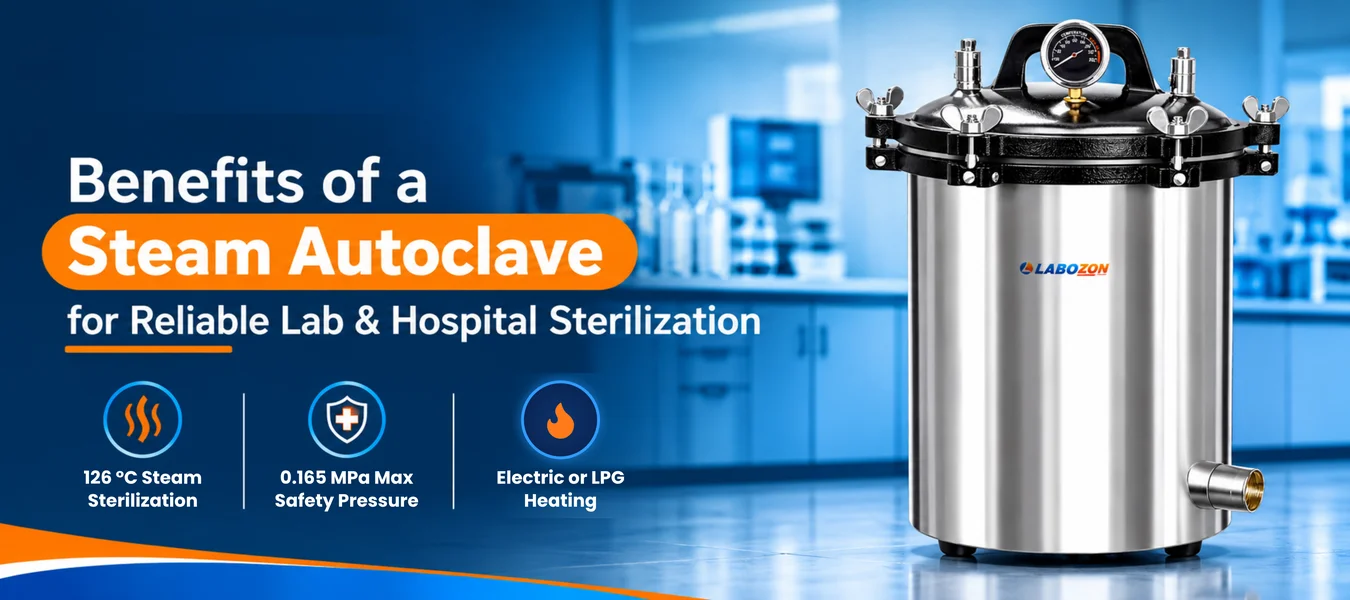
Instruments, glassware, and culture media must be free of living microbes before they touch a patient or a sample. A Steam Autoclave achieves this with pressurized saturated steam, without chemical residues. This guide explains how the process works, where it fits, how it differs from vacuum-assisted designs, and what to check before choosing one.
How Pressurized Steam Sterilizes
The steam autoclave principle rests on one fact: water boils at 100 °C under normal air pressure, but inside a sealed vessel the pressure rises and the steam becomes hotter. That moist heat denatures proteins in microorganisms, including resistant bacterial spores when a validated cycle is followed, much faster than dry heat can. Steam also transfers heat efficiently where condensation occurs on cooler surfaces, so the load heats evenly.
The Steam Autoclave LZ-SA-A21 from Labozon works in this pressure-steam way. Its page lists a working temperature of 126 °C, a working pressure of 0.14 to 0.16 MPa, and a maximum safety pressure of 0.165 MPa.
A basic steam autoclave includes these main components: a stainless steel chamber that holds the load, a lid designed to seal it, a heating device (electric or LPG on this model), a double-scale pressure gauge, and an outlet tap for releasing steam.
Where It Is Used in Labs and Hospitals
Steam autoclave uses cover clinical, dental, and research settings. According to the product page, this model is used for surgical and dental instruments, glassware, culture media, biological dressings, and goods in fields such as food handling.
- Dental rooms cycle mirrors, probes, and handpiece accessories between patients.
- Microbiology labs prepare agar bottles and dilution blanks before plating.
- Small hospital departments process open surgical trays and dressings.
- Teaching and research labs prepare glassware for clean work.
In each setting, steam sterilization equipment gives a repeatable, chemical-free process, provided loads are packed correctly and cycles are verified with indicators.
Pressure-Steam Units Versus Vacuum Designs
Large sterile processing departments often install a pulse vacuum sterilizer, which removes air from the chamber in several pulses before steam enters. A vacuum sterilizer of this kind helps steam reach wrapped packs and narrow lumens. A compact steam sterilizer autoclave such as the LZ-SA-A21 serves open instruments, glassware, and media at bench level, and its page lists no vacuum or pulse function.
| Feature | Compact pressure-steam unit | Pulse vacuum sterilizer |
|---|---|---|
| Air removal | Steam displaces air in the chamber | Repeated vacuum pulses before steam |
| Suited loads | Open instruments, glassware, media | Wrapped packs, porous items, lumens |
| Footprint | Bench-top, small room | Floor-standing, dedicated space |
| Utilities | Electric or LPG heating | Typically electricity, steam, and drainage |
Published Details of the LZ-SA-A21
| Parameter | Details |
|---|---|
| Capacity | 24 L |
| Sterilizing volume | 280 × 390 mm |
| Working temperature | 126 °C |
| Working pressure | 0.14 to 0.16 MPa |
| Maximum safety pressure | 0.165 MPa |
| Heating | Electric or LPG |
| Power | AC220V, 50 Hz, 2 kW |
| Construction | Stainless steel |
| Dimensions | 410 × 410 × 550 mm |
| Weight | 15 kg net, 17 kg gross |
Steam Sterilizer How to Use: Step by Step
- Add clean water to the chamber up to the marked level.
- Place instruments or glassware in the basket, leaving gaps for steam flow.
- Close the lid and seal it firmly.
- Start heating and watch the pressure gauge until it reaches the working range.
- Hold the cycle for the time your load requires.
- Switch off the heat and let pressure fall to zero before opening.
- Open the lid away from your face, then remove the load with heat-resistant gloves.
Always read the user manual before the first cycle.
Common Selection Mistakes
The most frequent error is buying on chamber size alone. Review the load type, whether wrapped items need air removal, the available power or LPG supply, and the weight and bench space. Also check how the pressure gauge is marked, since clear indication makes each cycle easier to monitor.
A second mistake is treating all electric autoclaves as interchangeable. Models differ in heating method, safety pressure limits, and chamber shape, so look through the wider laboratory autoclave range before narrowing your shortlist.
User Tips and Recommended Practices
- Clean instruments first, since blood or residue shields microbes from steam.
- Do not overfill the chamber, because crowded loads block steam circulation.
- Use distilled water when possible to slow scale buildup on the heating element.
- Loosen caps on bottles and flasks so sealed containers cannot burst.
- Wait for the gauge to read zero before opening the lid.
- Keep a cycle log with date, load type, and operator.
- Inspect the lid seal and pressure gauge regularly, and replace worn parts early.
- Run periodic biological or chemical indicator checks to confirm the cycle works as intended.
Exploring the Autoclave Category
The Steam Autoclave LZ-SA-A21 belongs to the wider group of laboratory autoclaves, which includes bench-top pressure-steam units, larger vertical and horizontal models, and vacuum-assisted designs. Buyers usually compare chamber capacity, heating method, pressure range, safety features, and the space available. To see the full range, visit the laboratory autoclave category.
Labozon supplies scientific equipment across many disciplines, and the rest of its catalog is reachable from the Labozon home page.
Related Products


Looking for steam autoclave?
Compare available models, review product specifications, and contact the Labozon team for assistance in identifying equipment that matches your laboratory requirements.