
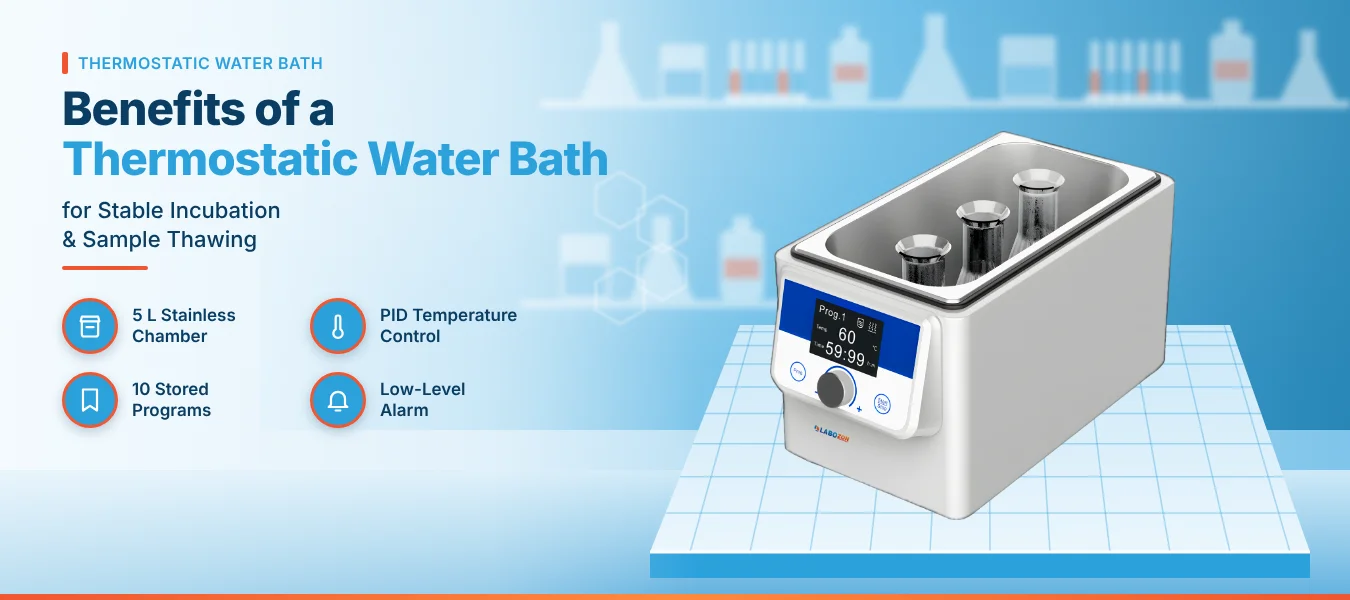
Plasma thawed too fast, an enzyme reaction that drifts two degrees, a reagent warmed unevenly: small temperature errors cause large problems at the bench. A thermostatic water bath holds a water volume at a set temperature, so samples warm or incubate at a controlled rate. This guide explains how it works, where it is used, and how to evaluate the Labozon Thermostatic Water Bath LZ-TWB-A100.
What a Thermostatic Water Bath Does
A thermostatic water bath is a heated tank that keeps water at a chosen temperature. Water carries heat evenly around a vessel, which is gentler than a dry block or hot plate.
Catalogs use many names for the same instrument: a laboratory water bath, a water bath thermostatic unit or a thermostatically controlled water bath. Most units today are a water bath digital design, with a numeric display and a programmable controller instead of a simple dial.
How It Works and Diagram
A heater warms the water, a sensor reads the temperature, and a controller switches the heater to hold the set point. Better controllers use PID control, which adjusts power smoothly instead of switching it fully on and off, so the temperature overshoots less.
The water then spreads heat through the tank, so each tube sits at nearly the same temperature as its neighbor.
Benefits of a Thermostatic Water Bath
Stability
Holds a set point for hours of incubation.
Even Heating
Water surrounds each tube evenly.
Gentle Thawing
Plasma, serum and reagents warm at a controlled pace.
Repeatability
The same program gives the same conditions on Monday and Friday.
Thermostatic Water Bath Uses
Typical thermostatic water bath uses include thawing frozen samples, incubating enzyme and serology reactions, warming reagents, melting agar and running heat-based sample preparation.
The product page lists biochemical sample processing, petrochemical analysis, environmental monitoring, industrial testing and research laboratory experiments. In each case the bath provides a known temperature for a known time.
Stable Incubation and Controlled Thawing
Incubation needs a steady temperature over a long period, and water changes temperature slowly, which suits that job. For thawing, set the bath to the temperature your procedure calls for, place closed tubes in a rack and remove them as soon as the ice is gone.
Leaving a sample in the bath longer than needed can damage sensitive material, so a timer and a stable set point protect both speed and sample quality.
Specifications of the LZ-TWB-A100
The Labozon Thermostatic Water Bath LZ-TWB-A100 is a compact unit with a stainless chamber. Its published details are below.
| Feature | Specification |
|---|---|
| Chamber | 5 L, stainless steel |
| Temperature range | Room temperature +5 °C to 100 °C |
| Uniformity | ±0.3 °C at 37 °C |
| Control | PID controller |
| Display | 4.3-inch TFT touch screen |
| Stored programs | 10 |
| Safety | Liquid level sensor with alarm buzzer, over-temperature protection |
| Drain | Drain valve |
| Power use | 270 W |
| Supply | 100 to 120 V or 200 to 240 V, 50 to 60 Hz |
| Weight | 3.5 kg |
How to Use Thermostatic Water Bath Equipment
For how to use thermostatic water bath equipment, good technique matters as much as the instrument. Start by filling the tank with clean water to the correct level.
- Switch on the bath and enter the set point on the touch screen.
- Wait until the display shows the water has reached temperature.
- Place tubes upright in a rack.
- Keep the lid on between uses to limit evaporation.
- When work is done, switch off, let the water cool and drain the tank through the valve.
Water Bath, Dry Block and Hot Plate Compared
The table below sets three heating options side by side.
| Factor | Water Bath | Dry Block | Hot Plate |
|---|---|---|---|
| Heat transfer | Water surrounds the vessel | Metal contacts the vessel | Surface contact from below |
| Temperature evenness | High | Moderate | Low |
| Vessel flexibility | Many shapes and sizes | Needs matching blocks | Flat-bottom vessels |
| Typical fit | Incubation and thawing | Small tubes | Fast heating of liquids |
Selection Mistakes That Cause Rework
- Comparing a laboratory water bath on capacity alone and ignoring the controller and sample load.
- Ignoring tank size against the vessels used.
- Skipping the low-liquid alarm.
- Forgetting the voltage supply at the bench.
- Not reviewing the uniformity figure at the temperature used most.
Buyers who want to compare similar baths can start with the bath and circulator category before shortlisting.
User Tips and Recommended Practices
- Fill the bath to the marked level before switching on.
- Use clean water and change it on a regular schedule to limit growth.
- Let the bath reach its set point before adding samples.
- Seal tubes so water cannot enter, and keep the rack upright.
- Keep the lid on between uses to cut evaporation and heat loss.
- Use a timer when thawing so samples do not overheat.
- Never run the bath without water.
- Wipe the tank and rinse the drain valve after use.
- Log set point, date and operator for each run.
Exploring Wider Bath and Circulator Options
The LZ-TWB-A100 belongs to the bath and circulator category, which groups heated and circulating baths in several capacities and configurations. Buyers usually compare chamber size, temperature range, uniformity, control type and safety features.
The full Labozon bath and circulator range shows these instruments together, and the Labozon home page opens the other laboratory equipment groups.
See the full specification of the Thermostatic Water Bath LZ-TWB-A100.
Explore Thermostatic Water BathRelated Products


Looking for thermostatic water bath?
Compare available models, review product specifications, and contact the Labozon team for assistance in identifying equipment that matches your laboratory requirements.