
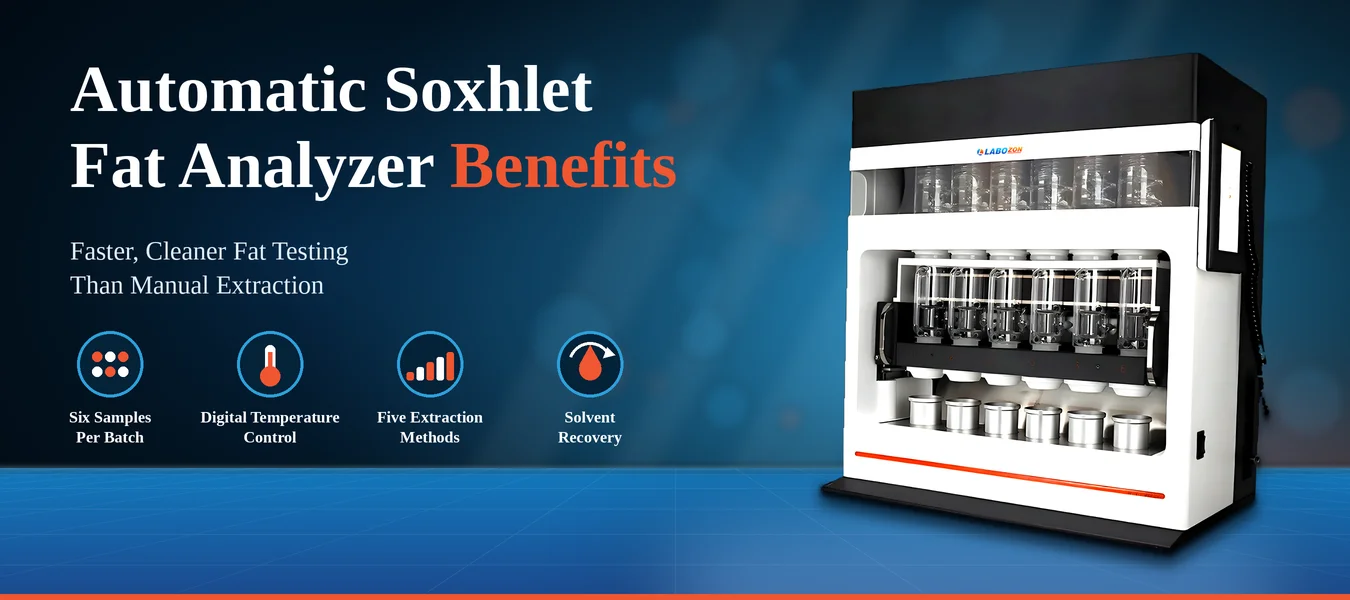
A practical look at how an Automatic Soxhlet Fat Analyzer changes daily workflow in the modern laboratory.
Fat content is one of the most requested measurements in food testing, and the method behind it shapes both accuracy and workload. Many laboratories still assemble glassware, adjust heat by hand, and watch each run closely. A modern Automatic Soxhlet Fat Analyzer brings controlled heating, preset programs, and solvent recovery into a single unit. This article explains how the technology works, where it helps most, and what to check before choosing one. Along the way, you will see how the Labozon Automatic (Soxhlet) Fat Analyzer applies these ideas in practice.
How Soxhlet Apparatus Works
To judge any upgrade, start with how soxhlet apparatus works. A weighed sample sits in a porous thimble above a flask of solvent. As the flask heats, solvent vapor rises into a condenser, turns back into liquid, and drips over the sample. Fat dissolves into the warm solvent, and when the chamber fills, the liquid siphons back to the flask carrying the extracted fat. The cycle repeats until extraction is complete, after which the solvent is evaporated and the remaining fat is weighed.
- Sample in thimble
- Solvent heated
- Vapor condenses
- Chamber fills
- Siphon returns liquid
- Fat weighed
Diagram: the Soxhlet extraction cycle
The Automatic Soxhlet Fat Analyzer follows this same Soxhlet extraction principle and uses a weighing method for fat determination. The chemistry stays the same; the difference lies in who manages heating, timing, and solvent handling.
Where Manual Setups Hold Laboratories Back
Manual soxhlet extraction equipment works, but it asks a great deal of the analyst. Glassware must be assembled and aligned, heat adjusted by hand, siphon cycles watched, and separate steps handled for extraction, solvent removal, and drying. Small differences in heating or timing can shift results between runs, and loose joints may release solvent vapor into the workspace. These limits become more noticeable as sample numbers grow.
What an Automated System Adds
An automatic soxhlet extraction system takes over the repetitive parts of the workflow. This Automatic (Soxhlet) Fat Analyzer machine from Labozon shows how a laboratory fat analyzer can combine several capabilities in one body.
Batch capacity
Six samples run together, with sample weights from half a gram to fifteen grams. A technician loads one batch and lets the automatic soxhlet extractor handle the rest.
Digital temperature control
The Automatic (Soxhlet) Fat Analyzer digital controller holds temperature within plus or minus one degree Celsius, from just above room temperature up to three hundred degrees Celsius.
Five extraction methods
Soxhlet Extraction, Soxhlet Hot Extraction, Continue Flow Extraction, Hot Extraction, and CH methods cover a wide range of samples, from zero point one percent to one hundred percent fat.
One-click operation
A seven-inch vertical color touch screen starts repeated trials, extraction, lifting, pre-heating, dilution, and solvent recovery, so the fat extraction analyzer needs fewer manual handoffs.
Solvent recovery
Recovery above eighty-five percent, preset common reagent options, and compatibility with all organic solvents give the laboratory room to adapt methods.
Safety and purity
This Automatic (Soxhlet) Fat Analyzer equipment includes built-in ether leak detection, an enclosed heating system for uniform heating, and glass and PTFE parts that help prevent impurities.
Manual Versus Automatic at a Glance
An automated fat extraction system changes the working day in specific, visible ways. The table below sets the two approaches side by side.
| Aspect | Manual setup | Automatic Soxhlet Fat Analyzer |
|---|---|---|
| Heating control | Adjusted by hand | Digital controller with plus or minus one degree Celsius accuracy |
| Operator attention | Constant watching of siphon cycles | One-click start with preset programs |
| Sample handling | Glass sets built for each sample | Six samples per batch |
| Solvent handling | Removed in a separate step | Built-in recovery above eighty-five percent |
| Safety monitoring | Visual checks for leaks | Built-in ether leak detection |
| Method options | Usually one fixed setup | Five extraction methods |
Practical Use Cases
Automatic (Soxhlet) Fat Analyzer use centers on measuring fat content in diverse food samples.
Food-testing laboratories
Routine fat checks across varied samples suit batch loading: fill the positions, start the run, and return to finished extractions.
Educational and research institutions
Repeated trials at one click and five available methods make side-by-side method exploration straightforward.
The food industry
Steady, repeatable fat determination helps teams understand product composition.
Common Selection Mistakes
Choosing an analyzer goes more smoothly when these oversights are avoided.
Overlooking the sample weight range
Check that typical samples fall between half a gram and fifteen grams per position before shortlisting any model.
Ignoring solvent compatibility
Confirm the system works with the solvents your methods call for. This analyzer accepts all organic solvents and offers preset common reagent options.
Underestimating batch needs
Six positions suit many routines, but plan throughput against the number of samples your laboratory handles in a working day.
Looking past method coverage
Five extraction methods reduce the need for separate instruments, so match them to the methods you use now and expect to use later.
Skipping safety details
Leak detection and an enclosed heating system matter when ether is in use. Weigh them as carefully as speed. Reviewing the wider fat analyzer range also shows how safety features differ between formats.
User Tips and Recommended Practices
- Load similar samples together so each batch runs under uniform conditions.
- Choose the extraction method before loading, rather than adjusting mid-run.
- Select the preset reagent option that matches the solvent in use.
- Keep glass and PTFE parts clean to protect precision.
- Leave the ether leak detection device active, and run solvent recovery after each batch.
- Record method, solvent, and batch details, and use one-click repeated trials to verify unusual results.
Exploring the Wider Fat Analyzer Range
Fat analyzers measure the fat content of samples for scientific research, diagnostics, and industrial applications. Within the Labozon catalog, the Fat Analyzer category is the place to explore the full range, and the automatic Soxhlet fat analyzer subcategory groups the Soxhlet-based models. When evaluating options, laboratory teams typically compare sample capacity, temperature range, solvent handling, available extraction methods, and safety features. Labozon Scientific Inc. is a USA based manufacturer, and its home page lists the other laboratory equipment families that sit alongside fat analyzers.
Final Thoughts
Manual extraction still has a place, but it asks for steady attention and careful hands. The Automatic Soxhlet Fat Analyzer replaces scattered steps with one controlled workflow: batch capacity, digital heating, five extraction methods, solvent recovery, and leak detection. For laboratories that value steady fat testing with less hands-on effort, an Automatic Soxhlet Fat Analyzer is a logical step forward.
Name: Olivia Carter – Labozon
Specialty: Laboratory Equipment, Scientific Technology, and SEO Content Writing
Writing Style: Professional, informative, research-driven, and reader-friendly.
Bio: Olivia Carter is a content writer at Labozon, specializing in laboratory equipment, scientific technologies, and laboratory applications. She creates informative, SEO-focused blog articles that highlight product features, explain key benefits, and explore the practical uses of scientific instruments. Her goal is to present technical information in a clear, accurate, and accessible manner, helping laboratory professionals, researchers, and science enthusiasts make informed decisions.
Looking for Automatic Soxhlet Fat Analyzer?
Compare available models, review product specifications, and contact the Labozon team for assistance in identifying equipment that matches your laboratory requirements.