
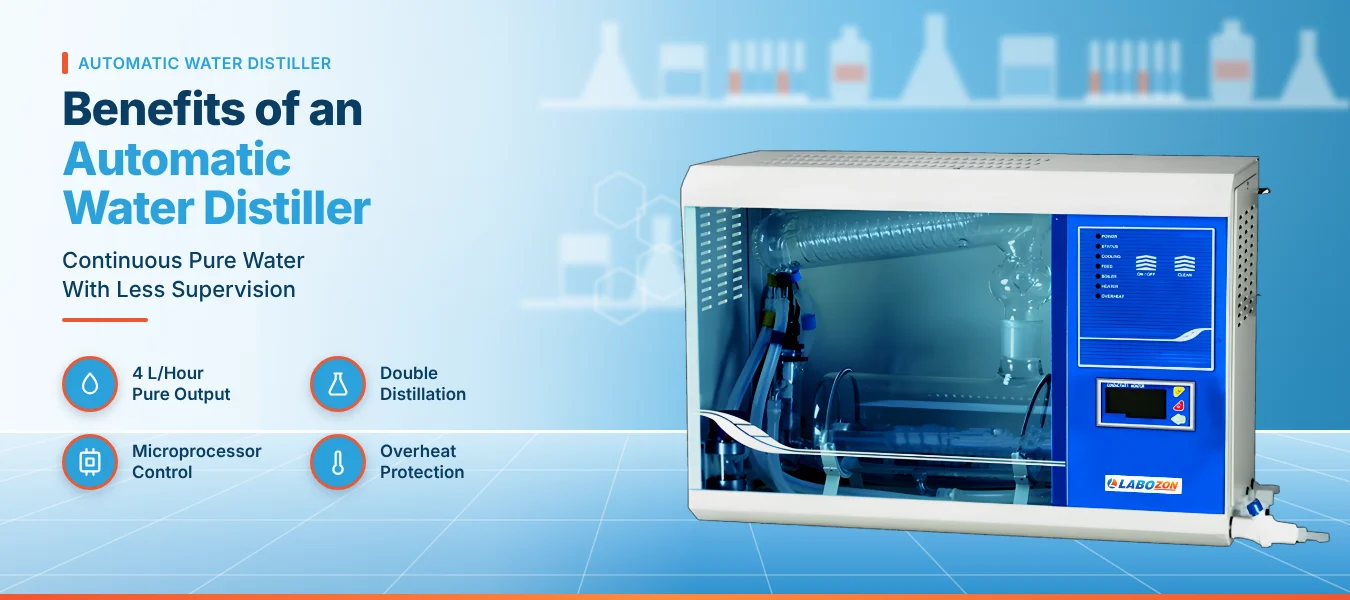
A technician who stops each hour to check a boiler loses time that belongs to the bench. An Automatic Water Distiller removes most of that checking by handling heating, cooling and fault alarms on its own, so pure water collects while staff work on other tasks. This guide explains how the process works, where the water is used and what to review in the Labozon Automatic Water Distiller LZ-WD-A110.
How Distillation Turns Tap Water Into Pure Distillate
A water distillation system heats feed water until it boils, then collects the steam and cools it back into liquid. Dissolved salts and most particles stay behind in the boiler, so the condensed liquid is far purer than the water that entered.
A double distillation design repeats the cycle, which removes more carryover and supports pyrogen-free output. A water distiller of this kind also needs cooling water at the condenser, so the water supply matters as much as the power supply.
Where Laboratories Put Distilled Water to Work
Teams in research centers, hospitals and teaching labs use distilled water for buffers, reagents, media and glassware rinsing. Tissue culture work and chemical analysis both depend on a clean, low-mineral water source.
A distilled water machine for lab use also supports instruments that scale up when fed with mineral-rich water, such as autoclaves and humidifiers. Workshops and clinics sometimes use a battery distilled water making machine setup to top up lead-acid cells, because low-mineral water slows deposits on the plates.
The product page of the LZ-WD-A110 highlights chemical analysis, research experiments and tissue culture work.
What Automatic Control Changes in Daily Work
Self-Managed Cycle
A microprocessor controller runs heating and cooling without constant checks.
Early Warning
An alarm indication system flags faults before they spread.
Visible Quality
Built-in conductivity measurement shows water quality at a glance.
Overheat Cut-Off
Cut-off protection stops the heaters if temperatures climb.
Key Details of the LZ-WD-A110
The Labozon Automatic Water Distiller LZ-WD-A110 sits on a bench or mounts on a wall. Its published details are below.
| Feature | Specification |
|---|---|
| Output | 4 L per hour |
| Process | Double distillation, pyrogen-free distillate |
| Boiler and condenser | Borosilicate glass |
| Heating | 4 quartz pipes with silica sheathing, 6.2 kW |
| Control | Microprocessor controller with LCD display |
| Condenser water | Inlet 1 L/min, below 35 °C, 70 to 560 kPa |
| Distillate quality | pH 5.0 to 6.5, conductivity 1.00 to 1.50 µS/cm |
| Protection | Overheat cut-off, alarm indication system |
| Working conditions | Ambient 0 to 50 °C |
| Electrical supply | AC 220 V ±10%, 50/60 Hz |
| Dimensions (W × D × H) | 570 × 380 × 420 mm |
| Gross weight | 26.1 kg |
Automatic and Manual Units Compared
The table below sets a basic distilled water machine with manual water stills against an automatic unit, using typical features.
| Factor | Manual Water Stills | Automatic Unit |
|---|---|---|
| Start and stop | Operator controlled | Controller managed |
| Fault warning | Visual checks | Alarm indication |
| Quality check | Separate meter | Built-in conductivity display |
| Staff attention | High, throughout the run | Low, between checks |
| Typical fit | Occasional use | Daily supply |
Selection Mistakes That Cause Rework
- Comparing units on output alone and ignoring the cooling water supply.
- Overlooking the electrical load of a 6.2 kW heater on the site circuit.
- Choosing the wrong mounting plan, then finding the bench or wall cannot carry the unit.
- Skipping the feed water check, so hard water scales the boiler early.
- Asking each supplier of an automatic water distiller machine for different figures, which makes offers hard to compare.
Teams that want to compare similar units can start with the water distiller category before shortlisting.
User Tips and Recommended Practices
- Confirm cooling water flow before each run.
- Use regular water as the feed, as stated for this unit.
- Descale the boiler and heating elements on a regular schedule.
- Flush the unit with distillate after any cleaning step.
- Watch the conductivity reading and clean the unit if it drifts.
- Collect distillate in clean, covered containers.
- Leave space around the unit so the condenser stays cool.
- Keep a log of run hours, descaling dates and conductivity readings.
Exploring Wider Water Distiller Options
The LZ-WD-A110 belongs to the water distiller category, which covers glass and metal units across several output sizes. Buyers of automatic water distiller equipment usually compare output per hour, boiler and condenser material, control type, cooling water need and mounting style.
The full Labozon water distiller range shows these units together, and the Labozon home page opens the other laboratory equipment groups.
See the full specification of the Automatic Water Distiller LZ-WD-A110.
Explore Automatic Water DistillerRelated Products

Looking for automatic water distiller?
Compare available models, review product specifications, and contact the Labozon team for assistance in identifying equipment that matches your laboratory requirements.