
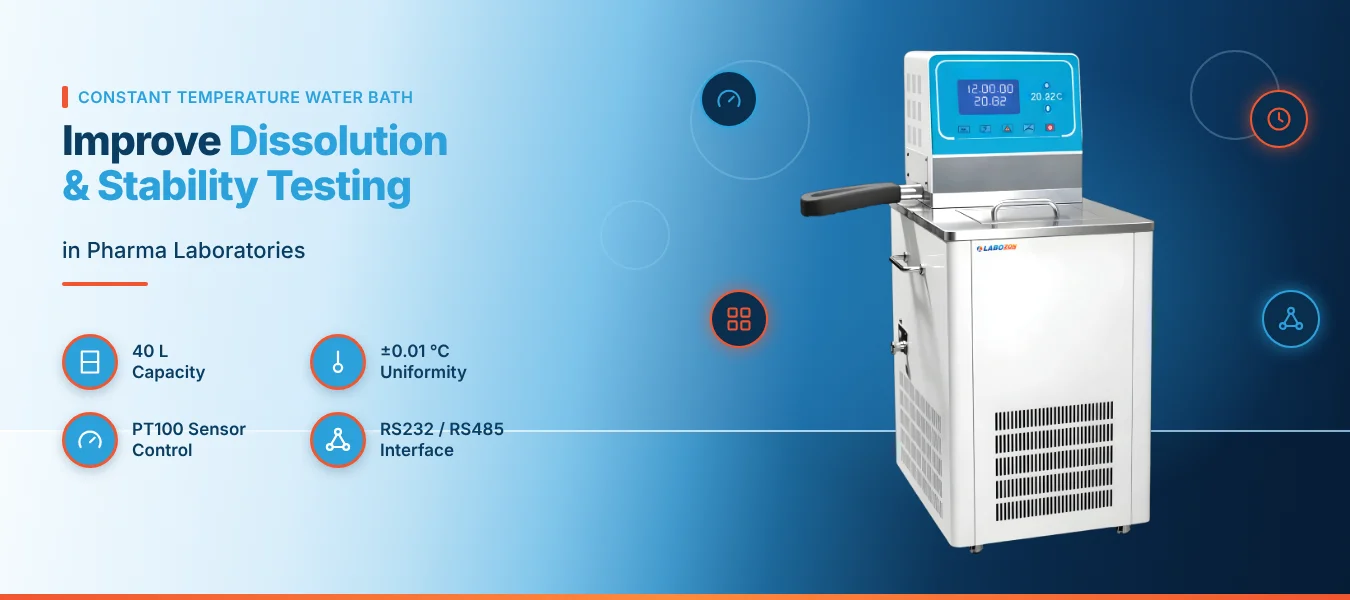
A drug release run that drifts by a fraction of a degree can raise questions about the whole data set, and a stability sample that warms unevenly invites the same doubt. A Constant Temperature Water Bath removes heat as a variable by surrounding each vessel with water held at a fixed setpoint. This guide explains how it works, where pharma laboratories use it and what to review in the Labozon Constant Temperature Water Bath LZ-CWB-A705D.
How Water Holds a Fixed Temperature
A temperature water bath works as a closed loop. A sensor reads the water temperature, a microprocessor compares it with the setpoint, and the heater switches on or off to close the gap. Insulation around the tank slows heat loss, so the heater cycles less often.
Water has a high heat capacity, so a large volume changes temperature slowly and passes heat evenly to each vessel it surrounds. That steady transfer is what separates a temperature controlled water bath from a hot plate or a dry block.
Where Pharma Laboratories Put the Bath to Work
Constant temperature water bath uses in a pharma laboratory span several workflows, and each one asks for a different part of the instrument.
Drug Release Testing
Pre-warming media and holding vessels at the target temperature between time points.
Stability Studies
Short thermal holds and sample conditioning before longer storage.
Reagent Preparation
Bringing reagents to working temperature before an assay begins.
Sample Incubation
Keeping tubes immersed at a uniform level for a set period.
Why Even Heating Changes the Data
The main constant temperature water bath benefits come down to repeatability. When water temperature is uniform from top to bottom and side to side, a vessel in the corner behaves like a vessel in the center, and results across a batch can be compared without asking whether tank position played a role.
Heat also reaches the sample gently. Sensitive formulations and biological materials tolerate a water jacket better than direct contact with a hot surface, which lowers the chance of local overheating during a hold.
For constant temperature water bath laboratory use in regulated work, a stable setpoint also makes each run easier to document, because the thermal conditions are known and repeatable from one analyst and one shift to the next.
Key Details of the LZ-CWB-A705D
The Constant Temperature Water Bath LZ-CWB-A705D is a 40 L laboratory water bath with microprocessor control. Its published details are below.
| Feature | Specification |
|---|---|
| Capacity | 40 L |
| Temperature range | Starts at room temperature |
| Uniformity (horizontal and vertical) | ±0.005 to ±0.01 °C |
| Display | LCD |
| Sensor | PT100 |
| Interface | RS232 or RS485 |
| Work slot | 350 × 300 mm |
| Inner groove dimensions | 500 × 340 × 240 mm |
| Drain | Yes |
| Control features | Adjustable timer, safety cut-off system |
| Chamber | Seamless stainless inner chamber with thermal insulation |
| Optional additions | Magnetic stirring, built-in cooling coil, adjustable immersion platform, Modbus RTU communication |
Water Bath Compared With Dry Block Heaters
The table below sets two common heating methods side by side using typical features.
| Factor | Dry Block Heater | Water Bath |
|---|---|---|
| Heat transfer | Through metal contact points | Through water around the whole vessel |
| Vessel shapes | Limited to block wells | Flasks, tubes and racks of mixed sizes |
| Temperature spread | Can vary between wells | Even through the water volume |
| Upkeep | Wipe and dry | Water changes and chamber cleaning |
Selection Mistakes That Cause Rework
- Choosing a constant temperature bath by tank volume alone and ignoring how uniformity is stated.
- Overlooking sensor type and how often the displayed temperature can be checked.
- Skipping a check of communication ports before connecting the bath to data logging.
- Forgetting that stirring or cooling add-ons must be specified when the bath is chosen.
- Ignoring bench space and drain access for a 40 L water-filled tank.
Teams that want to compare similar instruments can start with the bath and circulator category before shortlisting.
User Tips and Recommended Practices
- Fill the tank to the marked level and let the water reach the setpoint fully before loading samples.
- Use fresh purified water and change it on a fixed schedule to limit mineral buildup and microbial growth.
- Keep the lid closed during long holds to reduce evaporation.
- Space vessels evenly so water can circulate around each container.
- Check the displayed temperature against a calibrated thermometer at regular intervals.
- Keep immersion depth consistent between runs.
- Drain and clean the chamber after use, and descale when buildup appears.
- Record setpoint, start time and end time for each run.
Exploring Wider Bath and Circulator Options
The LZ-CWB-A705D belongs to the bath and circulator category, which covers heated baths, refrigerated circulators and stirred baths in several tank sizes. Buyers usually compare tank capacity, temperature range, uniformity, sensor type, control and communication options, and available add-ons such as stirring and cooling.
The full bath and circulator range shows these instruments together, and the home page opens the other laboratory equipment groups.
See the full specification of the Constant Temperature Water Bath LZ-CWB-A705D.
Explore Constant Temperature Water BathRelated Products

Looking for Constant Temperature Water Bath?
Compare available models, review product specifications, and contact the Labozon team for assistance in identifying equipment that matches your laboratory requirements.