
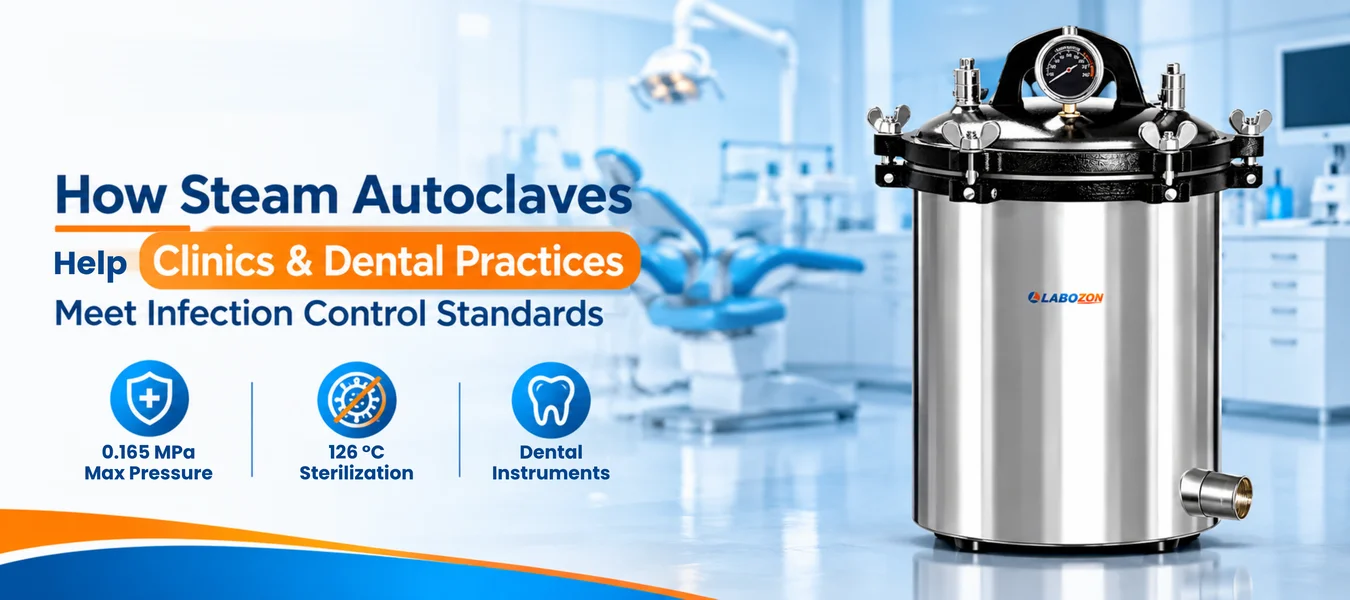
Reusable instruments only protect the next patient when they are properly reprocessed. A Steam Autoclave uses pressurized moist heat for that job in a compact footprint. This guide explains how it works, where it fits, and what to review before choosing and running one.
Steam Autoclave Principle: Moist Heat Under Pressure
The steam autoclave principle is simple. Water in a sealed chamber is heated until it turns to steam. As steam builds, pressure rises, and the boiling point of water rises with it. The Steam Autoclave LZ-SA-A20 works at 0.14 to 0.16 MPa and a working temperature of 126 °C.
At that temperature, moist heat denatures proteins inside microorganisms, which inactivates or destroys them when the required temperature and exposure time are maintained. Moist heat generally transfers thermal energy more efficiently than dry heat. Air in the chamber matters too, because trapped air creates cool pockets, so a loaded steam autoclave needs loading and venting done as the manual describes.
Cleaning remains a separate step. Cleaning removes visible soil and residue, while steam sterilization is intended to destroy microorganisms on heat-stable reusable instruments when the correct cycle, loading, and validation procedures are followed.
Steam Autoclave Diagram: Parts of a Portable Unit
A basic steam autoclave diagram for a portable unit like the LZ-SA-A20 shows a handful of parts that each play a clear role in a run.
- Chamber: an 18 L stainless steel vessel with a sterilizing volume of 280×260 mm
- Locking lid: closes the chamber and supports safe pressurization
- Double-scale pressure gauge: supports cycle monitoring during a run
- Heating device: electric or LPG
- Outlet tap: lets operators release steam and drain the unit
The gauge shows pressure only, so keep a separate written or digital log for each load.
Steam Autoclave Uses Across Clinical and Lab Work
Steam autoclave uses cover several settings. According to the product page, the LZ-SA-A20 is applied to the following:
- Surgical and dental instruments
- Glassware and metal instruments
- Culture media and biological dressings
- Food and other goods in related fields
In a dental office, the unit handles hand instruments and trays between appointments. Clinics use it for minor-procedure kits. Small labs add it to media and glassware handling. Because it has one 18 L chamber, it suits low-to-moderate daily loads rather than large hospital batches. Only heat-stable items where steam sterilization is appropriate should go inside, and each instrument maker’s guidance comes first.
Published Details of the LZ-SA-A20
| Parameter | Details |
|---|---|
| Chamber capacity | 18 L |
| Sterilizing volume | 280×260 mm |
| Working pressure | 0.14 to 0.16 MPa |
| Maximum safety pressure | 0.165 MPa |
| Working temperature | 126 °C |
| Heating | Electric or LPG |
| Power | AC220V, 50 Hz, 2 kW |
| Construction | Fully stainless steel structure |
| Dimensions | 410×410×430 mm |
| Weight | 14 kg net, 16 kg gross |
Portable Steam Units Versus Vacuum Models
Larger systems such as a pulse vacuum sterilizer or another vacuum sterilizer use a pump to remove air before steam enters, which helps with hollow or heavily wrapped loads. A portable steam sterilizer machine relies on the loading and venting steps in its manual instead.
| Feature | Portable steam unit | Vacuum-capable unit |
|---|---|---|
| Air removal | Follow the manual’s loading and venting steps | Pump-assisted |
| Suited loads | Open trays, instruments, glassware | Hollow or heavily wrapped items |
| Footprint | Compact, movable | Larger, fixed |
| Heat source | Electric or LPG on this model | Depends on model |
Electric Autoclave or LPG Heating?
The LZ-SA-A20 supports both heating methods. An electric autoclave setup is convenient where power is steady, since operators plug in and watch the gauge. LPG heating is useful where power is limited. Either way, keep the heat source stable so pressure stays within the working range.
Steam Sterilizer How to Use: Step-by-Step
- Clean and rinse instruments to remove blood, tissue, and debris.
- Fill the unit with clean water to the level shown in the manual.
- Arrange instruments loosely so steam can reach each surface.
- Close and lock the lid, and set the outlet tap as directed.
- Start electric or LPG heating and watch the pressure gauge.
- Hold the working pressure of 0.14 to 0.16 MPa for the time set by your protocol.
- Switch off the heat, let pressure fall to zero, and open the lid carefully.
- Let instruments cool, then store them covered.
Read the user manual before the first run, and follow the manufacturer’s safety procedures.
Common Selection Mistakes
The most frequent mistake is choosing by chamber size alone. Review the load type, whether hollow or wrapped items are common, the available power or LPG supply, and the bench or cart space. A compact autoclave sterilizer will not suit a workload of large wrapped packs, and a steam sterilizer autoclave without a vacuum stage needs open loading.
Another mistake is skipping the routine around the device. Staff training, validated procedures, maintenance, and documentation matter as much as the hardware. To compare formats before narrowing a shortlist, browse the laboratory autoclave range.
User Tips and Recommended Practices
- Residual soil can interfere with steam contact and effective reprocessing, so clean instruments before sterilization.
- Use clean water, because mineral buildup damages the chamber.
- Do not overload; leave space so steam circulates freely.
- Never let pressure exceed the 0.165 MPa maximum safety pressure, which is a design limit, not an operating target. Operate only within the manufacturer’s specified working range and follow the manual’s safety procedures.
- Release remaining steam first and open the lid slowly to avoid burns.
- Record date, operator, and contents for each load to keep a traceable log.
- Check each instrument maker’s guidance and local infection control requirements.
- Inspect seals and the lid, and replace worn parts early.
Exploring the Laboratory Autoclave Category
The Steam Autoclave LZ-SA-A20 belongs to the wider group of laboratory autoclaves, which includes portable steam units, benchtop sterilizers, and larger floor-standing systems. Buyers usually compare chamber capacity, heating method, pressure and temperature range, door and lid design, and footprint. To see the full range of steam sterilization equipment, visit the laboratory autoclave category.
Labozon supplies scientific equipment across many disciplines, and the rest of its catalog is reachable from the Labozon home page.
Related Products


Looking for steam autoclave?
Compare available models, review product specifications, and contact the Labozon team for assistance in identifying equipment that matches your laboratory requirements.