
Drug, fuel and food samples all reach the laboratory as mixtures. This guide explains how gas chromatography separates and measures their parts, where it is applied, and what to check when choosing an instrument such as the Gas Chromatography LZ-GC-A100.
Why Mixtures Need Separation First
A single reading rarely describes a sample. A tablet carries an active ingredient plus traces of solvent, a fuel blend holds dozens of hydrocarbons, and a food extract contains aroma, fat and possible contaminants. Until those parts are pulled apart, none of them can be named or measured with confidence.
That is the job of gas chromatography analysis: it turns one complicated sample into a row of separate peaks that an analyst can record, repeat and review. The benefit is clarity, because each compound reports its own identity and its own amount.
The Principle and the Working Sequence
The gas chromatography principle rests on separation by speed. A vaporized sample is swept by a carrier gas through a long column. Each compound interacts with the column coating in its own way, shaped by boiling point and polarity, so light compounds leave early and heavy ones leave late.
Gas chromatography working follows a fixed path: the injector places a small sample into a heated chamber, the carrier gas moves the vapor into the column, the oven raises its temperature on a program, and the detector measures each compound as it exits. Software then draws the chromatogram. A gas chromatography system performs only as well as its weakest part, so injector, oven, column and detector must be matched to the sample.
Column and Detector Choices
Gas chromatography types are usually described by the column and the detector. Packed columns handle simple, high-volume samples, while capillary columns give sharper peaks for complex mixtures. The detector decides what the instrument can see.
Flame Ionization
Responds to organic compounds such as hydrocarbons and solvents.
Thermal Conductivity
Responds to most compounds, including permanent gases.
Flame Photometric
Targets sulfur and phosphorus compounds.
Nitrogen-Phosphorus
Targets compounds that contain those two elements.
Practical Uses Across Three Industries
A gas chromatography application looks different in each sector, yet the logic stays the same: separate first, then measure.
Pharmaceutical
Residual solvents, impurity profiles and raw material checks before a batch moves on.
Petrochemical
Hydrocarbon blends, fuel composition and process gas streams that need a clear breakdown.
Food and Dairy
Aroma compounds, fatty acid profiles and contaminant screening in routine batches.
Environmental and biotechnology laboratories extend the same method to volatile organic compounds and fermentation products.
What the LZ-GC-A100 Brings to the Bench
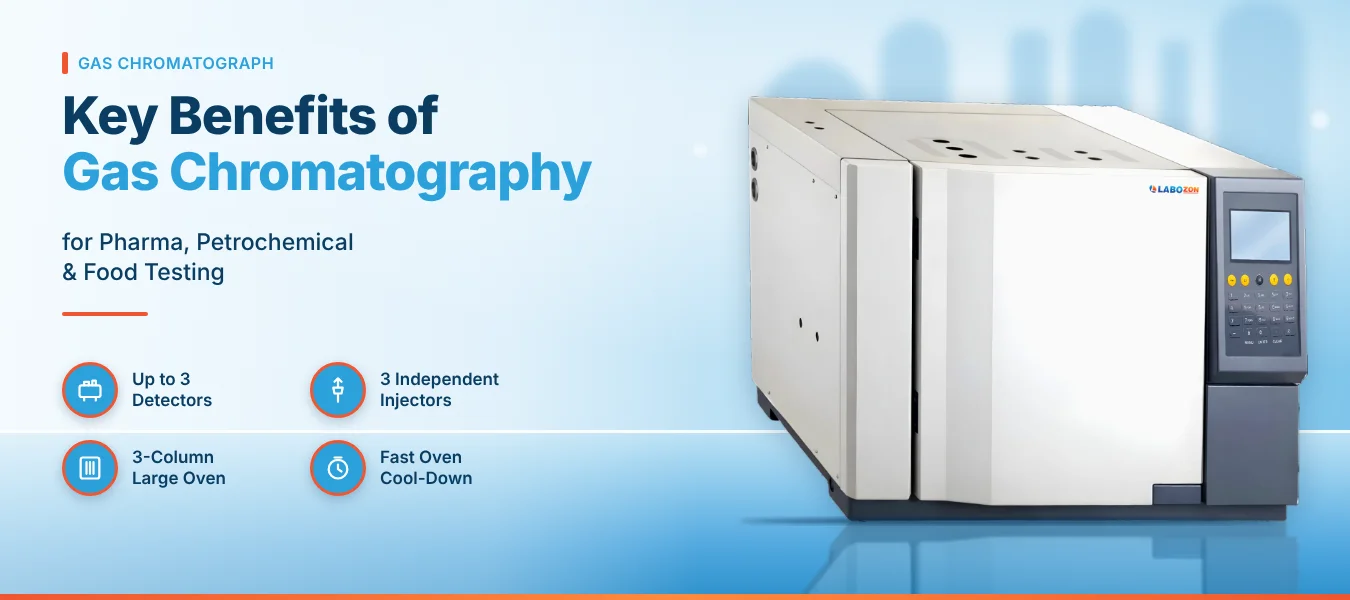
The Labozon Gas Chromatography LZ-GC-A100 is a desktop and tabletop gas chromatography machine with a flame ionization detector as its main channel. Its published specifications are summarized below.
| Feature | Specification |
|---|---|
| Detectors | TCD, FID, FPD and NPD available; up to three installed together |
| Injectors | Three, each with independent temperature control |
| Oven | Holds three columns; up to 400°C; ramp rate 0.1°C to 40°C per minute |
| Programming | 7 ramps, or 10 with the control workstation |
| Temperature accuracy | ±0.02°C |
| Cool-down | 400°C to 50°C in 8 to 10 minutes |
| Protection | Self-diagnosis, overheat protection and power-off protection |
| Options | AutoSampler for unattended batches |
| Weight and size | 70 kg; 340 × 345 × 281 mm |
The quick cool-down matters in practice, because the oven becomes ready for the next method sooner.
Portable, Desktop and Mass Spectrometry Formats
Instrument format shapes what a laboratory can do with it. The overview below separates the three formats buyers meet most often.
| Format | Suited to | Limitation |
|---|---|---|
| Portable gas chromatography | Field screening and on-site checks | Smaller oven and fewer detector options |
| Desktop unit | Routine bench work with several columns and detectors | Needs bench space and a fixed gas supply |
| Gas chromatography mass spectrometry | Naming unknown compounds | More complex to operate and maintain |
The LZ-GC-A100 weighs 70 kg, so it belongs on a laboratory bench rather than in the field.
Selection Mistakes That Waste Time Later
Gas chromatography equipment is often chosen in a hurry, and the same errors appear again and again.
- Judging the instrument by its detector alone, and overlooking oven range, ramp rate, column count and injector count.
- Choosing a detector before listing the target compounds, which can leave a key analyte unseen.
- Ignoring the carrier gas and consumables each detector needs.
- Skipping software review, although data handling affects each batch report.
- Buying a larger system than the sample load needs, or a smaller one that limits future methods.
When two models look close, the chromatography category page lets buyers read their specifications side by side before deciding.
User Tips and Recommended Practices
- Condition new columns with gentle heating before analysis to lower baseline noise.
- Use clean carrier gas, since impurities raise noise and shorten column life.
- Check fittings for leaks after changing a column or septum.
- Replace septa on schedule to prevent ghost peaks and drift.
- Run a blank first to confirm a clean baseline.
- Keep ramps modest, because slower ramps usually separate peaks better.
- Control injection volume to avoid overloaded peaks.
- Log method, column and gas settings with each run.
- Let the oven cool before opening it.
Exploring the Wider Chromatography Category
The LZ-GC-A100 sits in the chromatography category, which groups gas chromatographs, liquid chromatography instruments and related accessories used in pharmaceutical, petrochemical, food and environmental laboratories. Buyers usually review detector range, column capacity, temperature programming, automation options and software.
The full Labozon chromatography range shows these instruments together, and the Labozon home page opens the other laboratory equipment groups.
Name: Olivia Carter – Labozon
Specialty: Laboratory Equipment, Scientific Technology, and SEO Content Writing
Writing Style: Professional, informative, research-driven, and reader-friendly.
Bio: Olivia Carter is a content writer at Labozon, specializing in laboratory equipment, scientific technologies, and laboratory applications. She creates informative, SEO-focused blog articles that highlight product features, explain key benefits, and explore the practical uses of scientific instruments. Her goal is to present technical information in a clear, accurate, and accessible manner, helping laboratory professionals, researchers, and science enthusiasts make informed decisions.
See the full specification of the Gas Chromatography LZ-GC-A100.
Explore Gas Chromatography LZ-GC-A100Related Products


Looking for gas chromatography?
Compare available models, review product specifications, and contact the Labozon team for assistance in identifying equipment that matches your laboratory requirements.