
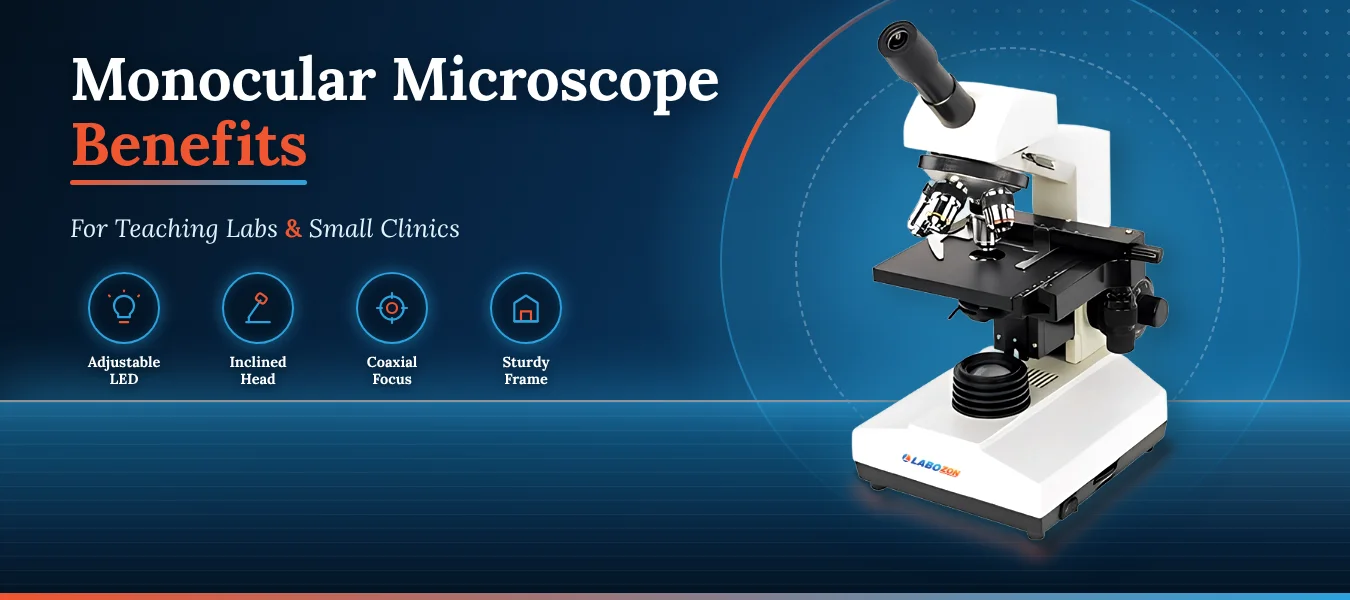
A Monocular Microscope keeps slide observation direct and approachable. This guide explains how the optics work, which parts matter, where the instrument fits in laboratories, hospitals, research centers, and advanced labs, and how to choose and care for it.
How Light Becomes a Magnified Image
A compound Monocular Microscope passes light through a thin specimen, magnifies it with an objective lens, and enlarges it again at the eyepiece. Because two lens stages cooperate, the design is called a compound microscope, or a compound light microscope when the focus is on its illumination path.
Laboratories group it with the biological microscope family because it is made for slide-based observation. A single viewing tube keeps the optical path short, which is why a laboratory Monocular Microscope suits first lessons and routine slide review. Readers searching for monocular and microscope basics usually want exactly this clear starting point.
Seeing the field with one eye lets learners concentrate on focus and lighting, and instructors can compare views simply by taking turns at the eyepiece.
Monocular Microscope Parts and Diagram
Knowing the Monocular Microscope parts speeds up training and troubleshooting. The Monocular Microscope Diagram follows the path from the eyepiece at the top to the light source in the base.
Eyepiece
A wide-angle ocular lens gives a comfortable field of view.
Inclined Head
Tilted and rotatable, so posture can change during long sessions.
Nosepiece
A quadruple nosepiece holds semi-plan achromatic objectives.
Stage
A dual-layer mechanical platform holds and moves slides smoothly.
Condenser
The Abbe condenser adds an aperture diaphragm and a filter.
Focus Knobs
Coaxial coarse and precision focus sit together.
Illumination
LED lighting with adjustable brightness, plus a plan-concave mirror.
Frame
A sturdy aluminum frame suits busy benches.
Where the Instrument Earns Its Place
The product page lists education, biological research, medical diagnostics, agriculture, and quality control as core applications. These Monocular Microscope uses reach across very different benches, and the uses of Monocular Microscope work are easiest to compare by setting.
Teaching Labs
A Monocular Microscope lets learners practice slide handling, focusing, and lighting control on simple, repeatable hardware.
Small Clinics
Staff review specimens between appointments on a Monocular Microscope with controls that are quick to learn.
Hospital Laboratories
Medical diagnostics benches use a Monocular Microscope for routine specimen checks.
Research Centers
Biological research teams rely on a Monocular Microscope for routine specimen observation.
Advanced Labs
A Monocular Microscope serves as a routine bench companion beside specialized instruments.
Agriculture and Quality Control
Close examination of samples in agricultural and quality control work.
Common Selection Mistakes
Chasing the highest magnification
Total magnification on a Monocular Microscope depends on pairing the right objective with the right eyepiece. Optical clarity at working power matters more than the headline figure.
Overlooking illumination control
Adjustable LED brightness helps match lightly and densely stained slides. A fixed light source forces compromises in contrast.
Ignoring stage and focus handling
A dual-layer mechanical stage and coaxial coarse and precision focus decide how smoothly slides are scanned during long sessions.
Forgetting future needs
Optional phase contrast kits, dark field attachments, and a polarization set extend the Monocular Microscope. Planning for them early avoids replacing it later.
Overlooking power and space planning
Benches with few outlets benefit from the rechargeable battery that supports the LED illumination, and the power supply accepts a wide range of mains voltages.
Skipping the wider range
A monocular head suits individual viewing. Labs that need group viewing or image capture should compare other instruments across the wider microscope range before deciding.
Included Setup vs Optional Upgrades
The Labozon Monocular Microscope arrives with a defined optical train, and several elements can be upgraded as needs grow.
| Feature | Included | Optional |
|---|---|---|
| Eyepiece | Wide-angle, ten times | Wide-field, sixteen times |
| Objectives | Semi-plan achromatic: four, ten, and forty times | Achromatic and plan achromatic ranges |
| Nosepiece | Quadruple | Quintuple |
| Illumination | Adjustable LED | Adjustable halogen light |
| Contrast methods | Abbe condenser with filter | Phase contrast, dark field, polarization |
| Total magnification | Up to one thousand times | Up to sixteen hundred times |
Reading the table from left to right shows how a basic teaching setup grows into a contrast-capable research setup.
Exploring the Wider Microscope Category
Monocular models belong to a broad microscope category that also includes stereo, biological, digital, fluorescence, polarizing, metallurgical, comparison, and confocal designs, along with microscopic cameras and slide scanners. Labs comparing options typically weigh viewing configuration, optical quality, illumination type, stage handling, accessory range, and power requirements.
The Labozon microscope category page lays out the full range for that review, and the Labozon Home Page leads to the rest of the laboratory equipment catalog.
User Tips and Recommended Practices
These habits protect the optics and keep sessions productive in both teaching and clinical settings.
User Tips
- Start on the lowest power objective, center the specimen, then step up.
- Use coarse focus on low power only, then switch to precision focus.
- Adjust the aperture diaphragm of the Abbe condenser to improve contrast.
- Raise LED brightness gradually to reduce eye fatigue.
- Keep both eyes open while viewing and rotate the head for comfort.
- Secure slides flat on the stage before changing objectives.
Recommended Practices
- Clean lenses with lens tissue and lens cleaner only.
- Return the nosepiece to the lowest power objective before storage.
- Recharge the battery on a regular routine so the LED stays ready.
- Choose the anti mold option for humid rooms and cover the instrument when idle.
- Carry the Monocular Microscope with one hand on the arm and the other under the base.
- Wipe the stage and base after use.
Ready to Review the Specifications?
Open the product page for full details on Monocular Microscope optics, stage, focus, and optional accessories.
Name: Olivia Carter – Labozon
Specialty: Laboratory Equipment, Scientific Technology, and SEO Content Writing
Writing Style: Professional, informative, research-driven, and reader-friendly.
Bio: Olivia Carter is a content writer at Labozon, specializing in laboratory equipment, scientific technologies, and laboratory applications. She creates informative, SEO-focused blog articles that highlight product features, explain key benefits, and explore the practical uses of scientific instruments. Her goal is to present technical information in a clear, accurate, and accessible manner, helping laboratory professionals, researchers, and science enthusiasts make informed decisions.
Linked.in
Related Products


Looking for Monocular Microscope?
Compare available models, review product specifications, and contact the Labozon team for assistance in identifying equipment that matches your laboratory requirements.