
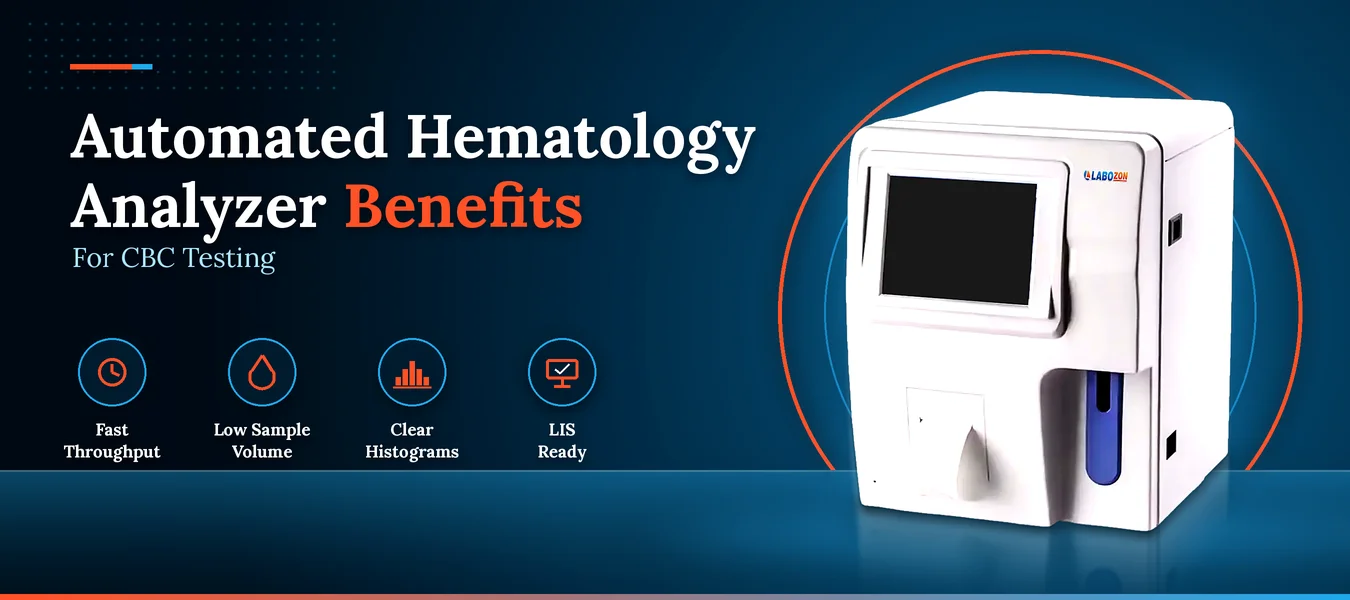
A complete blood count is a routine test in many laboratories, and the instrument behind it shapes how quickly and clearly results reach the care team. This guide explains how an automated hematology analyzer fits into modern CBC testing, using the 3 Parts Hematology Analyzer LZ-HTA-B110 as a working example.
Why CBC Workflows Are Moving Toward Automation
A complete blood count analyzer replaces repetitive manual steps with measured, repeatable processing, so each sample follows the same path from loading to report.
A cbc blood test analyzer also pairs numeric values with histograms, giving technologists more context than a single total count. Within this family, a 3 part cbc analyzer separates white blood cells into three groups, which adds useful detail to routine testing. That balance explains why a 3 part cbc machine remains a familiar sight in busy laboratories.
Where Blood Analyzers Are Put to Work
Hematology analyzer uses reach well beyond a single department. Labozon notes that these instruments are widely used for testing blood components in medical labs, zoo and veterinary labs, research labs, medical institutes, and clinical laboratories.
Medical Labs
Routine blood component testing on patient samples.
Clinical Laboratories
Steady CBC workflows where results must be readable at a glance.
Medical Institutes
Blood testing within institutional diagnostic settings.
Research Labs
Blood component measurement that supports study work.
Zoo and Veterinary Labs
Blood testing for animal care, as listed on the product page.
Understanding the 3-Part Hematology Analyzer Principle
The 3-part hematology analyzer principle rests on two measurement methods. The Labozon model counts cells by electrical resistance and measures hemoglobin with the SFT method.
So how does a 3 parts hematology analyzer work in practice? Once a sample is loaded, red blood cells and platelets are counted, white blood cells are separated into three groups, and hemoglobin is measured. Results appear as numeric values together with three color histograms for WBC, RBC, and PLT. A 3 part hematology analyzer machine of this type can then print the report, store it, or pass it along to a laboratory information system.
Practical Gains in Daily Testing
An automated hematology analyzer earns its place through a handful of practical gains rather than a single headline feature.
Higher throughput
Automated sample handling and cleaning reduce manual effort, so a busy bench keeps moving while staff focus on review.
Flexible sample volume
Venous, capillary, and pre-diluted modes run on a very small sample volume, which helps when blood is limited, as with children and neonates.
Consistent results
Automation limits the variation that comes from manual handling, so reports look alike from one run to the next.
Built-in quality control
X-B, L-J, SD, and CV% tools, with manual or automatic calibration, let a laboratory follow performance over time.
Connected data handling
Large result storage that includes histograms, external barcode scanner support, and LIS linking keep records organized.
Simple operation
A color touchscreen leads the workflow, a mouse and keyboard can be added, and a built-in thermal printer offers various printout formats.
Exploring the Wider Hematology Analyzer Category
The hematology analyzer category at Labozon gathers instruments that count and classify blood cells for routine and specialized testing. The range listed beside the LZ-HTA-B110 includes both three part and five part analyzers, along with veterinary versions.
When evaluating options here, laboratories typically compare how finely white blood cells are differentiated, which sample modes are supported, how much result storage is available, which interfaces are included, and what quality control tools come with the instrument.
A hematology bench rarely works alone. Centrifuges, microscopes, and slide stainers from the wider Labozon laboratory equipment range often sit beside it, so reviewing them together helps a laboratory plan a complete workspace.
Common Selection Mistakes
Reading specifications side by side across the full set of hematology analyzer models makes most of these gaps easier to spot.
Matching only on parameter coverage
A long parameter list says little about sample handling. Check whether venous, capillary, and pre-diluted modes are supported, especially for small-volume work.
Overlooking connectivity
Confirm LIS linking, barcode scanner support, and the available USB, serial, ethernet, and VGA ports before the instrument reaches the bench.
Skipping the quality control review
Look at which quality tools are built in and whether calibration can be manual, automatic, or both.
Ignoring installation conditions
Compare the stated working temperature and humidity range with the room the analyzer will occupy, and measure the bench against the instrument footprint.
Forgetting reference groups and reports
Reference value settings for male, female, children, and neonate groups, along with printout formats, shape how usable the final report is.
Good Practices for Routine Use
- Walk each operator through the touchscreen workflow, including the optional mouse and keyboard, before routine runs begin.
- Confirm that the selected sample mode matches the tube or sample type before starting a run.
- Read the histograms next to the numbers. An unusual curve is a prompt to recheck the sample.
- Record calibration dates and quality control results in a simple log kept beside the instrument.
- Keep spare thermal paper close by and pick a printout format that suits the report audience.
Final Takeaways
An automated hematology analyzer shortens the path from sample to readable report, and a 3 part hematology analyzer keeps that path focused on routine needs. Matching sample modes, connectivity, and quality control tools to the way a laboratory actually works matters more than any single specification.
Name: Olivia Carter – Labozon
Specialty: Laboratory Equipment, Scientific Technology, and SEO Content Writing
Writing Style: Professional, informative, research-driven, and reader-friendly.
Bio: Olivia Carter is a content writer at Labozon, specializing in laboratory equipment, scientific technologies, and laboratory applications. She creates informative, SEO-focused blog articles that highlight product features, explain key benefits, and explore the practical uses of scientific instruments. Her goal is to present technical information in a clear, accurate, and accessible manner, helping laboratory professionals, researchers, and science enthusiasts make informed decisions.
Looking for Automated hematology analyzer?
Compare available models, review product specifications, and contact the Labozon team for assistance in identifying equipment that matches your laboratory requirements.