
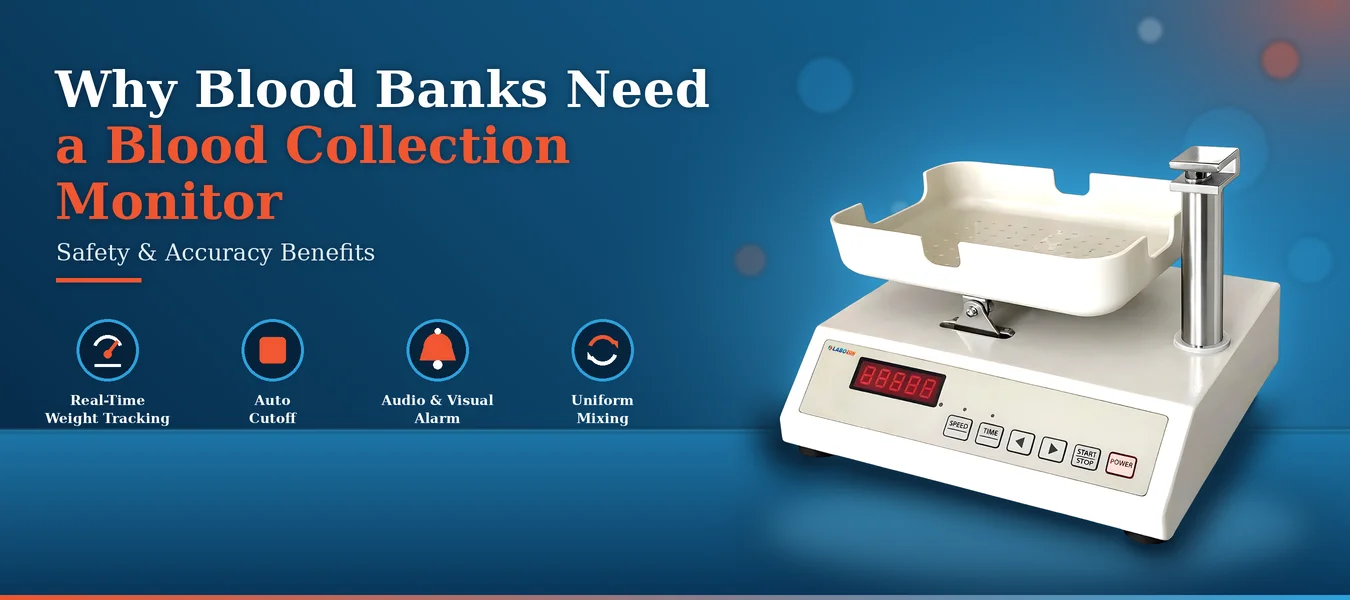
A donation moves quickly, yet the volume in each bag still needs careful tracking. This guide shows how a Blood Collection Monitor supports laboratory, hospital, research center, and advanced lab teams during donor procedures.
Where Collection Accuracy Starts
Each donation depends on a bag reaching the required volume. When staff judge the fill level by eye, small differences creep in from one shift to the next, and attention drifts away from the donor. A Blood Collection Monitor moves that task to a unit that tracks volume while blood flows into the bag.
The Blood Collection Monitor LZ-BCM-B110 from Labozon is one such unit. It stays connected with the blood bag during the procedure, follows the rise in bag weight, and stops collection at the required level. For teams that treat blood collection equipment as part of a repeatable routine, this gives each session the same clear measuring step.
How the Unit Works at the Donor Chair
The principle is simple. The bag rests on the unit, and the unit reads its weight as blood flows in. Real-time weight tracking turns that rise into a collected volume, shown on the display. Once the target is set through the volume adjustment option, an automatic blood collection monitor runs the sequence on its own, so staff can stay with the donor.
Bag rests on the unit
Weight is tracked
Blood is mixed
Display shows volume
Cutoff and alarm act
Safety Benefits Across the Collection Routine
Safety in collection comes down to predictable control and early warning. Four functions of the unit address this directly.
Controlled finish
The auto cutoff function stops the process after the target volume is reached, so the end point does not rest on timing by eye.
Prompt alerts
An audio and visual alarm with an interrupter draws attention when the team needs to act.
Steady flow
Collection speed runs from half a milliliter to three milliliters per second, which supports a steady draw.
Even mixing
Uniform agitation keeps the collected blood mixed through the draw.
Taken together, an automatic blood collection device removes much of the guesswork that can enter a manual routine.
Accuracy Benefits That Reach the Lab
Accuracy shows up downstream. A bag measured consistently is easier to log, easier to review, and easier to handle in later laboratory steps.
- Real-time weight tracking keeps measurement consistent from the first milliliter to the last.
- Fine measuring accuracy and a display that reads in single milliliter steps make each reading easy to confirm.
- The measuring range reaches up to twelve hundred milliliters, and the volume adjustment option lets staff set different targets for different procedures.
Practical Use Cases
Blood collection monitor uses extend across several settings, and the same unit adapts to each.
Hospital Blood Banks
Staff monitor collection during routine donation procedures.
Blood Donation Camps
In mobile or temporary setups, the unit supports safe monitoring of blood collection.
Clinical Laboratories
The unit supports blood collection and handling processes in clinical and diagnostic laboratories.
Bag Weight Observation
Teams follow the increase in bag weight throughout the donation.
Knowing the blood collection monitor use in each setting helps managers plan placement. A hospital may keep a unit at each donor chair, while a camp team may pack the blood collection monitor machine with the rest of its field kit. In both cases, the blood collection monitor equipment brings the same readable status to the session. Teams that want to see how units differ can also browse the wider range of blood collection monitors.
Common Selection Mistakes
Looking only at the measuring range
A wide range matters, yet display clarity, collection speed, and alarm design shape daily handling just as much.
Overlooking power compatibility
Sites differ in supply. This unit accepts dual voltage at both common frequencies, so confirm the match before a camp or a new room goes live.
Skipping mixing and alerts
A unit without agitation or alarms leaves more work to staff during a busy session.
Forgetting the footprint
A compact body sits easily on a donation bench without crowding the donor area, which matters in small rooms.
Tips for Smooth Daily Operation
Recommended practices come straight from how the unit is designed to work.
- Set the target first through the volume adjustment option, before the donor procedure begins.
- Keep the unit connected with the blood bag during the procedure, and check the setup before starting.
- Glance at the display during the draw and confirm that the reading rises steadily.
- Train each team member on what the audio and visual alarm means.
- Use a steady bench, since the swing action mixes the blood.
- Write a short routine for setup, monitoring, and cleanup, and hold refresher sessions for new and experienced staff.
Manual Judgment and Automatic Monitoring Side by Side
| Aspect | Manual judgment | Automatic monitoring |
|---|---|---|
| Volume reading | Estimated by eye | Tracked by weight in real time |
| End point | Depends on staff timing | Auto cutoff at the set level |
| Mixing | Handled by hand | Uniform agitation during the draw |
| Alerts | Rely on observation | Audio and visual alarm |
| Session to session | Varies between shifts | Same measuring step each time |
Exploring the Wider Product Category
The LZ-BCM-B110 belongs to a family of bedside units that track and control the volume of blood drawn into a bag during donation. This family sits within the broader range of blood bank equipment used by hospital blood banks, donation camps, and clinical laboratories. Facilities reviewing options usually weigh measuring range, accuracy, display clarity, flow rate, alarm design, agitation, power input, and size. The full range of blood collection monitors makes it easy to review those points across models, including the LZ-BCM-B100. For wider laboratory needs, the Labozon home page lists the other instrument groups on offer.
Name: Olivia Carter – Labozon
Specialty: Laboratory Equipment, Scientific Technology, and SEO Content Writing
Writing Style: Professional, informative, research-driven, and reader-friendly.
Bio: Olivia Carter is a content writer at Labozon, specializing in laboratory equipment, scientific technologies, and laboratory applications. She creates informative, SEO-focused blog articles that highlight product features, explain key benefits, and explore the practical uses of scientific instruments. Her goal is to present technical information in a clear, accurate, and accessible manner, helping laboratory professionals, researchers, and science enthusiasts make informed decisions.
See how the unit fits your collection routine.
Explore the LZ-BCM-B110Related Products

Looking for blood collection monitor?
Compare available models, review product specifications, and contact the Labozon team for assistance in identifying equipment that matches your laboratory requirements.