
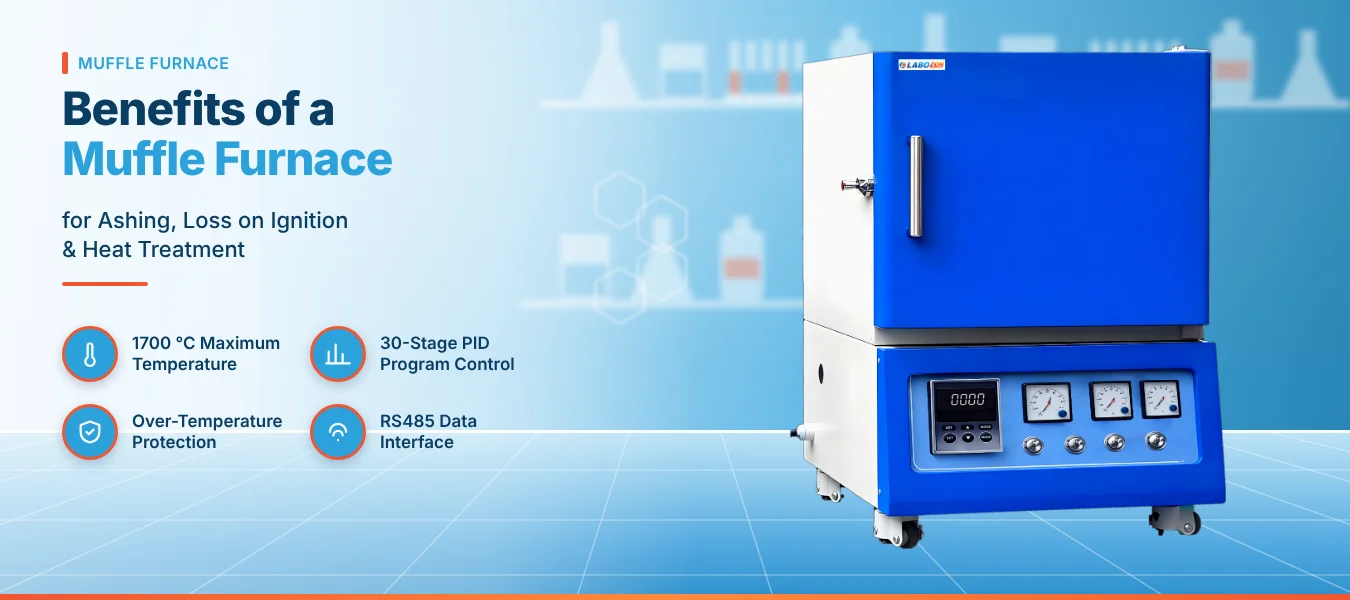
A crucible goes in with a weighed sample and comes out with a few milligrams of ash, and those few milligrams decide whether a batch moves forward or a coal lot is approved for use. A Muffle Furnace makes that result repeatable by heating the sample in a closed chamber, away from flame and combustion gases. This guide explains how it works, where it is used and what to review in the Labozon Muffle Furnace LZ-MFF-A401.
Working Principle and Chamber Layout
The muffle furnace working principle is simple. Electric heating elements warm the chamber walls, and heat reaches the sample by radiation, convection and conduction. A thermocouple reads the chamber temperature, and a controller adjusts power to hold the set point.
An electric muffle furnace keeps the sample in a sealed chamber, so no flame or combustion gas touches it. That separation is what makes weighing the leftover ash meaningful.
What Ash Content Tells Pharma and Coal Labs
A muffle furnace is used for burning off the organic part of a sample so the non-volatile, non-combustible fraction can be weighed. In a pharmaceutical lab, that ash value shows inorganic residue in raw materials, excipients and herbal products, and it can flag contamination early.
In a coal lab, proximate analysis reports moisture, volatile matter, ash and fixed carbon. The furnace handles the ash step, and the ash value affects heating value and handling. A muffle furnace laboratory therefore needs even heat, tight temperature control and repeatable runs.
Applications Beyond Ashing
Muffle furnace uses extend well past ash content, and each muffle furnace application relies on clean, high heat.
Loss on Ignition
Soil, cement and mineral samples lose weight as organic matter burns away.
Heat Treatment
Small metal parts are hardened or tempered in the closed chamber.
Ceramics and Glass
Samples are fired or dried without direct flame contact.
Calcining
Powders and crucibles are conditioned before weighing.
Key Details of the LZ-MFF-A401
The Labozon Muffle Furnace LZ-MFF-A401 is a compact benchtop lab furnace. Its published details are below.
| Feature | Specification |
|---|---|
| Capacity | 3.6 L, chamber 160 × 150 × 150 mm |
| Maximum temperature | 1700 °C |
| Heating element | MoSi2, phase-shifted trigger |
| Thermocouple | B-type, control accuracy ±1 °C |
| Heating rate | Up to 30 °C/min, recommended 15 °C/min or lower |
| Control | 30-stage program, intelligent PID adjustment |
| Chamber material | Alumina polycrystalline fiber |
| Protection | Over-temperature, door-opening cut-off, over-current, power-off |
| Interface | RS485 communication, software and data cable |
| Surface temperature | 45 °C or lower |
| Electrical supply | 220 V, single-phase, 3 kW |
| Dimensions | 520 × 490 × 880 mm |
Furnace, Oven and Hot Plate Compared
The table below sets three heating tools side by side using typical features.
| Factor | Drying Oven | Muffle Furnace | Hot Plate |
|---|---|---|---|
| Temperature range | Modest | Very high | Moderate |
| Sample exposure | Hot air | Closed chamber, no flame | Open surface |
| Main role | Moisture removal | Ashing, ignition loss | Warming, evaporation |
| Typical fit | Coal moisture step | Coal and pharma ash step | Sample preparation |
Muffle furnace equipment complements an oven rather than replacing it, which is why many labs use both in sequence.
Selection Mistakes That Cause Rework
- Comparing a heating muffle on maximum temperature alone and ignoring chamber size and control accuracy.
- Choosing a chamber too small for the crucible count of a full test batch.
- Skipping a check of the electrical supply against the furnace power draw.
- Overlooking bench clearance and ventilation around a hot cabinet.
- Asking each electric muffle furnace supplier for different figures, which makes offers hard to compare.
Teams that want to compare similar furnaces can start with the Labozon furnace category before shortlisting.
User Tips and Recommended Practices
- Preheat the chamber to the test temperature before loading crucibles.
- Pre-ignite empty crucibles, cool them in a desiccator and record their weight.
- Use a consistent sample mass, because large samples ash unevenly.
- Keep to the recommended heating rate to protect the chamber and avoid spatter.
- Cool crucibles in a desiccator before weighing, since warm crucibles read light.
- Use tongs and high-temperature gloves, and keep the door closed during heating.
- Brush out ash residue after each run.
- Inspect the thermocouple and wiring on a regular schedule.
- Log sample ID, temperature, time and weights for each run.
Exploring Wider Furnace Options
The LZ-MFF-A401 belongs to the laboratory furnace category, which covers muffle, tube and ashing furnaces in several chamber sizes and temperature ranges. Buyers usually compare maximum temperature, chamber volume, heating element type, control stages, safety protection and data output.
The full Labozon furnace range shows these units together, and the Labozon home page opens the other laboratory equipment groups.
Name: Olivia Carter – Labozon
Specialty: Laboratory Equipment, Scientific Technology, and SEO Content Writing
Writing Style: Professional, informative, research-driven, and reader-friendly.
Bio: Olivia Carter is a content writer at Labozon, specializing in laboratory equipment, scientific technologies, and laboratory applications. She creates informative, SEO-focused blog articles that highlight product features, explain key benefits, and explore the practical uses of scientific instruments. Her goal is to present technical information in a clear, accurate, and accessible manner, helping laboratory professionals, researchers, and science enthusiasts make informed decisions.
Linked.in
See the full specification of the Muffle Furnace LZ-MFF-A401.
Explore Muffle FurnaceRelated Products


Looking for muffle furnace?
Compare available models, review product specifications, and contact the Labozon team for assistance in identifying equipment that matches your laboratory requirements.