
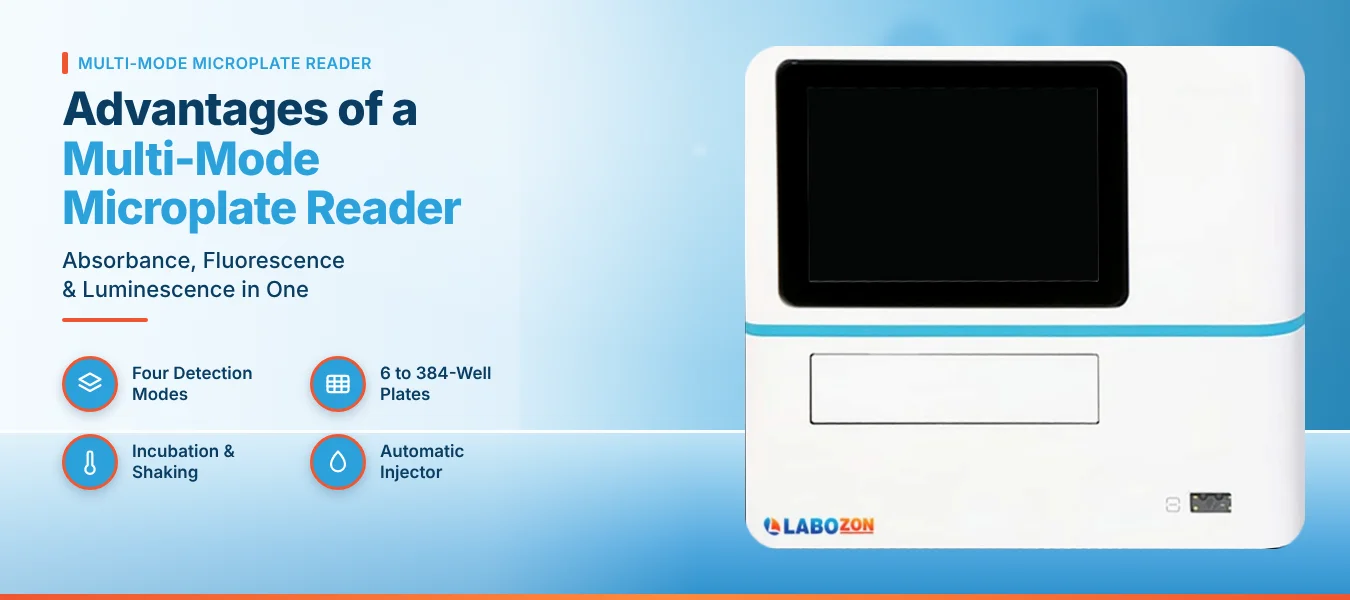
Plate-based assays rarely stay with one readout. A color change may need a fluorescent check, and a reporter assay may need a glow signal. A multi-mode microplate reader covers those readouts in one benchtop unit. This guide explains how it works, where it fits, and what to check when evaluating the Multi-Mode Microplate Reader LZ-MMR-A100.
From Three Instruments to One
A lab that runs plate assays often ends up with separate instruments for color, fluorescent labels and glow signals. Each one needs bench space, software and upkeep, and each one reads plates a little differently.
A multimode reader, sometimes called a multi microplate reader, brings those readouts together, so a plate can move from one detection method to another without changing hardware or file formats.
How Does a Microplate Reader Work?
A light source or a chemical reaction produces a signal in each well, a detector measures it, and software turns the reading into a number for each well.
In absorbance, light passes through the sample and the detector records how much was taken up. In fluorescence, light of one color excites a label, and the detector records the longer-wavelength light that returns. In luminescence, no excitation is needed, because the reaction itself emits light.
Multi-Mode Reader Principle
The multi-mode reader principle is that one optical path and one detector can serve several detection methods when wavelength selection and read geometry change with the mode.
The LZ-MMR-A100 uses a xenon lamp and a photomultiplier tube detector. Absorbance runs through a monochromator, fluorescence uses filters, and luminescence reads the glow signal directly.
Multi Mode Detection Explained
Multi mode detection gives one instrument several ways to read the same plate.
Absorbance
Colorimetric assays, protein and nucleic acid quantification.
Fluorescence
Labeled molecules and cell-based assays, read from the top.
Luminescence
Reporter genes and ATP-based assays with faint signals.
Time-Resolved
Lanthanide labels, where a read delay cuts background light.
Microplate Reader Uses Across the Lab
Microplate reader uses reach across molecular biology, biochemistry, cell biology, drug discovery and clinical research. Multimode microplate reader uses go further, because one plate can follow an assay from a color readout to a fluorescent or luminescent confirmation.
Teams that once booked three instruments can keep a single plate in one place from start to finish, which also keeps plate-handling steps to a minimum.
Specifications of the LZ-MMR-A100
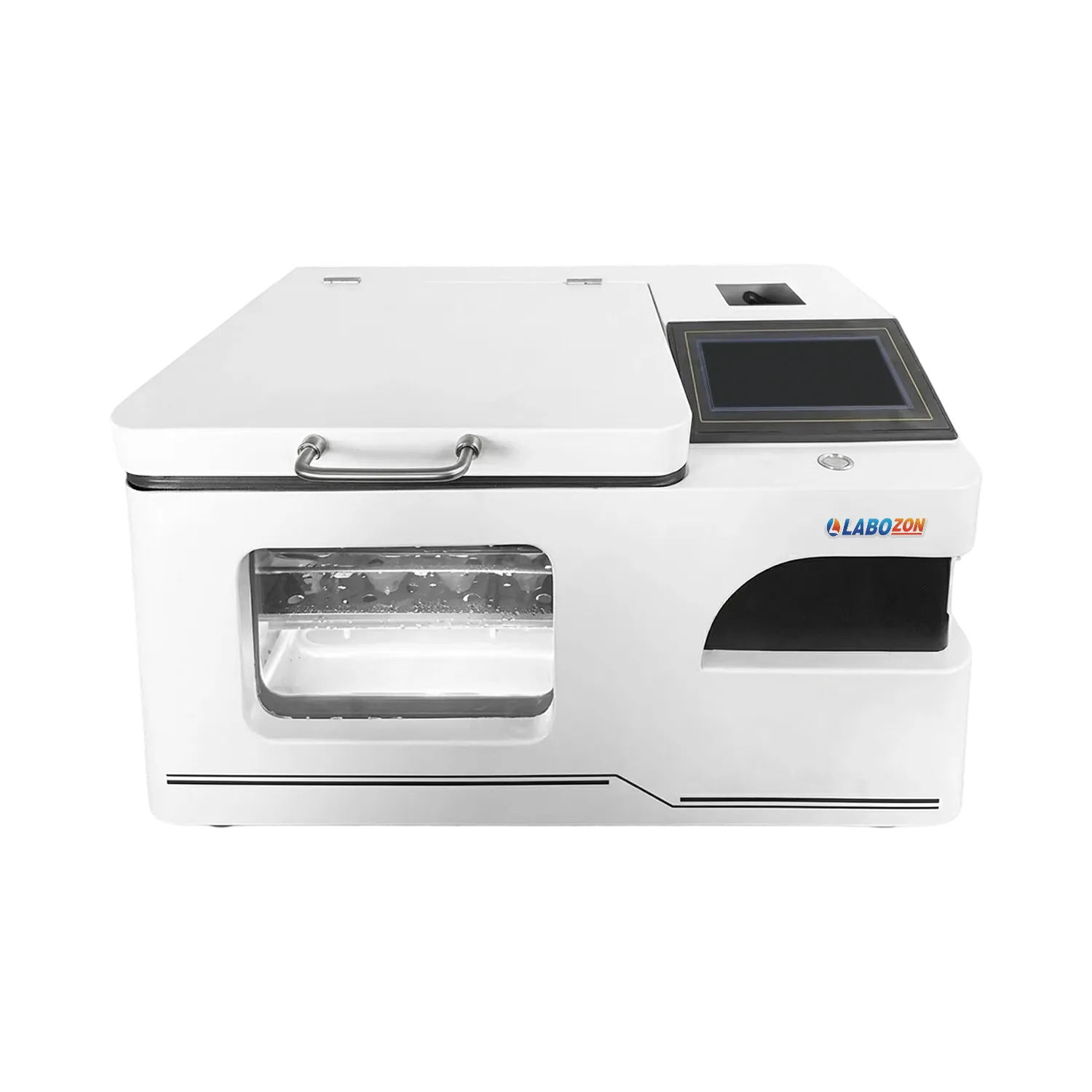
The Labozon Multi-Mode Microplate Reader LZ-MMR-A100 pairs a capacitive touch screen with Reader It-II analysis software. Its published details are below.
| Feature | Specification |
|---|---|
| Detection modes | Absorbance, fluorescence, luminescence, time-resolved fluorescence |
| Optics | Xenon lamp; monochromator for absorbance; filters for fluorescence; PMT detector |
| Wavelength range | Absorbance 200 to 1000 nm; fluorescence excitation 200 to 1000 nm and emission 270 to 850 nm; luminescence 200 to 850 nm |
| Absorbance performance | Readings in steps of 0.0001 OD; linearity R² ≥ 0.999 from 0 to 3 Abs |
| Dynamic range | More than 6 orders of magnitude |
| Plates | 6 to 384 wells; 96-well read in under 15 seconds in fast mode |
| Incubation and shaking | Room temperature plus 4 °C to 45 °C, ±0.5 °C at 37 °C; linear, annular and double-annular shaking |
| Injection | Automatic injector |
| Data and connectivity | 10 GB storage; FTP upload to a PC server; USB and Ethernet ports |
| Power | AC 100 to 240 V, 50 to 60 Hz |
| Size and weight | 420 × 550 × 386 mm; 33 kg |
Running a Plate from Load to Result
A typical read follows seven steps:
- Warm the instrument and set the incubation temperature.
- Choose the plate format in the software.
- Load the plate flat in the carrier.
- Select the detection mode and wavelength settings.
- Choose shaking and injection options if the assay needs them.
- Start the read and let the carrier finish.
- Review the data and save the protocol.
Selection Mistakes That Waste Time Later
- Choosing on the mode list alone and ignoring sensitivity, wavelength range and detector type.
- Overlooking plate formats, temperature control and injection.
- Treating software as an afterthought, even though analysis tools shape daily workflow.
- Skipping bench space and weight when planning where the instrument will sit.
- Forgetting the plate-washing step that often comes before the read.
Labs that also wash plates can review readers and washers together on the microplate reader and washer category page before deciding.
User Tips and Recommended Practices
- Warm the instrument for a few minutes before the first read so the lamp output settles.
- Use black plates for fluorescence, white plates for luminescence and clear plates for absorbance.
- Check that the plate sits flat in the carrier before each run.
- Match the shaking mode to the assay: gentle for cell work, stronger for mixing reagents.
- Set the incubation temperature before loading the plate and let it stabilize.
- Include blank wells on each plate to correct for background signal.
- Keep the plate carrier and optics free of dust and spills.
- Save the protocol for each assay so later runs follow the same settings.
Exploring the Wider Microplate Reader Range
The LZ-MMR-A100 belongs to the microplate reader and washer category, which groups absorbance readers, multimode plate readers and plate washers. Buyers usually review detection modes, wavelength range, plate formats, incubation, injection and software.
The full Labozon microplate reader and washer range shows these units together, and the Labozon home page opens the other laboratory equipment groups.
Name: Olivia Carter – Labozon
Specialty: Laboratory Equipment, Scientific Technology, and SEO Content Writing
Writing Style: Professional, informative, research-driven, and reader-friendly.
Bio: Olivia Carter is a content writer at Labozon, specializing in laboratory equipment, scientific technologies, and laboratory applications. She creates informative, SEO-focused blog articles that highlight product features, explain key benefits, and explore the practical uses of scientific instruments. Her goal is to present technical information in a clear, accurate, and accessible manner, helping laboratory professionals, researchers, and science enthusiasts make informed decisions.
Linked.in
See the full specification of the Multi-Mode Microplate Reader LZ-MMR-A100.
Explore Multi-Mode Microplate ReaderRelated Products
Looking for multi-mode microplate reader?
Compare available models, review product specifications, and contact the Labozon team for assistance in identifying equipment that matches your laboratory requirements.