
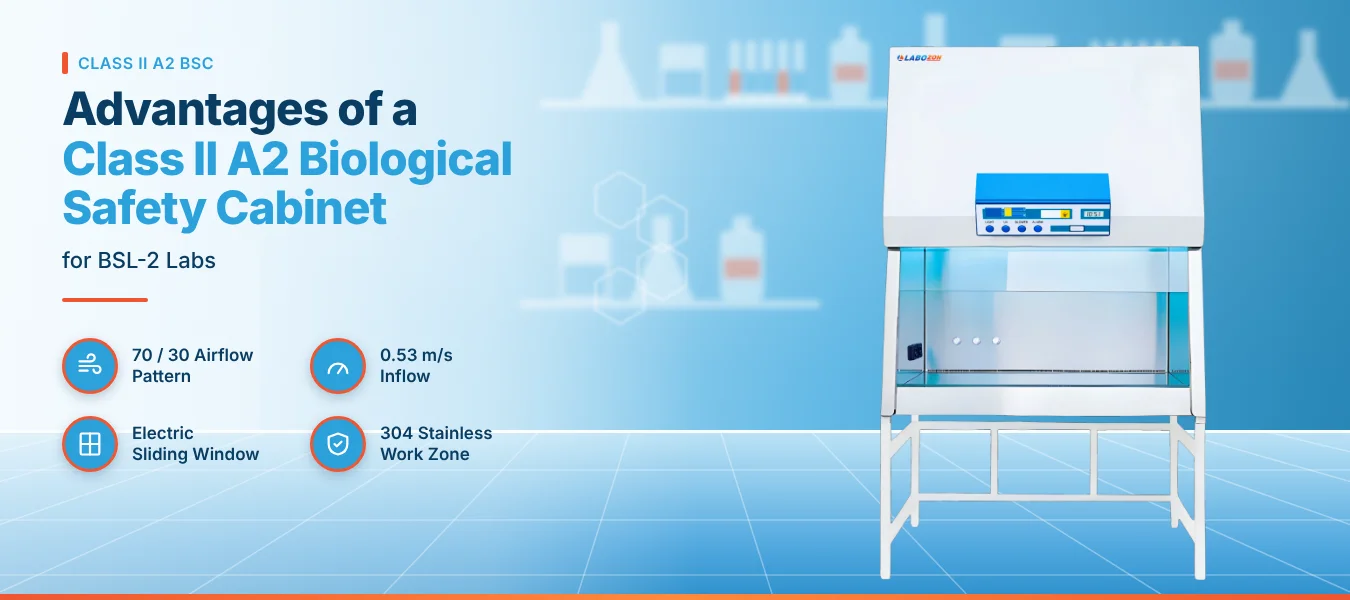
Work at Biosafety Level 2 involves agents of moderate hazard: cell cultures, clinical specimens and microbial samples that can cause harm through splashes, aerosols or accidental contact. A Class II A2 biological safety cabinet is the primary barrier for that work, protecting the operator, the sample and the room. This guide explains how it works, where it fits and what to check when evaluating the A2 Biological Safety Cabinet LZ-BSC-A220.
What a Class II Cabinet Does
A class II cabinet has an open front, an inward airflow at the opening and filtered downward airflow over the work surface. Together those streams keep room air away from the sample and keep aerosols inside the cabinet.
In daily talk the same unit goes by several names: a BSC class II, a biological safety cabinet class II or a class II type A2 biosafety cabinet. All describe a front-opening cabinet with filtered airflow, and the A2 label points to its airflow pattern.
Working Principle and Airflow Diagramr
The biological safety cabinet working principle rests on three airflows. Room air enters through the front grille, which shields the operator. A blower then sends filtered air down over the work zone, which shields the sample.
Most of that air recirculates and a smaller share is exhausted through a filter, which protects the room. The LZ-BSC-A220 lists a 70% recirculated and 30% exhausted split, an inflow of 0.53 m/s and a downflow of 0.35 m/s.
Why BSL-2 Work Favors This Design
Four traits explain the match between BSL-2 procedures and this cabinet type.
Operator Protection
Inward airflow at the front opening.
Sample Protection
Filtered downflow over the work zone.
Room Protection
Exhaust air passes through a filter.
Front Access
Room for both hands during long procedures.
Routine Laboratory Uses
Typical biological safety cabinet uses include cell culture, molecular biology setup, clinical specimen handling and microbiology work. The product page lists molecular biology labs, clinical testing rooms, pharmaceutical experiment labs, and pathology and immunology centers.
This cabinet type is built for biological material. Confirm with a safety officer before using any cabinet with volatile hazardous chemicals, since the recirculated air carries vapors back into the work zone.
Specifications of the LZ-BSC-A220
The Labozon A2 Biological Safety Cabinet LZ-BSC-A220 is a front-access cabinet with an electric sliding window and a control panel. Its published details are below.
| Feature | Specification |
|---|---|
| Air pattern | 70% recirculated, 30% exhausted |
| Inflow velocity | 0.53 m/s |
| Downflow velocity | 0.35 m/s |
| Filter efficiency | 99.9995% at 0.1 to 0.2 µm, inflow and downflow (listed as ULPA) |
| Nominal size | 0.9 m |
| Internal work space | 0.54 m² |
| Work zone material | Stainless steel, type 304 |
| Noise | Below 60 dBA |
| Power use | 361 W |
| Supply | 220 V at 50 Hz or 110 V at 60 Hz |
| Optional accessories | Support stand, ultraviolet lamp kits, prefilters, illumination light, active carbon postfilters |
How to Use a Cabinet Correctly
For biological safety cabinet how to use, start by switching on the blower and waiting a few minutes before work. Wipe the work surface with disinfectant, then load only the items needed.
- Place clean items on one side and waste on the other.
- Keep your arms inside and move them in and out slowly.
- Avoid fast movements that pull room air across the opening.
- Close containers before they leave the work zone.
- Wipe down items and the surface again before the blower is switched off.
Class I, A2 and B2 Compared
The table below sets three cabinet types side by side.
| Factor | Class I | Class II A2 | Class II B2 |
|---|---|---|---|
| Operator protection | Yes | Yes | Yes |
| Sample protection | No | Yes | Yes |
| Air handling | Room air drawn in and exhausted | Mostly recirculated | Fully exhausted |
| Typical fit | Operator and room protection | Cell culture and clinical work | Work involving volatile hazards |
Selection Mistakes That Cause Rework
- Comparing biological safety cabinet manufacturers on width alone and ignoring airflow and noise figures.
- Forgetting ceiling height and room clearance around the cabinet.
- Placing the cabinet near doors or air vents that disturb the airflow curtain.
- Overlooking the electrical supply at the bench.
- Skipping a plan for annual airflow and filter testing.
Buyers who want to compare similar cabinets can start with the Class II A2 cabinet category before shortlisting.
User Tips and Recommended Practices
- Switch the cabinet on for a few minutes before starting work.
- Wipe the work surface with disinfectant before and after each session.
- Load only the items needed so airflow paths stay open.
- Never block the front or rear grille with paper or equipment.
- Work several inches inside the sash opening.
- Move arms in and out slowly and straight.
- Keep open flames out of the cabinet.
- Schedule airflow and filter testing on a regular cycle.
- Record cleaning and maintenance in a logbook.
Exploring Wider Class II Cabinet Options
The LZ-BSC-A220 belongs to the Class II A2 cabinet category, which groups cabinets of this airflow pattern in several widths and configurations. Buyers usually compare work space, airflow velocity, filter type, noise level, lighting, controls and stand options.
The full Labozon Class II A2 cabinet range shows these cabinets together, and the Labozon home page opens the other laboratory equipment groups.
See the full specification of the A2 Biological Safety Cabinet LZ-BSC-A220.
Explore A2 Biological Safety CabinetLooking for class ii a2 biological safety cabinet?
Compare available models, review product specifications, and contact the Labozon team for assistance in identifying equipment that matches your laboratory requirements.