
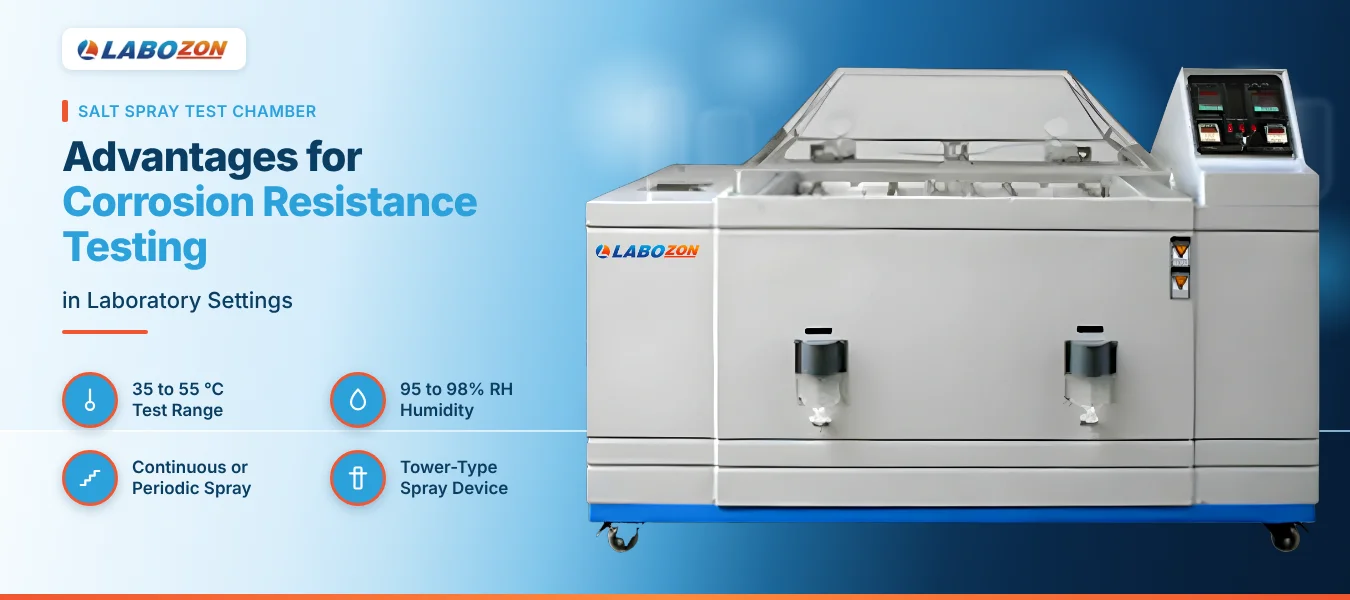
A coating that looks flawless on the line can start to blister after a few weeks near the coast or on a salted road. A Salt Spray Test Chamber compresses that exposure into days of controlled testing, so weaknesses show up before products ship. This guide explains how it works, where laboratories use it and what to review in the Labozon Salt Spray Test Chamber LZ-SSC-A102.
How Salt Fog Is Made and Controlled
Salt spray chamber working starts with salt water. The saline is preheated to chamber temperature, drawn to a nozzle and atomized by compressed air into a fine fog, which a tower-type spray device spreads through the test space.
A heater and an air saturator hold temperature and humidity steady, while a collection funnel and metering cylinder measure how much mist settles on the samples each hour. This is the working principle behind any salt fog test chamber.
Where Laboratories Apply Accelerated Exposure
Salt spray test chamber uses cover many industries because corrosion affects most metal products, and each sample type asks for something different from the test.
Metal Coatings
Zinc, nickel and chrome plating checks.
Painted Parts
Paint and powder coating durability.
Electronics
Components and connectors exposed to salt air.
Hardware
Fasteners, brackets and industrial assemblies.
What Controlled Exposure Adds to Quality Work
A salt spray test chamber use case usually falls into one of three groups: incoming material checks, process control for coating lines and product development. In each case, the lab can compare one coating or process against another under identical exposure.
Because temperature, humidity and spray settings are controlled, differences in rust or blistering reflect the sample rather than the test. Continuous or periodic spray modes suit different test plans, and stable settings make each run easy to document.
A salt spray cabinet in a coating lab also gives early warning. Defects surface before parts reach customers, which supports faster corrective action on the line.
Key Details of the LZ-SSC-A102
The Salt Spray Test Chamber LZ-SSC-A102 uses a PID + SSR microprocessor temperature controller and a tower-type spray device. This salt spray test chamber equipment lists the following published details.
| Feature | Specification |
|---|---|
| Spray modes | Continuous and periodic |
| Temperature range | 35 to 55 °C |
| Temperature fluctuation | ±0.5 °C or less |
| Temperature uniformity | 2 °C |
| Humidity range | 95 to 98% RH |
| Air saturator | Room temperature plus 5 °C to 55 °C |
| Spray deposition | 1 to 2 mL/cm²·h |
| Internal working space | About 330 L |
| Power consumption | 2.5 kW |
| Gross weight | 350 kg |
| Safety and sealing | Electronic and mechanical over-heat protection, water seal between cover and body |
| Body | PVC plate outer body, one-piece liner |
| Accessories | V-type sample shelf, two nozzles, two funnels, metering cylinder |
Accelerated Testing Compared With Field Exposure
The table below sets two common ways of judging corrosion resistance next to each other using typical features.
| Factor | Natural Weathering | Salt Spray Test Machine |
|---|---|---|
| Time to result | Months to years | Days |
| Conditions | Vary with weather | Controlled and repeatable |
| Sample alignment | Hard to align across batches | Identical exposure for all samples |
| Records | Depend on site notes | Logged test settings |
Selection Mistakes That Cause Rework
- Choosing on size alone and ignoring temperature uniformity and humidity range.
- Overlooking how spray deposition is checked and controlled.
- Skipping a check of nozzle type, since crystal buildup blocks fine mist.
- Comparing salt spray test chamber manufacturers on appearance without reviewing safety protection and body material.
- Forgetting floor space and the 350 kg gross weight of the unit.
Teams that want to compare salt spray testing equipment and similar instruments can start with the test chamber category before shortlisting.
User Tips and Recommended Practices
- Prepare fresh salt water from pure water and pure salt, and check its concentration before each test.
- Clean samples to remove oil and fingerprints before loading them.
- Place samples at the specified angle on the V-type shelf and keep them from touching.
- Check spray deposition with the funnels and metering cylinder before and during a run.
- Let the chamber reach its setpoint temperature before loading samples.
- Keep the cover water seal topped up so mist stays inside.
- Clean nozzles and the saline tank after each test.
- Record temperature, humidity, spray mode and run time for each test.
- Rinse and dry the interior after use and leave the cover open to dry.
Exploring Wider Test Chamber Options
The LZ-SSC-A102 belongs to the test chamber category, which covers salt spray, humidity and temperature chambers in several working volumes. Buyers usually compare working space, temperature range and uniformity, humidity range, spray modes, nozzle design and safety protection. A salt spray test chamber machine with adjustable spray periods can cover continuous, periodic and drying steps.
The full test chamber range shows these instruments together, and the home page opens the other laboratory equipment groups.
See the full specification of the Salt Spray Test Chamber LZ-SSC-A102.
Explore Salt Spray Test ChamberLooking for Labozon explains how a salt spray test chamber speeds corrosion resistance testing?
Compare available models, review product specifications, and contact the Labozon team for assistance in identifying equipment that matches your laboratory requirements.