
Powder behavior decides how a tablet fills a die, how a capsule is dosed and how battery material packs into an electrode. A tap density tester measures the settled volume of a powder after a counted number of taps, which gives the tapped value used for flow and packing studies. This guide explains how the instrument works, where it is used and what to check before choosing the Tap Density Tester LZ-TDT-A201.
What Tap Density Actually Tells You
Loose powder traps air between its particles. When the container is tapped under set conditions, the particles shift into those gaps, the volume drops and the density rises. Tap density is the powder mass divided by that settled volume.
A tapped density meter, a tap density meter and a tap density apparatus all describe the same job: repeatable tapping with a counted number of taps. Paired with bulk density, the result becomes a quick indicator of how a powder will flow, compress and pack.
How the Tapping Cycle Works
A tap density tester holds a graduated cylinder in a clamp, lifts it a fixed height and lets it drop onto a base. A motor repeats the movement at a set rate while a counter records each tap.
The operator weighs the powder, pours it into the cylinder, reads the starting volume, taps for a set count and reads the volume again. The cycle repeats until the volume stops changing by more than a small limit.
Why Method Control Matters for USP-Based Work
The USP general chapter on bulk density and tapped density describes how a powder column is tapped and how the result is reported. Following it means matching tap count, drop height, tap rate and cylinder size to the method.
A tap density machine that holds those settings steady lets one analyst repeat another analyst's result, and lets one batch be compared with the next. The instrument supports the method, but the laboratory still owns the written procedure, the calibration and the records.
Advantages in Daily Powder Work
Compared with tapping a cylinder by hand on a bench, a motorized instrument adds control in four places.
Repeatable Taps
The same drop and rate on each run.
Counted Cycles
A counter ends the test at the set tap number.
Analyst Agreement
Results that match between operators and shifts.
Hands-Free Tapping
The operator is free while the run continues.
Practical Uses Across Laboratories
Common tap density tester uses reach well beyond tablets. Pharmaceutical teams use the tapped value to guide capsule filling and tablet compression, and formulation groups use it to compare excipients and spot a change in raw material.
Battery researchers relate the reading to how much active material fits into an electrode. Ceramic and metal powder labs use it to judge packing before pressing or sintering, and pigment and food labs use it to check handling and packaging behavior.
From Tapped Value to Powder Flow
Dividing tapped density by bulk density gives the Hausner ratio, and the related Carr index expresses compressibility as a percentage. A low ratio points to a free-flowing powder. A high ratio points to a cohesive powder that may bridge in a hopper or fill a die unevenly.
Because both figures come from the same sample, the tap density tester becomes the second half of a two-step flow check that takes only a few minutes of bench time.
The LZ-TDT-A201 in a Powder Lab
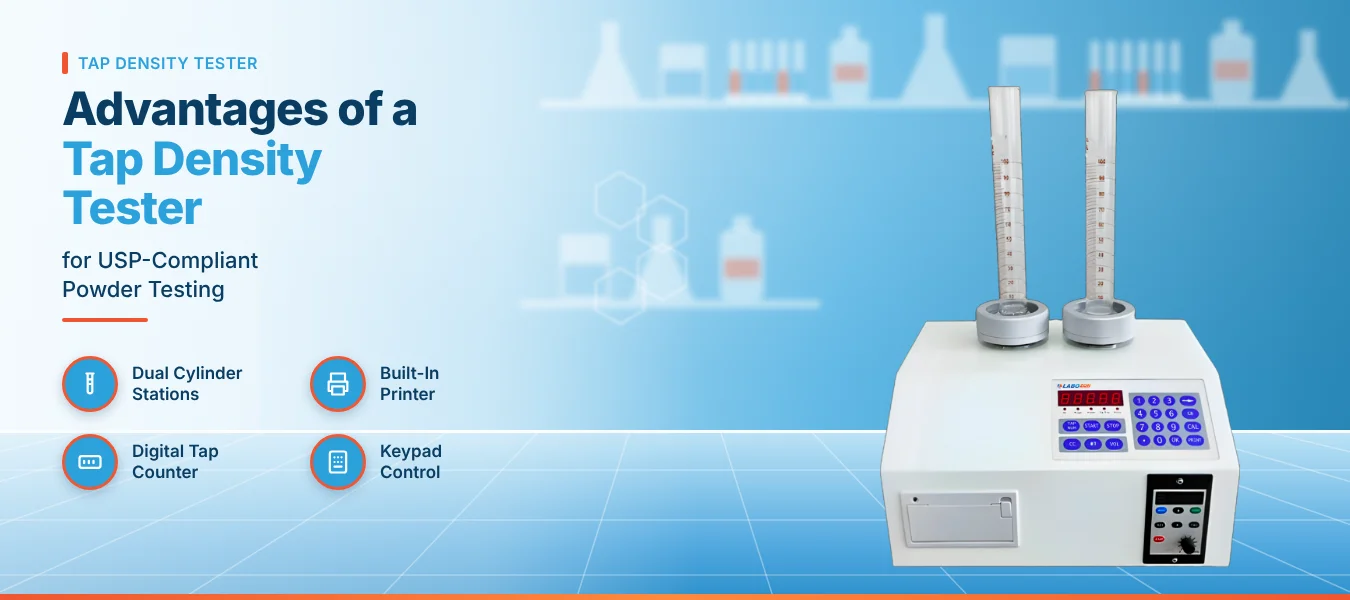
The Labozon Tap Density Tester LZ-TDT-A201 is a laboratory instrument for the routine powder tests described above. Its product photo shows a benchtop-style cabinet with cylinder holders on top, a built-in printer, a keypad and a digital display.
Exact tapping rate, drop height, cylinder sizes and power requirements are listed on the product page. Compare those figures with the written method before the unit is added to a procedure.
Method Checklist Before Choosing an Instrument
The table lists the parameters worth matching against a written procedure.
| Parameter | Why It Matters | What to Confirm |
|---|---|---|
| Drop height | Sets the energy of each tap | Fixed or adjustable to the method value |
| Tap rate | Changes how fast the powder settles | Matches the rate in the procedure |
| Cylinder sizes | Small samples need small cylinders | Sizes the holder accepts |
| Counter and timer | Ends the run at the set count | Clear display and preset entry |
| Cylinder positions | Sets how many samples run together | One or several holders |
| Output | Affects record keeping | Printer or data port availability |
| Supply | Decides where the unit can sit | Voltage and frequency |
Tapping by Hand, Motorized Unit or Multi-Cylinder Unit
The table below sets three common ways to obtain a tapped value.
| Factor | Manual Tapping | Single-Cylinder Unit | Multi-Cylinder Unit |
|---|---|---|---|
| Tap consistency | Varies by operator | Mechanically repeated | Mechanically repeated |
| Tap counting | By eye | Counter | Counter |
| Samples per run | One | One | Two or more |
| Operator attention | Constant | Low | Low |
Selection Mistakes That Cause Rework
- Choosing on footprint alone and ignoring drop height and tap rate.
- Overlooking cylinder sizes, which limits small-batch testing.
- Forgetting the supply requirements of the unit.
- Skipping the counter check, which can end a test too early.
- Pouring powder unevenly, which changes the starting volume.
Teams that want to compare similar instruments can start with the pharmaceutical equipment category before shortlisting.
User Tips and Recommended Practices
- Weigh the sample on a balance that suits the sample mass.
- Pour the powder gently and level the top before the first reading.
- Match the cylinder size to the sample so powder fills most of the scale.
- Seat the cylinder firmly in the holder before starting.
- Read the volume at eye level, at the bottom of the powder surface.
- Repeat the run at least three times and report the average.
- Record tap count, drop height, rate and cylinder size with each result.
- Clean the cylinder and holder between samples to avoid carryover.
Exploring Wider Pharmaceutical Equipment
The LZ-TDT-A201 belongs to the pharmaceutical equipment category, which groups instruments for powder, tablet and dosage-form testing. Buyers usually compare test method coverage, sample capacity, repeatability, record output and ease of cleaning.
The full Labozon pharmaceutical equipment range shows these instruments together, and the Labozon home page opens the other laboratory equipment groups.
See the full specification of the Tap Density Tester LZ-TDT-A201.
Explore Tap Density TesterRelated Products


Looking for tap density tester?
Compare available models, review product specifications, and contact the Labozon team for assistance in identifying equipment that matches your laboratory requirements.