
Sunlight, heat, and moisture slowly fade colors, chalk coatings, and crack plastics. Waiting for outdoor exposure takes too long for most development schedules. A UV test chamber compresses that wait by repeating ultraviolet light, heat, and condensation cycles in a controlled space. This guide covers how the process works, where it is used, what to compare, and the mistakes that skew results.
How Accelerated Weathering Works
A UV weathering test chamber exposes samples to ultraviolet radiation and moisture in alternating cycles. The aim is to reproduce the damage that outdoor sun and dew cause, only faster and with repeatable settings. Many labs call this equipment a weathering chamber, an ultraviolet chamber, or simply a UV chamber.
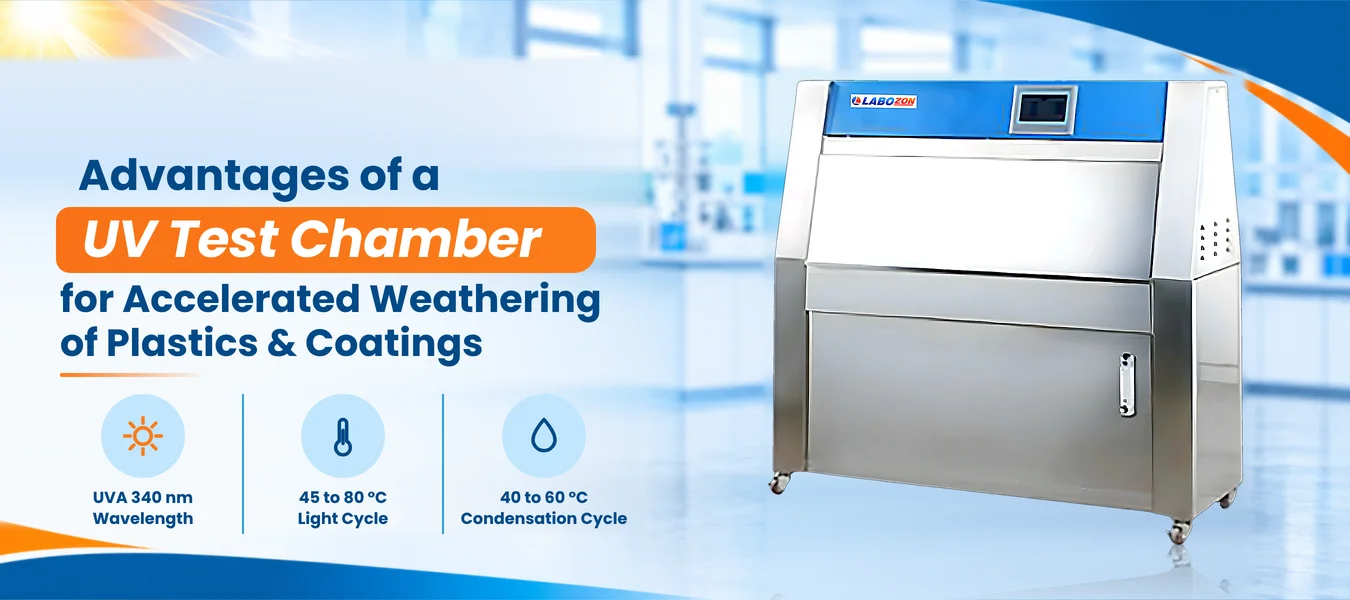
The UV Test Chamber LZ-UTC-A101 from Labozon uses UVA or UVB fluorescent ultraviolet lamps, with separate temperature ranges for the light cycle and the condensation cycle, so technicians can compare how different formulations age under the same conditions.
Practical UV Chamber Uses
Common UV chamber uses in plastics and coatings labs include:
- Checking color fade and gloss loss on paints and coatings
- Watching plastics for cracking, chalking, and surface haze
- Screening additives and stabilizers during formulation work
- Comparing batches of insulation materials and electronic parts
- Reviewing leather and textile samples for fading
The product page lists heat-resistance testing of electrical insulation, aging tests for electronic parts, plasticized products, and leather and textile tests among its applications. Quality teams also use this kind of testing to catch weak batches before products reach customers.
Inside the Chamber: Main Parts
A UV test chamber diagram usually shows the lamp bank, the sample racks, the condensation system, the temperature sensor, and the control panel. Samples sit on racks facing the lamps, while a blackboard temperature control based on the set value manages heating during the light cycle.
Reading a diagram before purchase helps buyers understand lamp distance, rack layout, and service access.
Why Labs Choose Controlled UV Exposure
Faster results
Weeks of cycling can stand in for long outdoor exposure, which shortens development time.
Repeatable conditions
Programmed cycles let each sample see the same exposure, so batches can be compared fairly.
Flexible light source
UVA at 340 nm is included, with 351 nm UVA or 313 nm UVB listed as options.
Easy operation
A 4.3-inch touch screen with a menu-style interface speeds up setup, and multi-cycle automatic control covers dark, light, and condensation phases.
Published Details of the LZ-UTC-A101
| Parameter | Details |
|---|---|
| Light cycle temperature | 45 °C to 80 °C |
| Condensation cycle temperature | 40 °C to 60 °C |
| Light source | UVA or UVB fluorescent ultraviolet lamp |
| Wavelength | UVA at 340 nm; 351 nm or UVB at 313 nm optional |
| Sample shelves | 18 pieces, each 75 × 150 mm |
| Cycle mode | Multi-cycle automatic control for dark, light, and condensation phases |
| Light control | Irradiance monitoring and control; optional RM-20 irradiance meter for manual adjustment |
| Calibration function | Yes |
| Chamber material | Stainless steel |
| Power supply | 220 V, 50 Hz |
| Net weight | 88 kg |
Common Selection Mistakes
Choosing on rack count alone is the most frequent error. Review temperature ranges, lamp type, wavelength options, irradiance control, and cycle programming together. A chamber that matches sample size and daily workload prevents repeat runs and delays.
Other mistakes include ignoring lamp availability, overlooking service access, and skipping calibration planning. If your work also needs humidity or thermal cycling, review the wider test chamber range before deciding.
Accelerated vs. Outdoor Exposure
| Factor | Chamber testing | Outdoor exposure |
|---|---|---|
| Test duration | Shorter, cycle based | Long, season dependent |
| Conditions | Set and repeatable | Variable weather |
| Sample matching | Same exposure for all samples | Depends on placement and season |
| Planning | Programmed in the lab | Needs outdoor racks and monitoring |
User Tips and Recommended Practices
- Before each run, clean sample surfaces and mount them flat on the racks so exposure is even.
- Rotate or reposition samples on a schedule, since lamp output can vary across the rack.
- Label each sample and log the cycle program used for each test run.
- Replace lamps as a set, and record the date of each change.
- Use the calibration function and an irradiance meter at planned intervals.
- Keep a reference sample of a known material in each run.
- Fill and drain the water system as the manual describes to avoid scale.
- Place the unit in a ventilated room with a stable power supply.
Explore the Test Chamber Category
The UV Test Chamber LZ-UTC-A101 belongs to a wider group of environmental and aging test equipment. Buyers usually compare temperature range, light source, sample capacity, control method, and maintenance access. To see the full range, browse the test chamber category.
Labozon supplies scientific equipment across many disciplines, and the rest of its catalog is reachable from the Labozon home page.
Related Products


Looking for uv test chamber?
Compare available models, review product specifications, and contact the Labozon team for assistance in identifying equipment that matches your laboratory requirements.