
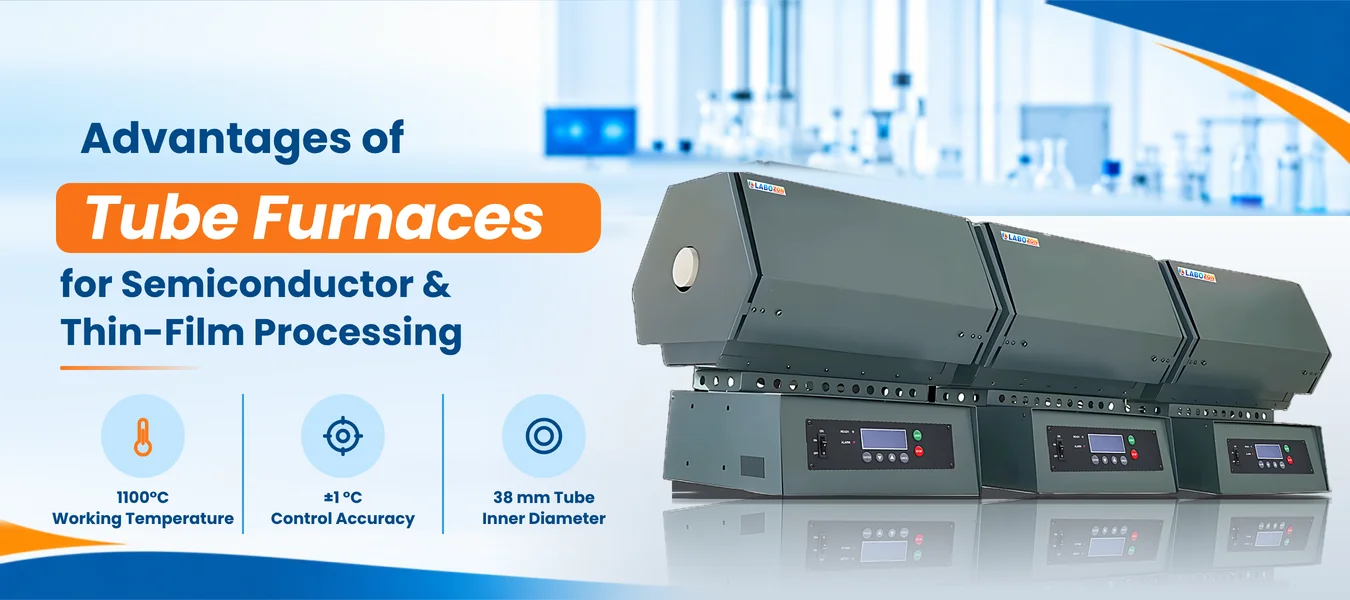
Semiconductor and thin-film research often requires controlled, repeatable thermal processing of small samples. A tube furnace delivers that by heating a sample inside a narrow tube, where temperature and atmosphere can be managed along a defined heated zone. This guide covers how it works, where it fits, how to use it, and what to review before choosing one.
What Makes the Tube Format Useful
A tube furnace is a high temperature laboratory furnace built around a cylindrical work tube. Heating elements surround the tube and insulation keeps heat inside, so the sample sits in a uniform hot zone. A lab tube furnace suits small batches, process development, and material research, where control matters more than volume.
Many buyers also search for a laboratory tube furnace a high temperature tube furnace, or a high temperature lab furnace when they need this format. The Tube Furnace LZ-TBF-C138 from Labozon is a compact unit with a 450 mm heated zone, a 38 mm tube internal diameter, an LCD controller, and ±1 °C control accuracy.
Where These Furnaces Are Applied
In materials and thin-film research, typical tube furnace uses include:
- Annealing small samples and coated substrates
- Oxidation and heat-treatment experiments on small samples
- Controlled-atmosphere heat treatments for materials and coating research
- Sintering and densifying deposited materials
- Preheating and ash analysis
The product page lists ash analysis, heat treatment, sintering, preheating, and melting and oxidation as applications. It is not marketed by Labozon for semiconductor wafer oxidation, diffusion, or doping. With a 38 mm tube bore it cannot take a 100 mm wafer, so for wafer-scale work, confirm tube diameter, wafer size, process chemistry, and cleanroom compatibility before use.
Tube Furnace Equipment: Main Parts
Tube furnace equipment usually includes the work tube, heating elements, insulation, a thermocouple, a controller, and gas and vacuum hardware. In the LZ-TBF-C138, an Fe-Cr-Al heating element surrounds the tube, a ceramic fiber blanket provides insulation, and a K-type thermocouple feeds the controller.r
A dual-layer housing helps keep the outside cooler, and an epoxy powder coated steel sheet shell protects the cabinet.
Why Researchers Choose Tube Heating
Uniform heating
The page describes homogeneous temperature distribution along the heated zone.
Tight control
±1 °C accuracy and a 4-line LCD menu keep settings clear, with support for heating programs and custom presets.
Atmosphere options
Vacuum flanges with valves, a gas regulator, and a vacuum pressure gauge are included, with protective gas connections and vacuum equipment as options.
Thermal shock resistance
The page lists thermal shock resistant tubes and a low external surface temperature from the dual-layer housing.
Published Details of the LZ-TBF-C138
| Parameter | Details |
|---|---|
| Tube internal diameter | 38 mm |
| Heated zone length | 450 mm |
| Tube length | 770 mm |
| Tube type | Mullite, per the specification table |
| Thermocouple | K type |
| Heating element | Fe-Cr-Al |
| Insulation | Ceramic fiber blanket |
| Display | LCD |
| Accuracy | ±1 °C |
| Net weight | 27 kg |
| Gross weight | 35 kg |
Common Selection Mistakes
Choosing on temperature alone is the most frequent error. Review heated zone length, tube diameter, tube material, control accuracy, gas and vacuum options, and program storage together. Matching the unit to sample size and process steps helps avoid repeat runs.
Other mistakes include ignoring spare tube availability, skipping atmosphere planning, and overlooking bench space. If your work needs a different furnace format, such as a chamber design, review the wider laboratory furnace range before deciding. When reviewing tube furnace manufacturers, look at service support and spare tube availability too.
Tube Furnace How to Use: User Tips and Recommended Practices
- Review the manual and confirm tube and flange fit before the first run.
- Load samples in the middle of the heated zone for even exposure.
- Use a gentle heating ramp, and cool slowly to protect the work tube.
- Purge the tube with the chosen gas before heating when atmosphere matters.
- Keep a log of each program, gas flow, and thermocouple check, so any drift in results can be traced back to a specific run or setting.
- As general safe-operation guidance, never seal a work tube without a safe gas outlet or vacuum path.
- Allow the furnace to cool fully before removing samples or flanges.
- Keep the area around the furnace clear and ventilated.
Explore the Furnace Category
The Tube Furnace LZ-TBF-C138 belongs to a wider group of heating equipment that includes tube and chamber designs for heat treatment, sintering, and ashing. Buyers usually compare maximum working range, heated zone size, control accuracy, atmosphere options, and housing design. To see the full range, browse the furnace category.
Labozon supplies scientific equipment across many disciplines, and the rest of its catalog is reachable from the Labozon home page.
Related Products


Looking for tube furnace?
Compare available models, review product specifications, and contact the Labozon team for assistance in identifying equipment that matches your laboratory requirements.