
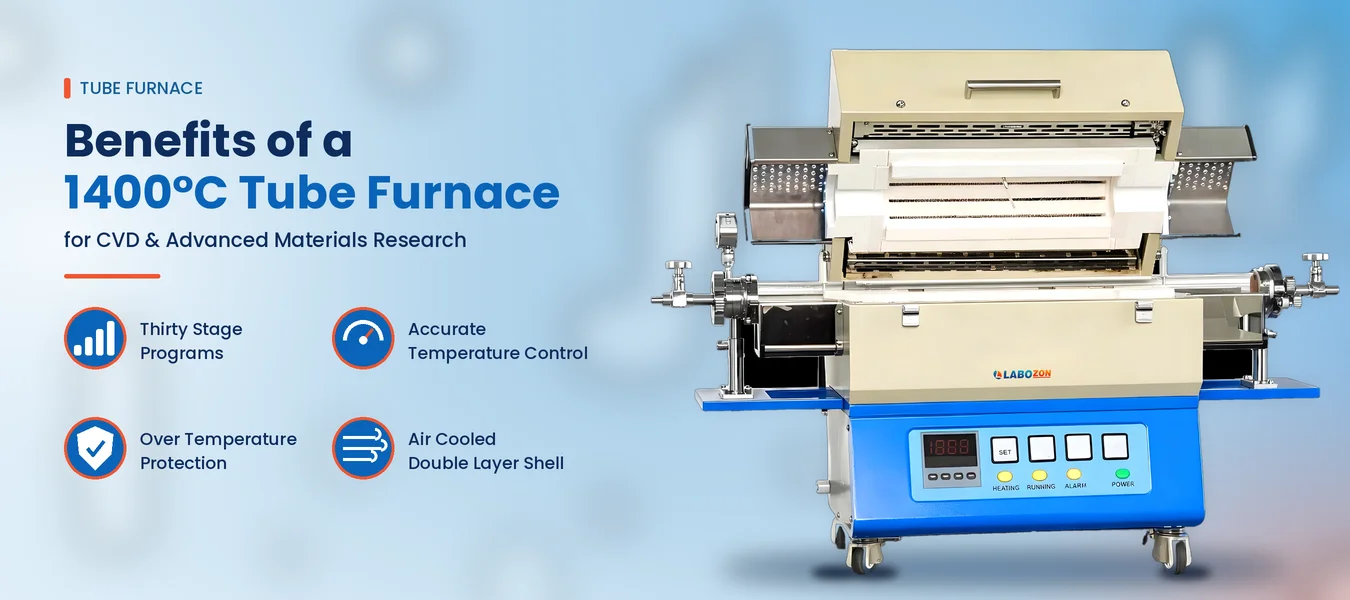
Chemical vapor deposition, atmosphere sintering, and vacuum annealing all depend on steady heat inside a sealed tube. This guide explains how a tube furnace provides that control, where it fits in research work, and which details deserve attention when choosing a unit, using Tube Furnace LZ-TBF-B202 as a working reference.
CVD ExperimentsAtmosphere SinteringVacuum AnnealingHow Heat Moves Inside a Sealed Tube
A tube furnace is an electric heating unit built around a cylindrical tube. Heat reaches the sample through convection, conduction, and electrical resistance heating. Because the tube ends can be closed, a laboratory tube furnace can hold a controlled atmosphere or a vacuum around the sample, something an open chamber cannot offer.
In Tube Furnace LZ-TBF-B202, the furnace body is formed from high purity alumina polycrystalline fiber by vacuum suction filtration. An S type thermocouple reports temperature to a microprocessor controller with intelligent PID adjustment.
Tube furnace diagram
Simplified diagram: the sealed tube path on top, cooling and control layers below.
The heating length of three hundred millimeters marks the zone where a sample sees the programmed temperature, so crucible placement is a process variable and not an afterthought.
Why a High Upper Temperature Limit Matters
The maximum working temperature of this model is fourteen hundred degrees Celsius, with a rated temperature of thirteen hundred fifty degrees Celsius. That headroom lets researchers cover CVD experiments, atmosphere reduction, atmosphere sintering, and vacuum annealing in one unit. A high temperature tube furnace in this range also supports the metallurgical applications named on the product page.
For deposition work, the sealed tube holds a controlled atmosphere while the controller follows a thirty stage program. Ramp, dwell, and cooling steps can be stored as a profile, which makes repeat runs easier to compare.
Tube Furnace Uses in Research and Industry
Tube furnace uses reach scientific research institutes and industrial and mining enterprises, where a single unit may serve several projects through changes in atmosphere and program.
CVD experiments
Deposition studies where the gas path and temperature profile must stay predictable.
Atmosphere sintering
Densifying powders and compacts at high temperature under a chosen atmosphere.
Atmosphere reduction
Converting oxides inside a controlled gas environment.
Vacuum annealing
Changing the structure of a sample without exposing it to air.
Metallurgical applications
Highly sophisticated metallurgical work that needs sustained high temperature.
Features That Shape Daily Operation
Specifications matter less than how they behave at the bench. These are the capabilities of the unit that influence routine work.
Program control
Thirty stage programming with intelligent PID adjustment, a temperature self-tuning function, and control accuracy of plus or minus one degree Celsius.
Heating response
The heating rate reaches up to thirty degrees Celsius per minute and can be modified on request. A double layer shell with air cooling supports quick rises and falls.
Protection
Over-temperature protection cuts the heating circuit, with break-off protection, over-current protection through an air switch, and power off protection.
Monitoring
An instantaneous energy consumption indicator, an average working temperature calculator, and a descriptive error indicator.
Data connection
A communication interface and software connect the unit to a computer for profile handling.
Body and footprint
Stainless steel that does not rust or slag, a smooth surface, and an outer surface at or below forty-five degrees Celsius. The unit measures one thousand one hundred twenty by five hundred twenty by nine hundred forty-five millimeters and runs on single phase power at six kilowatts and two hundred twenty volts.
Reading a Tube Furnace Equipment List
A tube furnace equipment list shows whether a first run is possible on arrival. Tube Furnace LZ-TBF-B202 lists a stainless steel flange set, a stainless steel hook, alumina furnace plugs, high temperature gloves, an S type thermocouple, and an alumina crucible, while its specification names a quartz tube measuring one hundred by one thousand millimeters.
Sealing hardware and a crucible deserve the closest look for atmosphere and vacuum work, because they decide how well the tube holds its environment.
Common Selection Mistakes to Avoid
Treating two temperatures as one
Maximum and rated temperature are different numbers. Plan routine work near the rated value and keep the maximum for short holds.
Matching tube size only
A sample must fit inside the heating length, not just inside the tube.
Skipping the atmosphere question
Decide early whether a process needs atmosphere, vacuum, or both, then confirm the sealing hardware supports it.
Overlooking utilities and bench space
Check the power supply and the unit dimensions against the room before the order is placed.
Assuming one format fits all work
A sealed tube is not the answer to all heating tasks. The furnace category also lists other formats for processes that do not need a controlled tube environment.
Ignoring safeguards
Look for over-temperature and over-current protection before looking at extras.
Operating Habits That Protect Results
- Follow the recommended ramp of up to fifteen degrees Celsius per minute for routine runs, and use faster rates only when the process allows it.
- Build programs in stages, with separate ramp, dwell, and cooling steps.
- Run temperature self-tuning again after the load or process conditions change.
- Check the flange and plug seals before any atmosphere or vacuum run.
- Center the alumina crucible inside the heating length.
- Wear the supplied high temperature gloves when handling hot parts.
- Log profiles with the communication software so results can be reviewed later.
Side by Side Review of Tube Furnace Manufacturers
When reviewing tube furnace manufacturers, lining up the same factors for each model keeps the review fair. Labozon Scientific Inc. is a USA based manufacturer of laboratory and heating equipment in Oakville, Connecticut, and its tube furnace range lists related models.
| Factor | What to check | Why it matters |
|---|---|---|
| Temperature range | Maximum and rated values | Sets which processes fit the unit |
| Tube and heating length | Tube size, tube material, heated zone | Controls sample capacity and the usable zone |
| Atmosphere hardware | Flanges, plugs, vacuum readiness | Decides how well the environment holds |
| Control and logging | Program stages, accuracy, data port | Supports repeatable runs |
| Protection | Over-temperature, over-current, power off | Limits damage to samples and equipment during faults |
| Orientation | Horizontal or vertical tube furnace layout | Some workflows favor one orientation |
Questions about layout options such as a vertical tube furnace are directed to the manufacturer directly.
Exploring the Wider Furnace Category
Tube Furnace LZ-TBF-B202 belongs to a broader group of laboratory furnaces that includes tube formats and open chamber formats such as the muffle furnace range. Units in this group differ mainly in chamber format, temperature reach, and atmosphere capability.
Lab teams reviewing the group usually compare temperature range, chamber or tube size, atmosphere and vacuum capability, control features, available bench space, and power supply. The full range of laboratory furnaces is the place to explore each format side by side, and the Labozon home page leads to the other equipment groups.
Name: Olivia Carter – Labozon
Specialty: Laboratory Equipment, Scientific Technology, and SEO Content Writing
Writing Style: Professional, informative, research-driven, and reader-friendly.
Bio: Olivia Carter is a content writer at Labozon, specializing in laboratory equipment, scientific technologies, and laboratory applications. She creates informative, SEO-focused blog articles that highlight product features, explain key benefits, and explore the practical uses of scientific instruments. Her goal is to present technical information in a clear, accurate, and accessible manner, helping laboratory professionals, researchers, and science enthusiasts make informed decisions.
Review the full specifications, features, and accessories of the unit discussed above.
Explore Tube FurnaceRelated Products


Looking for tube furnace?
Compare available models, review product specifications, and contact the Labozon team for assistance in identifying equipment that matches your laboratory requirements.