
Waiting days for outside lab results slows treatment decisions and discharge reporting. A COD Analyzer brings chemical oxygen demand testing into your own lab, so operators can check wastewater strength the same day. This guide covers how it works, where it fits, and what to review before choosing one.
How the Measurement Works
A COD Analyzer estimates the chemical oxygen demand of a water sample, meaning the amount of oxidant consumed under controlled chemical-oxidation conditions. Generally, the higher the value, the more organic load the water carries, although certain inorganic reducing substances can also raise it. Labs also call this instrument a COD meter, a COD tester, or a laboratory analyzer for water quality.
The cod analyzer working principle follows three steps. A measured sample is mixed with an oxidizing reagent in acid, the mixture is heated in a digestion device so organic matter oxidizes, and the instrument reads the result and shows it in mg/L. The same cod analyzer principle applies across most cod analysis equipment: stronger organic load consumes more oxidizer, and the reading reflects that change.
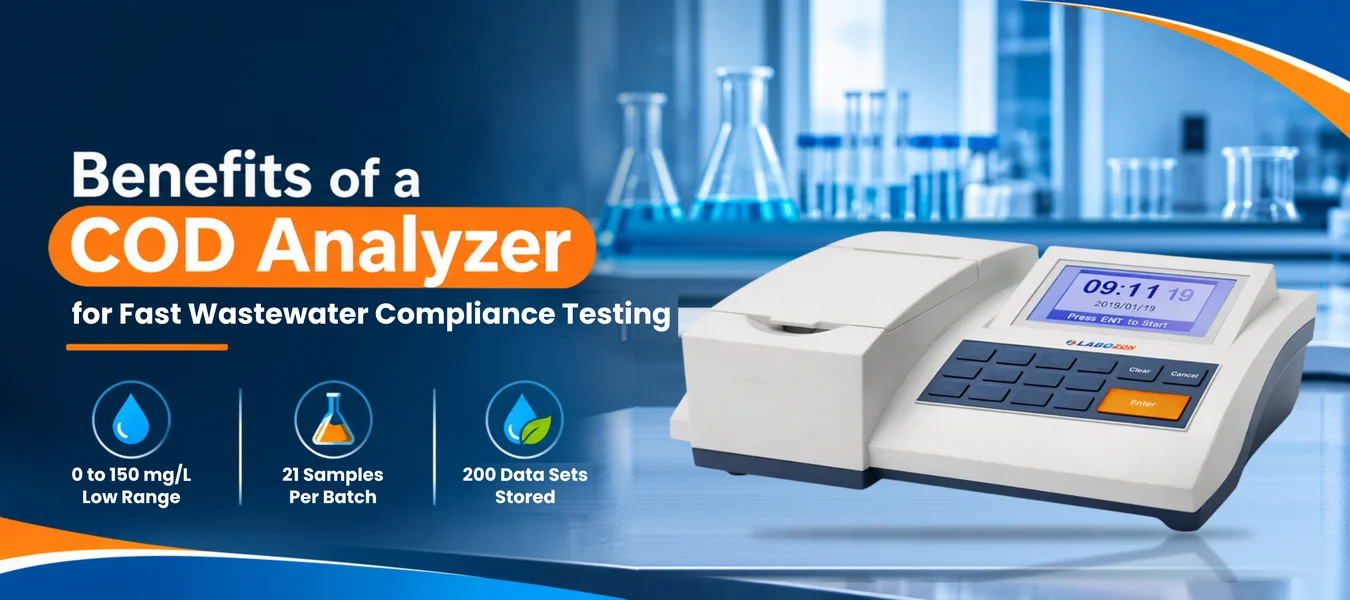
The COD Analyzer LZ-COD-A100 from Labozon uses the sealed reflux digestion method with a digestion device for 21 samples and two LED light sources, one for each testing range.
COD and BOD Compared
COD BOD analysis answers related but different questions. COD measures chemical oxidation of organic matter and gives a result in hours, depending on the digestion method and temperature. BOD measures oxygen used by microbes over a longer period and normally requires a separate incubation and BOD testing setup.
| Feature | COD | BOD |
|---|---|---|
| Basis | Chemical oxidation | Microbial oxygen use |
| Result time | Hours, method dependent | Several days |
| Typical use | Fast screening and process control | Biodegradable load assessment |
Practical Use Cases
Typical code analyzer use includes sewage treatment, environmental monitoring, textile dyeing, paper and printing, leather processing, petrochemical plants, metallurgy, biomedicine, and university or research labs. Common tasks include:
- Checking influent and effluent strength at treatment plants
- Tracking process stages for early warning of overloads
- Screening samples before sending them for detailed testing
- Keeping records for discharge reporting
In each setting, regular cod analysis gives operators a quick picture of organic load before water leaves the site.
Published Details of the LZ-COD-A100
| Parameter | Details |
|---|---|
| Measuring ranges | Low range of 0 to 150 mg/L plus a second, higher range |
| Accuracy | ±8% |
| Samples per batch | 21 |
| Digestion | Sealed reflux, 100 to 160 ℃, up to 120 minutes |
| Light source | Two LED lights |
| Calibration | Two-point |
| Display and data | LCD, 200 data sets, USB interface |
| Power | AC adapter, 200 to 240 VAC input |
| Analyzer size | 315 × 225 × 100 mm, 2 kg |
| Reactor size | 330 × 228 × 132 mm, 4 kg |
Common Selection Mistakes
Choosing on speed alone is the most frequent error. When comparing a COD meter or COD tester, review measuring ranges, accuracy, sample count per batch, digestion temperature, data storage, and power needs together. Ask whether the digestion device is included and how reagents and tubes are supplied.
Some buyers search for a portable COD Analyzer for field work, but benchtop units such as the LZ-COD-A100 suit labs with mains power. If your work needs a different measuring format, review the wider water testing instrument range before deciding.
User Tips and Recommended Practices
- Run the two-point calibration regularly and after any change in reagent batch.
- Shake each sample before pipetting so solids are evenly spread.
- Choose the low or high range based on expected strength, and dilute strong samples when needed.
- Wear gloves and eye protection, and follow your lab's chemical handling rules.
- Let digested tubes cool before measuring so readings stay stable.
- Wash and rinse tubes well, since residue changes results.
- Save each run with date and sample name.
- Wipe the digestion device and check vents on a schedule.
Explore the Water Testing Category
The COD Analyzer LZ-COD-A100 belongs to a wider group of water testing instruments, including COD analyzers, turbidity meters, multi-parameter testers, and digestion devices. Buyers usually compare measuring range, accuracy, batch size, data handling, and bench space. To see the full range, browse the water testing instrument category.
Labozon supplies scientific equipment across many disciplines, and the rest of its catalog is reachable from the Labozon home page.
Related Products


Looking for COD analyzer?
Compare available models, review product specifications, and contact the Labozon team for assistance in identifying equipment that matches your laboratory requirements.