
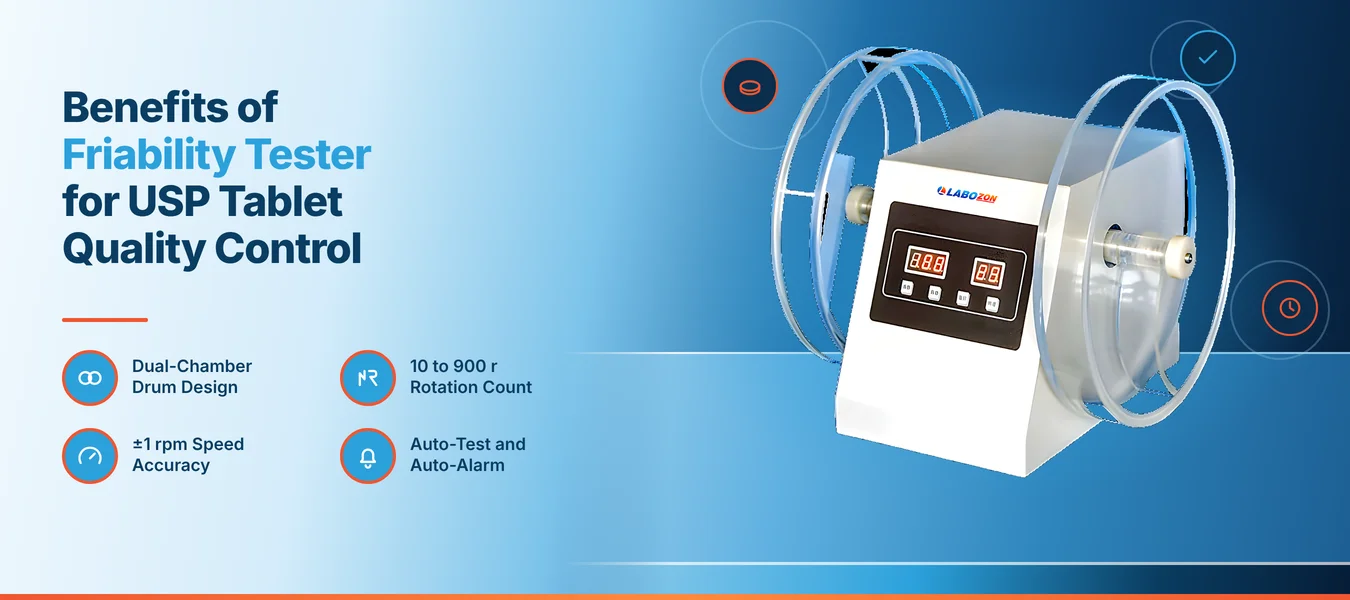
A tablet that survives the press can still chip, crumble or shed powder in the blister line, the bottle or the pharmacy shelf. A friability tester finds this weakness early by tumbling tablets in a controlled drum. This guide explains how the test works, where laboratories apply it, and what to review in the Labozon Friability Tester LZ-FT-A100.
How the Tumbling Test Works
A friability test apparatus tumbles compressed tablets in a rotating drum for a set number of rotations. The tablets lift and drop repeatedly, which creates the abrasion and shock they meet during handling and transport.
A friability test diagram usually shows the drum, a rotation counter, a display and a control panel. In a tablet friability test apparatus, the control system turns the drum while the counter tracks each rotation.
Why Quality Teams Rely on Controlled Tumbling
Friability describes how easily a tablet breaks down, and a friability tester gives quality control teams a way to see the durability of compressed tablets before the batch moves on.
Early Warning
Weak tablets show up before packaging.
Repeatable Runs
Drum speed and rotation count stay constant.
Two Samples
Dual cylinders run two samples at once.
Clear View
A hyaline acrylic drum shows the tumbling.
Where Laboratories Put It to Work
Friability tester uses center on quality and production control in pharmaceutical work, including hospital and research settings.
- Checking the durability of compressed tablets
- Reviewing uncoated tablets for resistance to breakage
- Production monitoring, where friability is part of the control plan
- Formulation work, where tablet strength is reviewed after changes
- Troubleshooting when chipping or crumbling appears
Friability tester uses also support documentation, because a fixed rotation count makes each result easy to record and review.
Key Details of the LZ-FT-A100
The Friability Tester LZ-FT-A100 is a dual-chamber, drum-type friability tester machine with microprocessor control and lists these published details.
| Feature | Specification |
|---|---|
| Cylinder number | 2 |
| Tablet fall height | 156 mm |
| Rotation count | 10 to 900 r |
| Rotation count accuracy | ±1 r |
| Rotation speed accuracy | ±1 rpm |
| Display | LED |
| Power | 50 W |
| Automation | Auto-test, auto-diagnose, auto-alarm, auto-stop at the set timing point |
Friability and Hardness Tests Side by Side
The table shows how the two common tablet checks differ.
| Factor | Friability Tester | Hardness Tester |
|---|---|---|
| What it shows | Resistance to tumbling and impact | Force a tablet withstands |
| Typical weakness found | Chipping and crumbling edges | Tablets that are too soft or brittle |
| Use with the other | Complements a hardness tester | Complements a friability tester |
Selection Mistakes That Cause Rework
- Choosing a single-drum unit when several batches must run each day.
- Ignoring rotation count range and accuracy when comparing a tablet friability tester with other models.
- Overlooking drum material, since clear acrylic scratches if cleaned with abrasive pads.
- Skipping a check of the display and control features before purchase.
- Treating the friability apparatus as a replacement for a hardness tester, when the two checks complement each other.
Teams reviewing options can browse the pharmaceutical equipment category to match drum count, rotation range and control features to the workload.
User Tips and Recommended Practices
- Follow your laboratory's written test method for sample size, rotation count and weighing.
- Set the rotation count before loading tablets, and confirm the display reads correctly.
- Check the drum for chips, cracks and residue before each batch.
- Load tablets gently so they are not damaged before the run starts.
- Remove loose dust from tablets after the run, as your method describes.
- Clean the drum with a soft cloth and avoid abrasive pads that scratch the acrylic.
- Run both cylinders under the same settings when comparing two batches.
- Record batch number, rotation count, results and operator for each test.
Exploring Wider Pharmaceutical Testing Equipment
The LZ-FT-A100 belongs to the pharmaceutical equipment group, which covers tablet testing instruments and related laboratory instruments used in drug production and quality control. Buyers usually compare drum or chamber count, rotation range, accuracy, display type, control features and ease of cleaning.
The full range of pharmaceutical equipment shows these instruments together, and the Labozon home page opens the other laboratory equipment groups.
See the full specification of the Friability Tester LZ-FT-A100.
Explore Friability TesterLooking for Labozon explains how a friability tester checks tablet durability?
Compare available models, review product specifications, and contact the Labozon team for assistance in identifying equipment that matches your laboratory requirements.