
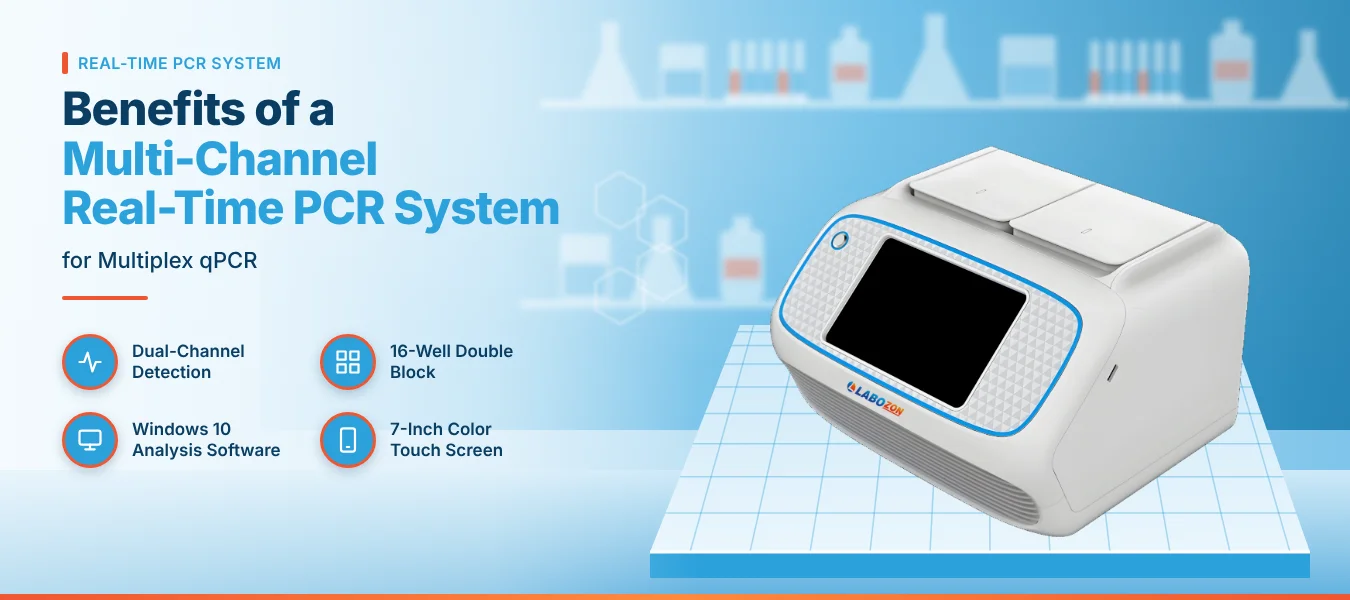
Running one target per tube uses time, samples and reagents. A multi-channel real-time PCR system detects more than one target in a single reaction by reading different fluorescent dyes at the same time, so a lab gets more information from each tube. This guide explains how it works, where multiplex qPCR fits in daily work and what to review in the Labozon Real-Time PCR System 2 Channel LZ-PCR-A11.
What the Instrument Does
A real-time PCR system is a thermal cycler with a built-in optical detector. A thermal cycler alone heats and cools samples to copy DNA, and conventional PCR then needs a gel or another step to see the result.
The real-time version measures fluorescence after each cycle, so the lab watches amplification as it happens and can quantify the starting material. Catalogs also call it a PCR analyzer or a molecular diagnostic system, and it is a core tool for genetic analysis. A real time PCR system multi channel equipment list usually includes the cycler, the optical module and the software.
How Multiplex Detection Works
Each channel is a separate detection path tuned to a range of wavelengths. A tube holds primers and probes labeled with different dyes, and the instrument excites each dye with its own light and reads the emission through its own channel.
Because each target has its own color, two or more targets can be tracked in one tube. The LZ-PCR-A11 offers two channels: F1 reads 520 to 540 nm, and F2 reads 540 to 580 nm.
Advantages in the Laboratory
More Data per Tube
Two channels track two targets at once.
Internal Control
One channel reads the target, the other a control.
Fast Ramping
Quick temperature changes shorten each run.
Sample Saving
Two reactions share one tube.
Real Time PCR System Multi Channel Technology and Applications
Real time PCR system multi channel technology combines a precise block, an LED light source, a sensitive detector and analysis software. Its applications include gene expression studies, microRNA and noncoding RNA work, mutation detection, genotyping, biomarker analysis and pathogen testing.
The product page also lists detection of SARS-CoV-2 and use in oncology, research institutes and hospitals.
Real Time PCR System Multi Channel Use in Practice
Real time PCR system multi channel use ranges from research labs to clinical laboratories. A research group might run gene expression plus a reference gene in the same well, while a diagnostic lab might pair a pathogen target with an internal control.
In both cases one reaction becomes two measurements, which reduces handling steps and the chance of pipetting error.
Key Details of the LZ-PCR-A11
The Labozon Real-Time PCR System 2 Channel LZ-PCR-A11 is a compact real time PCR system multi channel machine with double 8-well blocks. Its published details are below.
| Feature | Specification |
|---|---|
| Sample capacity | 16 wells (2 × 8, double block), 0.2 ml tubes or strips |
| Reaction volume | 10 to 100 µl |
| Temperature range | 0 to 100 °C |
| Maximum ramp rate | 6 °C per second |
| Temperature uniformity | ±0.25 °C |
| Heated lid | 30 to 115 °C, adjustable |
| Fluorescence channels | F1 520 to 540 nm (FAM, SYBR Green I); F2 540 to 580 nm (HEX, VIC, JOE, TET) |
| Light source and detector | High-brightness LED, photoelectric sensor |
| Software | Windows 10; quantitative analysis, melting curve, genotyping |
| Control and data | 7-inch color touch screen or computer; export to Excel, csv, txt |
| Interfaces | Wi-Fi, USB 2.0; optional USB thermal printer |
| Safety | Electromagnetic lock cover, over-current and over-temperature protection |
| Dimensions and weight | 300 × 267 × 198 mm, 5.5 kg |
Power and Supply Details to Confirm
The LZ-PCR-A11 page lists both a DC power rating and an AC voltage without explaining how they relate, so confirm the electrical supply with the supplier before ordering.
Also check the dye match between your probes and the two channels, and ask which software version ships with the unit.
Conventional, Real-Time and Multiplex Compared
The table below sets three PCR approaches side by side.
| Factor | Conventional PCR | Real-Time PCR | Multiplex Real-Time |
|---|---|---|---|
| Result view | End-point, after a gel | Live fluorescence curve | Live curves per channel |
| Quantification | Limited | Yes | Yes |
| Targets per tube | One | One | Two or more |
| Typical fit | Simple amplification | Single-target quantification | Targets plus internal control |
Selection Mistakes That Cause Rework
- Comparing instruments on channel count alone and ignoring dye compatibility.
- Overlooking well format against the sample load.
- Skipping software review for the analysis functions you need.
- Ignoring bench space and air flow around the unit.
- Planning no separation between pre-PCR and post-PCR areas.
Teams that want to review similar instruments can start with the PCR system category before shortlisting.
User Tips and Recommended Practices
- Design multiplex assays with dyes that match the channels.
- Test each primer and probe set alone before combining them.
- Keep a no-template control in each run.
- Use thin-walled 0.2 ml tubes or strips made for the instrument.
- Seal tubes firmly and avoid fingerprints on the caps.
- Place the unit on a firm bench with air flow around it.
- Back up run files to a computer on a regular schedule.
- Separate pre-PCR and post-PCR areas to limit contamination.
- Wipe the block and lid on a regular schedule.
Exploring Wider PCR Instrument Options
The LZ-PCR-A11 belongs to the PCR system category, which covers thermal cyclers and real-time instruments in several channel counts and well formats. Buyers usually compare channel count, well format, ramp rate, uniformity, software and data export.
The full Labozon PCR system range shows these instruments together, and the Labozon home page opens the other laboratory equipment groups.
See the full specification of the Real-Time PCR System 2 Channel LZ-PCR-A11.
Explore Real-Time PCR System 2 ChannelRelated Products
Looking for multi-channel real-time PCR system?
Compare available models, review product specifications, and contact the Labozon team for assistance in identifying equipment that matches your laboratory requirements.