
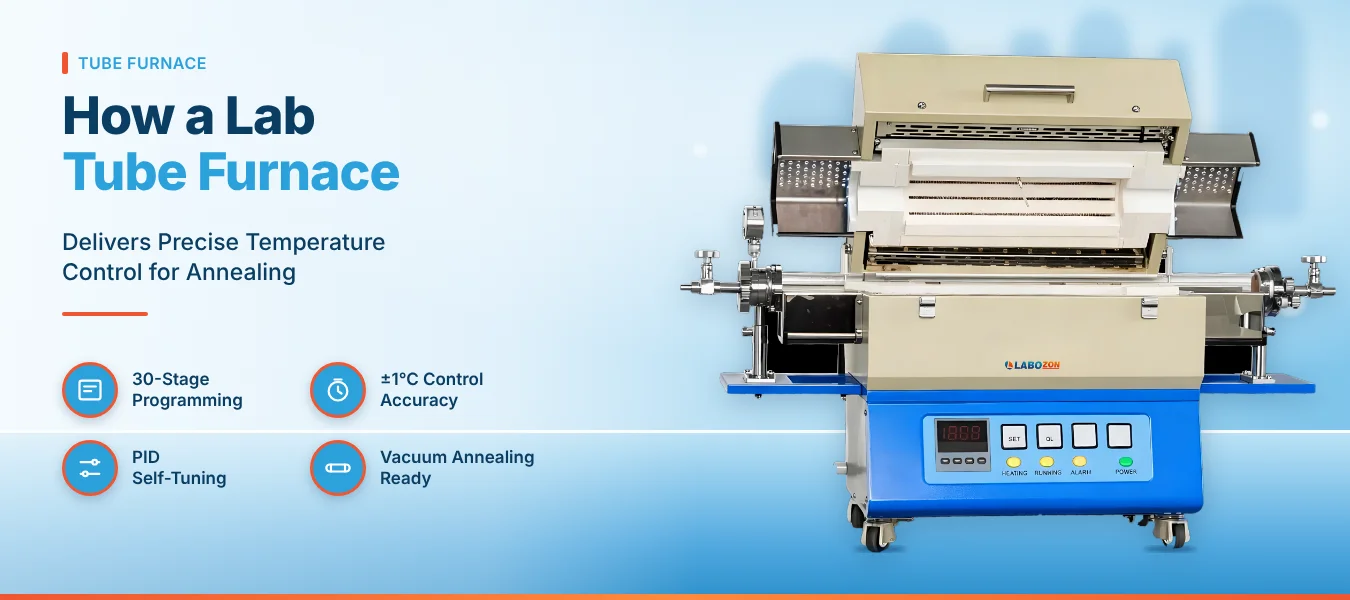
Annealing only works when the thermal cycle repeats exactly. A few degrees of drift, or a ramp that runs too fast, can leave stress in a metal part, cloud a thin film, or crack a ceramic pellet. A tube furnace keeps each sample on the same temperature path from run to run. This guide explains how it works, where it is used, and what to check when evaluating the Tube Furnace LZ-TBF-B100.
Why Annealing Needs Tight Thermal Control
Annealing softens a material, relieves internal stress and refines its structure. Each of those results depends on three things: how fast the sample heats, how long it holds at temperature, and how slowly it cools. If any one of them wanders, the outcome changes from batch to batch.
A heated tube around the sample makes that control practical. The tube holds a defined atmosphere, and the heated body around it can be steered by a controller, so the sample sees a steady zone instead of the uneven heat of an open chamber.
Parts and Working Principle
A basic tube furnace diagram shows five parts working as one loop. Heating elements wrap an insulated chamber. A thermocouple reads temperature near the sample. A controller compares that reading with the setpoint, and a power regulator adjusts current to the elements.
Precision comes from how finely this loop reacts. The regulator trims power in small steps rather than switching it fully on and off, and the controller learns the load so it can approach the hold temperature without overshoot.
Tube Furnace Uses Beyond Annealing
Tube furnace uses cover a wide range of laboratory processes, and tubular furnace uses extend across research centres, materials labs and industrial testing groups.
Vacuum Annealing
Relieves stress without surface oxidation.
Atmosphere Sintering
Bonds ceramic and metal powders under controlled gas.
Atmosphere Reduction
Converts metal oxides in a reducing gas flow.
CVD Experiments
Grows thin films from gas-phase precursors.
Tube Furnace Types Compared
Tube furnace types differ by orientation, number of zones and opening style. The table below sets the common formats side by side.
| Type | Ideal For | Main Trade-Off |
|---|---|---|
| Horizontal, solid body | Boats and crucibles, easy loading | Tube changes need cool-down |
| Horizontal, split body | Quick tube swaps, rapid cooling | Slightly more heat loss at the seam |
| Vertical | Hanging or gravity-fed samples | Harder to load small boats |
| Multi-zone | Long uniform regions or gradients | More controllers to program |
For single-zone annealing of small samples, a horizontal tube furnace with a solid body is usually the practical choice.
Specifications of the LZ-TBF-B100
The Labozon Tube Furnace LZ-TBF-B100 is a horizontal laboratory tube furnace with a quartz tube and a microprocessor controller. It works as a high temperature tube furnace for annealing metals, glass, ceramics and semiconductor materials. Its published details are below.
| Feature | Specification |
|---|---|
| Tube | Quartz, 60 × 1000 mm |
| Temperature | 1200 °C peak; 1100 °C continuous; 1000 °C continuous under vacuum |
| Heating length | 400 to 440 mm, with a 150 mm constant-temperature length |
| Control | PID with self-tuning; 30 programmable stages; ±1 °C accuracy |
| Feedback and power | K-type thermocouple; SEMIKRON silicon controlled rectifier with phase-shifted trigger |
| Ramp rate | Up to 30 °C/min; 15 °C/min or lower recommended |
| Connectivity | RS-485 port with communication interface and software |
| Safety | Over-temperature protection, break-off and over-current protection, air switch, power-off protection; outer surface 45 °C or less |
| Power | 3.5 kW, 220 V single phase |
| Size | 1140 × 450 × 690 mm |
| Supplied accessories | Quartz tube, stainless steel flange set, alumina furnace plug, stainless steel hook, K-type thermocouple, alumina crucible, high-temperature gloves |
Building an Annealing Profile Step by Step
A typical annealing run follows seven steps:
- Load the sample in a boat and center it in the constant-temperature length.
- Seat the alumina plugs and tighten the end flanges evenly.
- Pull vacuum or purge the tube with inert gas if oxidation matters.
- Program a gentle ramp to the soak temperature.
- Set the soak time the material needs.
- Program a slow cool under controller command.
- Open the tube only when the sample is safe to handle.
Selection Mistakes That Waste Time Later
- Choosing on peak temperature alone and ignoring the continuous rating and the vacuum rating.
- Overlooking the length of the constant-temperature region, which decides how many samples fit.
- Skipping controller features such as stage count, self-tuning and data connection.
- Ignoring safety cutoffs for long unattended runs.
- Judging tube furnace manufacturers by the headline figure instead of what ships in the box.
When two models look close, the furnace category page lets buyers read their specifications side by side before deciding.
User Tips and Recommended Practices
- Center the boat in the middle 150 mm of the heated region.
- Ramp at 15 °C per minute or lower for ceramics and other brittle samples.
- Check the vacuum rating before programming a vacuum anneal.
- Flush the tube with inert gas before heating if oxidation matters.
- Let the furnace cool under program control before opening the tube.
- Inspect the quartz for cracks or clouding before each long run.
- Save each recipe through the RS-485 port so a good anneal can be repeated.
Exploring the Wider Furnace Category
The LZ-TBF-B100 belongs to the laboratory furnace category, which groups tube, muffle, vacuum and box units. Buyers usually review maximum and continuous temperature, chamber or tube size, controller features, atmosphere options and safety cutoffs.
The full Labozon furnace range shows these units together, and the Labozon home page opens the other laboratory equipment groups.
See the full specification of the Tube Furnace LZ-TBF-B100.
Explore Tube FurnaceRelated Products


Looking for tube furnace?
Compare available models, review product specifications, and contact the Labozon team for assistance in identifying equipment that matches your laboratory requirements.