
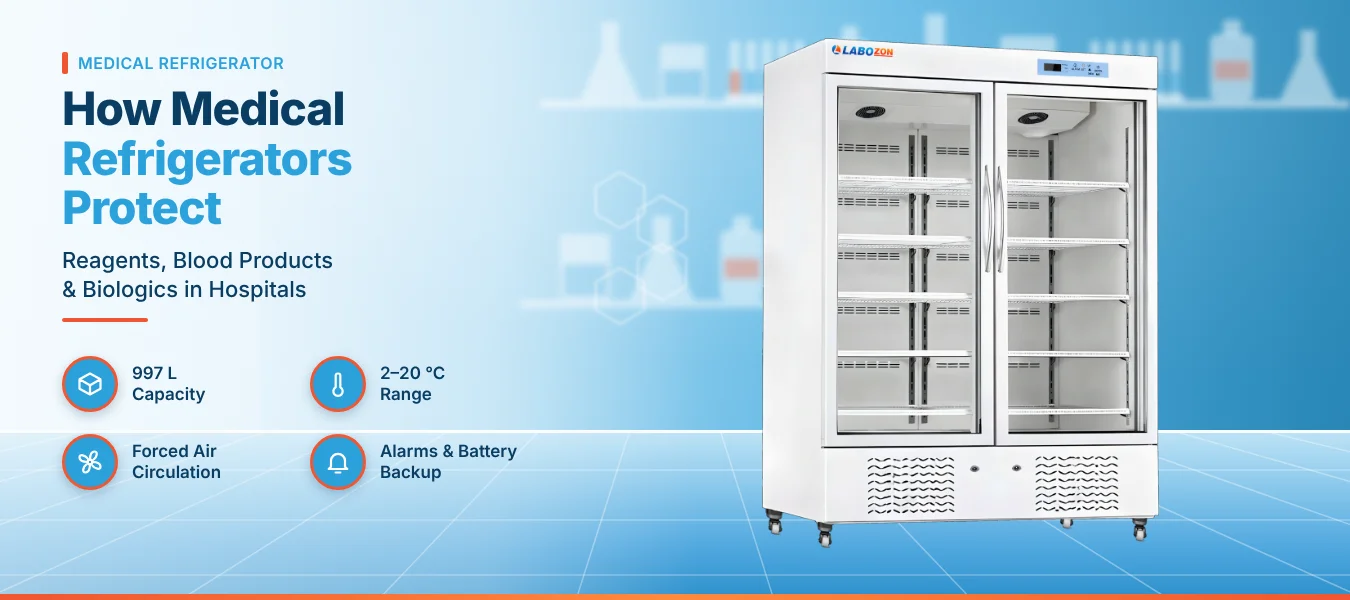
A reagent kit that warms for an hour, a vaccine tray left near a door, a biologic stored beside a cold spot: small temperature errors waste hospital stock and, worse, can affect patient care. A medical refrigerator prevents most of these errors by holding a controlled range, moving air evenly through the cabinet and sounding an alarm when conditions change. This guide explains how it works, where it is used and what to review in the Labozon Double Door Medical Refrigerator LZ-MR-A110D.
What This Cabinet Does
A medical refrigerator is a purpose-built cabinet that keeps reagents, vaccines, biological samples and temperature-sensitive medicines within a set range. Catalogs use several names for this equipment, including medical fridge, medicine fridge and medicine refrigerator.
It differs from a household unit because it controls temperature closely, records its readings and warns staff about faults. A refrigerator for medical use also adds security features such as locks and passwords.
Working Principle and Air Flow
A compressor, a condenser and an evaporator remove heat from the cabinet. A microprocessor controller reads the temperature and switches the cooling system to hold the set point.
An internal fan drives forced air circulation, so shelves near the back and near the door stay close in temperature. Automatic defrost prevents ice build-up, and thick insulation with a tight door seal speeds recovery after the door opens.
Four Layers of Protection
Stability
The set point holds within a narrow band.
Uniformity
Forced air removes cold and warm spots.
Warning
Alarms flag temperature, power, sensor and door faults.
Access Control
A lock and a password limit who can open or change settings.
Medical Refrigerator Uses in Hospitals
Typical medical refrigerator uses include storing reagents and enzymes in clinical laboratories, holding vaccines in immunization clinics, keeping biological samples before testing and storing temperature-sensitive pharmaceuticals on wards.
The product page of the LZ-MR-A110D names vaccines, biological samples, reagents, enzymes and temperature-sensitive pharmaceuticals in hospitals, laboratories and research facilities. For blood products, hospitals normally use a dedicated blood bank unit, so confirm with your transfusion service whether a general cabinet suits your needs.
Key Details of the LZ-MR-A110D
The Labozon Double Door Medical Refrigerator LZ-MR-A110D is an upright cabinet with two doors and a wide double-layer window. Its published details are below.
| Feature | Specification |
|---|---|
| Capacity and shelves | 997 L, ten adjustable shelves |
| Temperature range | 2 to 20 °C, display step 0.1 °C |
| Temperature stability | ±1.5 °C |
| Cooling and defrost | Forced air circulation, automatic defrost |
| Control | Microprocessor controller, records date, time, minimum and maximum temperature |
| Alarms | High and low temperature, power failure, sensor failure, door open; buzzer and flashing lights |
| Power backup | Rechargeable battery for display and alarms |
| Insulation and doors | 80 mm polyurethane foam, inner door, magnetic seal |
| Security | Password protection, mechanical lock |
| Refrigerant | Non-HCFC |
| Electrical supply | AC 220 V, 50 Hz |
| External dimensions | 1220 × 872 × 1885 mm |
| Weight | 207 kg, on castors |
What to Confirm Before Ordering
The cabinet covers 2 to 20 °C, so set the point to match the label of each product you store. Vaccine fridges in clinics often need a narrower range than reagent storage, so match the cabinet to the job.
The page does not list data interfaces or accessories, so ask the supplier how temperature records can be exported.
Household, Medical and Blood Bank Units Compared
The table below sets three cabinet types side by side using typical features.
| Factor | Household Fridge | Medical Unit | Blood Bank Unit |
|---|---|---|---|
| Temperature control | Basic dial | Digital, close control | Digital, narrow band |
| Air circulation | Passive | Forced air | Forced air |
| Alarms | None | Temperature, power, door | Temperature, power, door |
| Security | None | Lock, password | Lock, password |
| Typical fit | Food | Reagents, vaccines, samples | Blood products |
Selection Mistakes That Cause Rework
- Comparing cabinets on capacity alone and ignoring range and alarm coverage.
- Overlooking doorway width and floor loading for a 207 kg cabinet.
- Placing the unit beside heat sources or in direct sun.
- Asking medical refrigerator manufacturers for different figures, which makes offers hard to compare.
- Leaving the electrical supply unchecked against the site.
Teams that want to review similar cabinets can start with the laboratory refrigerator category before shortlisting.
User Tips and Recommended Practices
- Set the cabinet to the range printed on the label of your products.
- Let it reach its set point before loading stock.
- Store vaccines and reagents on shelves, away from the back wall and door.
- Leave space between packages so air can move around them.
- Keep food and drink out of the cabinet.
- Open the door only as long as needed and close it fully.
- Check and record the temperature at the start and end of each day.
- Test the alarms and the battery backup on a regular schedule.
- Clean the shelves and the door seal on a regular schedule.
Exploring Wider Laboratory Refrigerator Options
The LZ-MR-A110D belongs to the laboratory refrigerator category, which covers medical, pharmacy, blood bank and general-purpose cabinets in several capacities. Buyers usually compare temperature range, capacity, air circulation, alarm coverage and door type.
The full Labozon laboratory refrigerator range shows these cabinets together, and the Labozon home page opens the other laboratory equipment groups.
See the full specification of the Double Door Medical Refrigerator LZ-MR-A110D.
Explore Double Door Medical RefrigeratorRelated Products
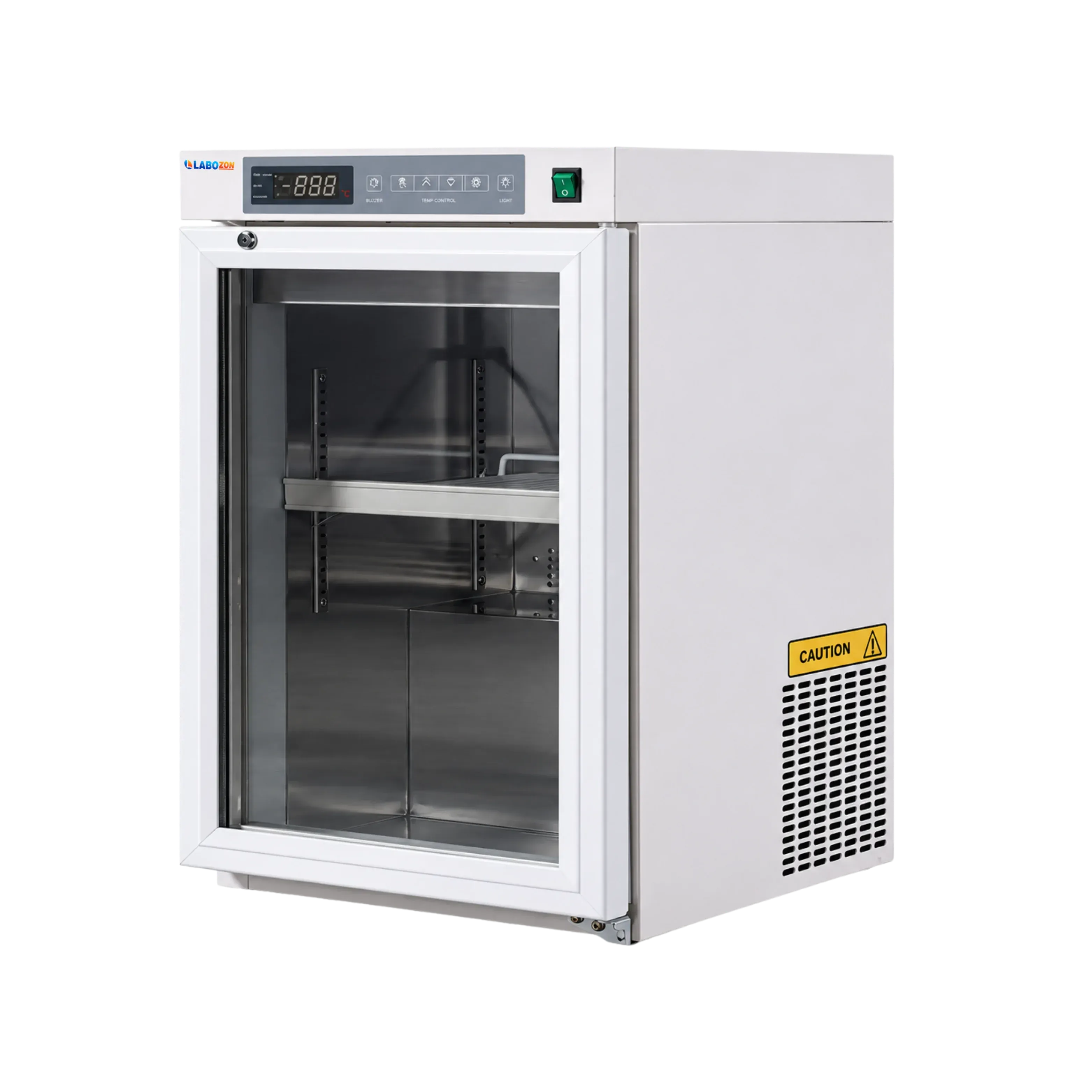


Looking for medical refrigerator?
Compare available models, review product specifications, and contact the Labozon team for assistance in identifying equipment that matches your laboratory requirements.