
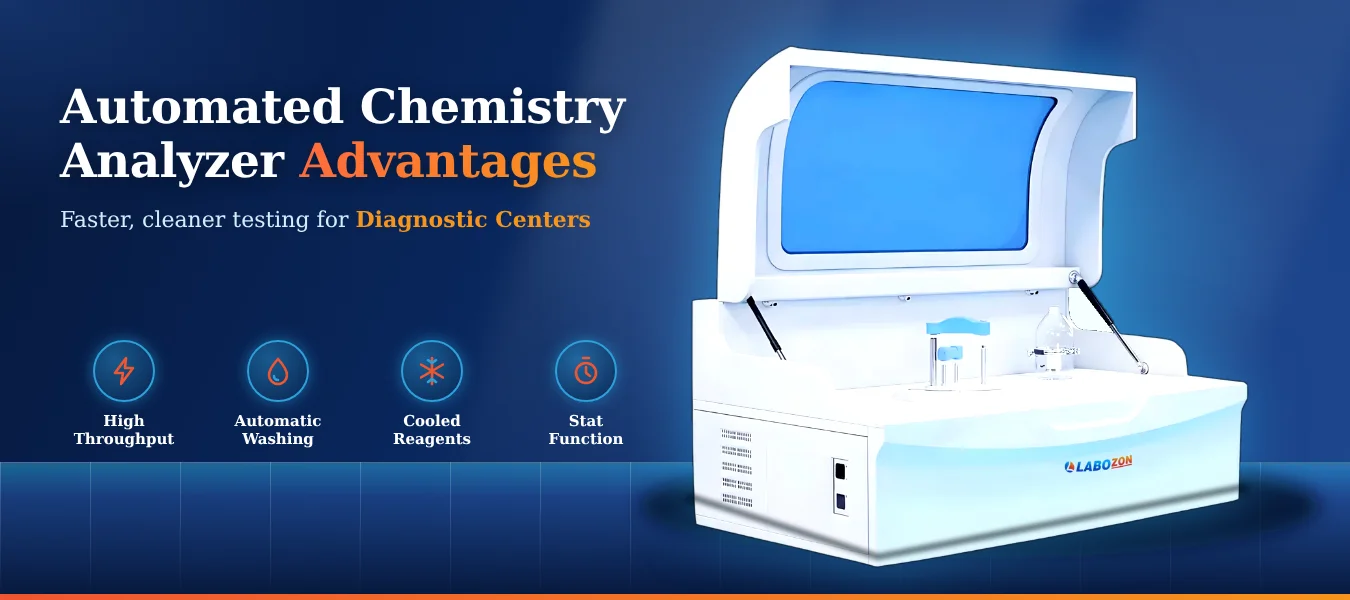
A practical guide to how automation changes daily biochemical testing, where it fits in a laboratory, and how to choose with confidence.
Why Laboratories Are Moving Toward Automation
A fully automated chemistry analyzer takes over the repetitive stages of biochemical testing, including reagent delivery, mixing, reading, and washing. Instead of pipetting each tube by hand, staff load samples and let the instrument carry the sequence from start to finish. The Auto Chemistry Analyzer LZ-ACA-A100 follows this approach for clinical chemistry testing in laboratories and diagnostic centers.
The same instrument may be called a clinical chemistry analyzer, a blood chemistry analyzer, or a biochemistry analyzer, depending on the department. Each name points to one idea: measuring chemical parameters in serum, plasma, and other biological samples through absorbance readings.
How the Workflow Unfolds
Inside the automated chemistry analyzer machine, a fully automated chemistry analyzer cycle moves each sample through a fixed order. The sample is drawn in from two to seventy microliters, reagent between twenty and three hundred fifty microliters is added, and an independent mixing probe stirs the reaction in a reusable cuvette with a six millimeter optical length. Light from a halogen lamp passes through the cuvette, and absorbance is read at wavelengths between three hundred forty and seven hundred nanometers.
Sequence followed during one cycle
When the cycle ends, the completed panel is ready for interpretation before the next sample begins.
Advantages That Matter at the Bench
Six practical advantages of a fully automated chemistry analyzer show up in daily routines.
Higher Throughput
Two hundred tests per hour and forty-nine sample positions support continuous handling of multiple samples.
Less Manual Handling
Reaction sequencing runs without manual intervention, leaving technicians free for preparation and review.
Controlled Liquid Handling
Detection-based sampling supports accurate liquid handling, while a probe safety mechanism protects the probe during operation.
Stable Reaction Conditions
A refrigerated reagent tray with an independent switch keeps reagents cooled and reactions consistent.
Automatic Washing
Cuvettes and the sampling probe, inside and outside, are washed automatically between cycles.
Stat Function and Organized Data
Urgent samples can be prioritized, and a LAN port supports structured output for orderly records.
Auto Chemistry Analyzer Uses Across Departments
Auto chemistry analyzer uses extend well beyond a single bench. Auto analyzer uses on the LZ-ACA-A100 cover clinical biochemistry testing labs, hospital laboratory departments, pathology units, diagnostic centers, and research and development laboratories. In a diagnostic center, the fully automated chemistry analyzer handles chemical testing of blood and body fluids for routine analysis, reporting, and interpretation. Laboratories planning a wider evaluation can review the full chemistry analyzer category alongside this model.
Common Selection Mistakes
Choosing Without Mapping Daily Volume
Instruments sized for low volumes can slow a busy center, while oversized ones leave capacity unused. Estimate daily samples first.
Overlooking Bench and Power Readiness
External dimensions, net weight, power draw of three hundred watts, and supply options of two hundred twenty volt or one hundred ten volt should be confirmed before delivery.
Reading Only the Throughput Figure
Sample positions, wavelengths, washing, reagent cooling, and the stat function shape daily experience of a fully automated chemistry analyzer as much as speed does.
Ignoring Reagent Storage Planning
Cooled reagent capacity and loading routines affect how smoothly a shift begins.
Comparing Automated Chemistry Analyzer Manufacturers on Appearance Alone
Published specifications, documented features, and product range depth give a clearer comparison than photographs.
Semi Automatic Versus Fully Automatic Operation
Many laboratories weigh a semi auto chemistry analyzer against an automatic chemistry analyzer before choosing a fully automated chemistry analyzer. The table summarizes how the two differ in routine handling.
| Aspect | Semi Auto Analyzer | LZ-ACA-A100 |
|---|---|---|
| Sample Loading | Serum or plasma pipetted into cuvettes by hand | Samples placed in forty-nine positions |
| Reagent Addition | Added by the operator after the sample | Drawn in automatically for the reaction |
| Reading | Triggered by the operator, one batch at a time | Runs as a continuous sequence |
| Typical Fit | Lower daily test volumes | Steady routine panels |
Exploring the Wider Chemistry Analyzer Category
A fully automated chemistry analyzer such as the LZ-ACA-A100 sits within a category that groups auto chemistry analyzers, semi auto units, and the automatic biochemistry analyzer line. Siblings such as the LZ-ACA-A101, LZ-ACA-A102, and LZ-ACA-A103 allow side by side review. Laboratories usually compare sample capacity, reagent handling, washing routines, connectivity, footprint, and electrical needs.
The complete range is available through the chemistry analyzer range, and broader laboratory equipment can be found from the Labozon home page.
User Tips and Good Practices
- Keep the refrigerated reagent tray switched on during working hours.
- Place the fully automated chemistry analyzer on a level, stable bench.
- Reserve the stat function for urgent samples only.
- Review cuvette and probe washing routines on a regular schedule.
- Train staff on the probe safety mechanism before the first run.
- Use the LAN port output to keep reporting organized.
Final Thoughts
Automation brings speed, controlled handling, and orderly data into one routine. For a busy diagnostic center, a fully automated chemistry analyzer turns repetitive manual steps into a predictable sequence.
Name: Olivia Carter – Labozon
Specialty: Laboratory Equipment, Scientific Technology, and SEO Content Writing
Writing Style: Professional, informative, research-driven, and reader-friendly.
Bio: Olivia Carter is a content writer at Labozon, specializing in laboratory equipment, scientific technologies, and laboratory applications. She creates informative, SEO-focused blog articles that highlight product features, explain key benefits, and explore the practical uses of scientific instruments. Her goal is to present technical information in a clear, accurate, and accessible manner, helping laboratory professionals, researchers, and science enthusiasts make informed decisions.
Linked.in
Related Products

Looking for Fully Automated Chemistry Analyzer?
Compare available models, review product specifications, and contact the Labozon team for assistance in identifying equipment that matches your laboratory requirements.