
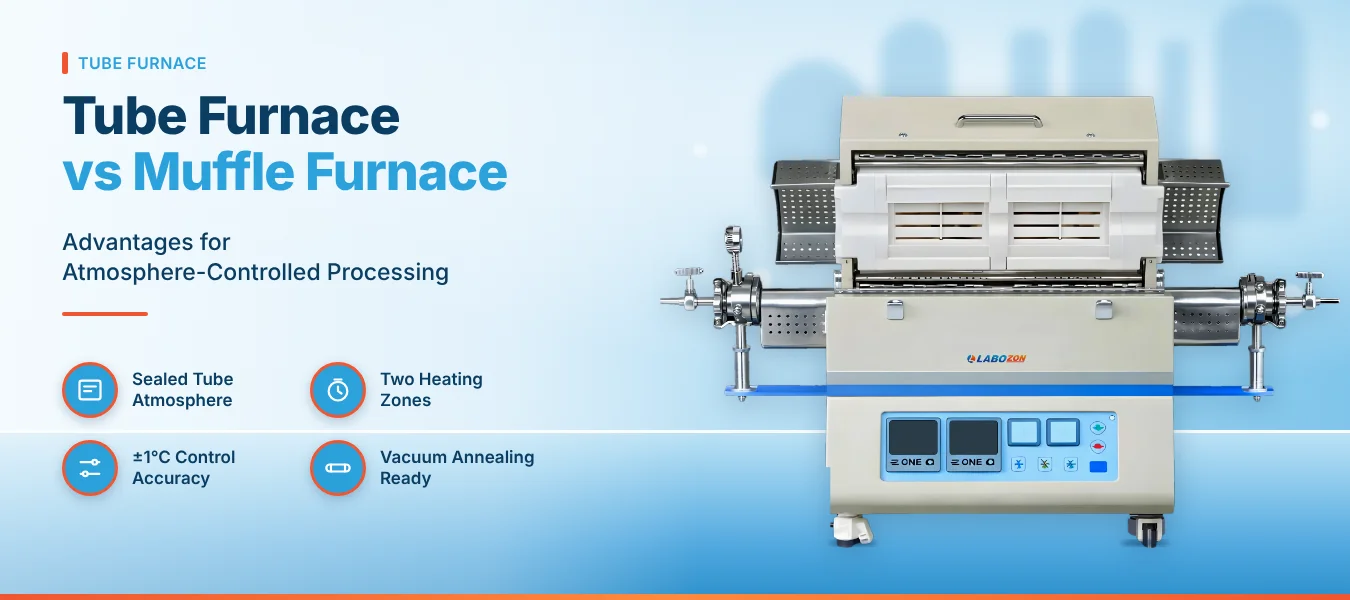
When a sample must be heated in a defined gas, or in vacuum, the choice of furnace decides the result. Both types reach high temperature, but they handle atmosphere very differently. This guide explains how each one works, where each fits, and what to check when evaluating a tube furnace such as the Tube Furnace LZ-TBF-A100.
Why Atmosphere Matters at High Temperature
Heat speeds up chemistry. At a few hundred degrees, oxygen in the surrounding air starts to react with metals, powders and thin films, and at higher temperature those reactions become hard to avoid. Processes such as sintering, reduction and thin-film growth need a chosen gas, or no gas at all, around the sample.
That requirement shifts the question from "how hot?" to "what surrounds the sample?" The answer points to a different furnace format than plain air heating does.
How a Muffle Chamber Handles Heat
A muffle furnace is a box-style chamber with insulated walls and heating elements outside the heated space. It is built for heating in ambient air, which makes it a familiar tool for ashing, loss on ignition and general heat treatment. Loading is simple, and a wide chamber holds many crucibles at once.
The limit appears when a process needs a specific gas. A box chamber has large door seals and a large volume to purge, so holding a clean atmosphere is slow and uses a lot of gas.
How a Sealed Tube Changes the Process
A basic tube furnace diagram shows a narrow process tube, usually quartz or alumina, running through an insulated heated body. Flanges seal both ends, so the operator can pull vacuum or flow inert, reducing or reactive gas across the sample.
Because the tube volume is small, purging is fast and gas use stays low. Gas also travels along the tube, so reaction products leave with the exhaust instead of lingering near the sample.
Atmosphere Handling Compared
The table below sets the two formats side by side for controlled-atmosphere work.
| Factor | Muffle Furnace | Tube Furnace |
|---|---|---|
| Atmosphere | Ambient air in a large chamber | Vacuum, inert or reactive gas in a sealed tube |
| Purge volume | Large, slow to clear | Small, quick to clear |
| Oxidation risk | High unless the work suits air | Low once the tube is purged |
| Sample capacity | Many crucibles at once | A few boats along the tube |
| Ideal for | Ashing, loss on ignition, air heat treatment | Sintering, reduction, CVD, vacuum annealing |
Neither format replaces the other. The match depends on the atmosphere the process requires and on how many samples run at once.
Controlled-Atmosphere Uses in the Lab
Tube furnace uses cover a wide range of laboratory processes, and tubular furnace uses extend across research centers, materials labs and industrial testing groups.
Vacuum Annealing
Relieves stress without surface oxidation.
Atmosphere Sintering
Bonds ceramic and metal powders under controlled gas.
Atmosphere Reduction
Converts metal oxides in a reducing gas flow.
CVD Experiments
Grows thin films from gas-phase precursors.
Formats and Layouts to Know
Tube furnace types differ by orientation, zones and opening style. A horizontal tube furnace is easy to load and suits boats and crucibles. Vertical designs suit hanging or gravity-fed samples. Split-body models open along their length for quick tube changes, while solid-body models favor tight insulation.
Multi-zone units create longer uniform regions or temperature gradients. Two zones, for example, widen the constant-temperature length compared with a single zone of the same size.
Specifications of the LZ-TBF-A100
The Labozon Tube Furnace LZ-TBF-A100 is a horizontal laboratory tube furnace with two heating zones and a microprocessor controller. It works as a high temperature tube furnace for atmosphere sintering, atmosphere reduction, CVD experiments and vacuum annealing. Its published details are below.
| Feature | Specification |
|---|---|
| Tube | 60 × 1000 mm; quartz tube supplied |
| Temperature | 1200 °C peak; 1100 °C rated |
| Heating zones | Two zones, 205 mm each; 250 mm constant-temperature length |
| Control | PID with self-tuning; 30 programmable stages; ±1 °C accuracy |
| Feedback and power | K-type thermocouples; silicon controlled rectifier with phase-shifted trigger |
| Ramp rate | Up to 30 °C/min; 15 °C/min or lower recommended |
| Connectivity | Communication interface and software |
| Safety | Over-temperature protection, break-off protection, over-current protection with air switch, power-off protection; outer surface 45 °C or less |
| Power | 3.6 kW, 220 V single phase |
| Size | 1140 × 460 × 695 mm |
| Supplied accessories | Quartz tube, stainless steel flange set, stainless steel hook, two alumina furnace plugs, two K-type thermocouples, high-temperature gloves |
Running a Controlled-Atmosphere Cycle
A typical run follows seven steps:
- Load the sample in a boat and center it in the constant-temperature length.
- Seat the alumina plugs and tighten the end flanges evenly.
- Pull vacuum or purge the tube with the chosen gas.
- Program a gentle ramp to the process temperature.
- Hold for the time the material needs, with gas flow steady.
- Program a slow cool while the atmosphere stays in place.
- Open the tube only when the sample is safe to handle.
Selection Mistakes That Waste Time Later
- Choosing on peak temperature alone and ignoring the rated temperature and the vacuum details.
- Picking a muffle format for work that needs a reducing or inert gas.
- Overlooking the length of the constant-temperature region, which decides how many samples fit.
- Skipping controller features such as stage count, self-tuning and data connection.
- Judging tube furnace manufacturers by the headline figure instead of what ships in the box.
Details such as vacuum rating and gas fittings are not listed for each model, so buyers can confirm them for the Labozon two-zone tube furnace before planning a vacuum run.
User Tips and Recommended Practices
- Choose a muffle furnace for air work and a tube furnace when gas or vacuum control matters.
- Center the boat in the 250 mm constant-temperature length.
- Seat the alumina plugs and tighten flanges evenly for a clean seal.
- Purge with inert gas before heating if oxidation matters.
- Ramp at 15 °C per minute or lower for ceramics and other brittle samples.
- Let the furnace cool under program control before opening the tube.
- Inspect the quartz for cracks or clouding before each long run.
- Save each recipe through the communication interface so a good run can be repeated.
Exploring the Wider Tube Furnace Category
The LZ-TBF-A100 belongs to the laboratory tube furnace category, which groups single-zone, multi-zone, horizontal, split-body and vacuum-ready units. Buyers usually review rated and peak temperature, tube size, zone count, controller features, atmosphere fittings and safety cutoffs.
The full Labozon tube furnace range shows these units together, and the Labozon home page opens the other laboratory equipment groups.
Name: Olivia Carter – Labozon
Specialty: Laboratory Equipment, Scientific Technology, and SEO Content Writing
Writing Style: Professional, informative, research-driven, and reader-friendly.
Bio: Olivia Carter is a content writer at Labozon, specializing in laboratory equipment, scientific technologies, and laboratory applications. She creates informative, SEO-focused blog articles that highlight product features, explain key benefits, and explore the practical uses of scientific instruments. Her goal is to present technical information in a clear, accurate, and accessible manner, helping laboratory professionals, researchers, and science enthusiasts make informed decisions.
Linked.in
See the full specification of the Tube Furnace LZ-TBF-A100.
Explore Tube FurnaceRelated Products


Looking for tube furnace?
Compare available models, review product specifications, and contact the Labozon team for assistance in identifying equipment that matches your laboratory requirements.