

Fine, uniform powders shape the quality of many research results. A Planetary Ball Mill grinds and mixes samples through high-energy motion inside rotating jars. This guide explains how it works, where it fits, and what to review before choosing and running one.
Planetary Ball Mill Working Principle: Motion and Impact
The planetary ball mill working principle explains the strong grinding action. Each jar sits on a rotating disc. The disc turns one way while each jar spins on its own axis, like planets circling a sun while turning themselves. This combined motion throws grinding balls across the jar, so they impact and shear the sample many times per minute.
The planetary ball mill machine working principle differs from a rotary ball mill, which turns a single drum so that balls mostly tumble and cascade. Planetary motion adds a strong centrifugal field, which raises impact energy and speeds fine grinding. The Planetary Ball Mill Machine LZ-PBM-A160 follows this planetary movement principle with a gear and belt driven disc.
Planetary Ball Mill Diagram: Main Parts
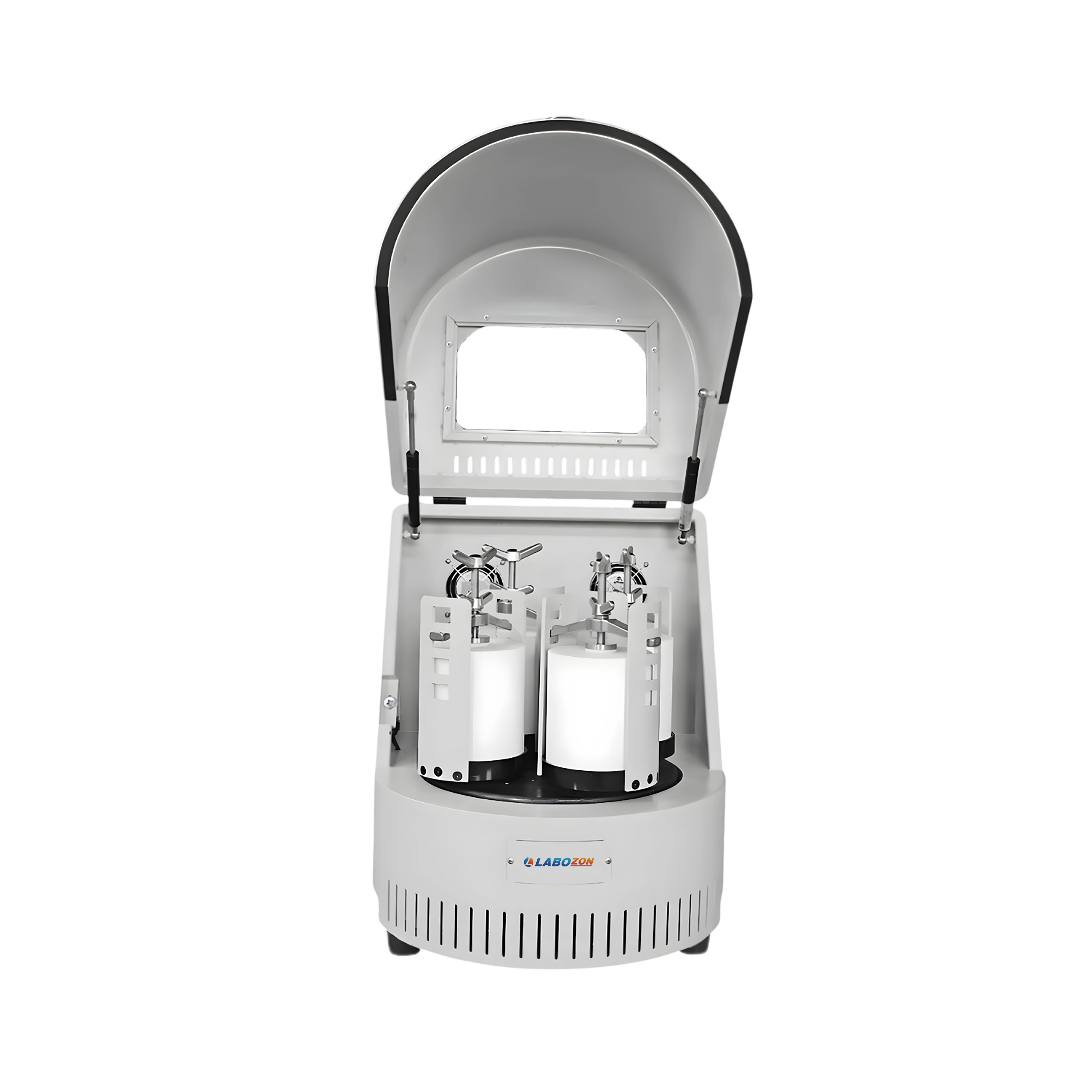
A basic planetary ball mill diagram for the LZ-PBM-A160 shows a few parts that each play a clear role.
- Mill jars: two or four jars working together, each listed at 1 to 2 L
- Grinding medium: stainless steel, tungsten carbide, zirconium oxide, or aluminium oxide balls
- Planetary disc: gear and belt driven, carrying the jars
- Frequency controller: adjusts rotation speed from 70 to 680 rpm
- Programmable timer: sets the run length
- Housing: a vertical semi-circle body with a low center of gravity
A planetary ball mill machine diagram like this helps new operators see how each part contributes to the milling action.
How a Planetary Ball Mill Machine Works in the Lab
Understanding how a planetary ball mill machine works helps with setup. Operators load sample and balls into matched jars, close and secure the lids, and place the jars on the disc. They set speed and time, and the planetary milling machine runs the program. In a planetary ball mill machine laboratory routine, jar and ball material is chosen to suit the sample and limit contamination. The page lists soft or crispy feed up to 100 mm and hard material up to 3 mm, although small feed grinds more efficiently.
Nano-Scale Grinding and Alloy Studies
Planetary motion provides high-energy grinding suited to fine-powder applications, and the LZ-PBM-A160 lists 0.1 µm output granularity, which equals 100 nm. The page names uniform nanoparticle preparation for lab and experimental studies as an intended application. It gives no particle-size distribution, so confirm the size reached with your own material and method.
As general technical context, mechanical alloying blends metal powders through repeated impact, welding, and fracture, and a planetary ball mill is a common tool for the method because of its high impact energy. The product page itself does not use that term. It lists metal alloy studies, described as controlled milling of metal powders for laboratory alloy evaluation. Listed applications are:
- Nanomaterial research
- Metal alloy studies
- Ceramic and composite materials
- Electronic materials
- Pharmaceutical labs handling active ingredients in contamination-controlled environments
The page does not describe inert atmosphere, vacuum, or wet milling, so confirm those needs with Labozon before planning air-sensitive work.
Published Details of the LZ-PBM-A160
| Parameter | Details |
|---|---|
| Type | Vertical semi-circle round shape |
| Maximum capacity | 3.33 L |
| Jar capacity | 1 to 2 L |
| Working mode | Two or four mill jars together |
| Rotation speed | 70 to 680 rpm |
| Drive and control | Gear and belt drive, frequency controller, programmable timer |
| Feed size | Soft material up to 100 mm; hard material up to 3 mm |
| Output granularity | 0.1 µm |
| Jar and ball materials | Stainless steel, tungsten carbide, zirconium oxide, aluminium oxide, and others |
| Power | 1.5 kW, 220V 60 Hz, single phase |
| Dimensions | 880×560×760 mm |
| Weight | 132 kg |
Rotary Mill Versus Planetary Milling Machine
A rotary ball mill suits coarse grinding and larger batches, while a planetary milling machine suits small batches that need fine output. The table summarizes the main differences.
| Feature | Rotary ball mill | Planetary milling machine |
|---|---|---|
| Motion | Single drum, tumbling balls | Disc rotation plus jar spin |
| Impact energy | Lower | Higher |
| Typical batch | Larger | Small laboratory batches |
| Fine-powder work | Limited | Suited to fine powders |
Step-by-Step Operation
- Select jars and balls that suit the sample.
- Load sample and balls, leaving free space in each jar.
- Close the lids securely.
- Place jars on the disc in matched, balanced positions.
- Set speed on the frequency controller and time on the timer.
- Start at lower speed, then raise it as needed.
- Let the mill stop fully before opening the cover.
- Allow jars to cool, then open and unload carefully.
Read the user manual before the first run.
Common Selection Mistakes
A frequent mistake is treating each ball mill as equal. Compare jar material, jar volume, speed range, timer, drive, and footprint together. When reviewing planetary ball mill machine manufacturers, ask for jar and ball options, spare parts, and technical documentation. To weigh other formats, browse the ball mill machine range before narrowing your shortlist.
Another mistake is ignoring weight and power. This unit lists 132 kg and 220V 60 Hz single phase, so plan floor support and supply in advance.
User Tips and Recommended Practices
- Balance the load with matched jars and similar fill.
- Choose jar and ball materials that limit contamination.
- Do not overfill; free space lets balls move and grind.
- Raise speed gradually to reduce stress on the machine.
- Allow cooling, since milling heats the jars.
- Clean jars and balls between samples.
- Check seals and lids, and replace worn parts early.
- Use protective equipment, dust control, and suitable ventilation for fine powders.
- Log speed, time, media, and sample for repeatable results.
Exploring the Ball Mill Category
The Planetary Ball Mill Machine LZ-PBM-A160 belongs to the wider group of laboratory ball mills, which includes planetary, roller, and other grinding formats. Buyers usually compare jar volume, speed range, drive type, timer and control options, jar and ball materials, and footprint. To see the full range, visit the ball mill machine category.
Labozon supplies scientific equipment across many disciplines, and the rest of its catalog is reachable from the Labozon home page.
Related Products


Looking for planetary ball mill?
Compare available models, review product specifications, and contact the Labozon team for assistance in identifying equipment that matches your laboratory requirements.