
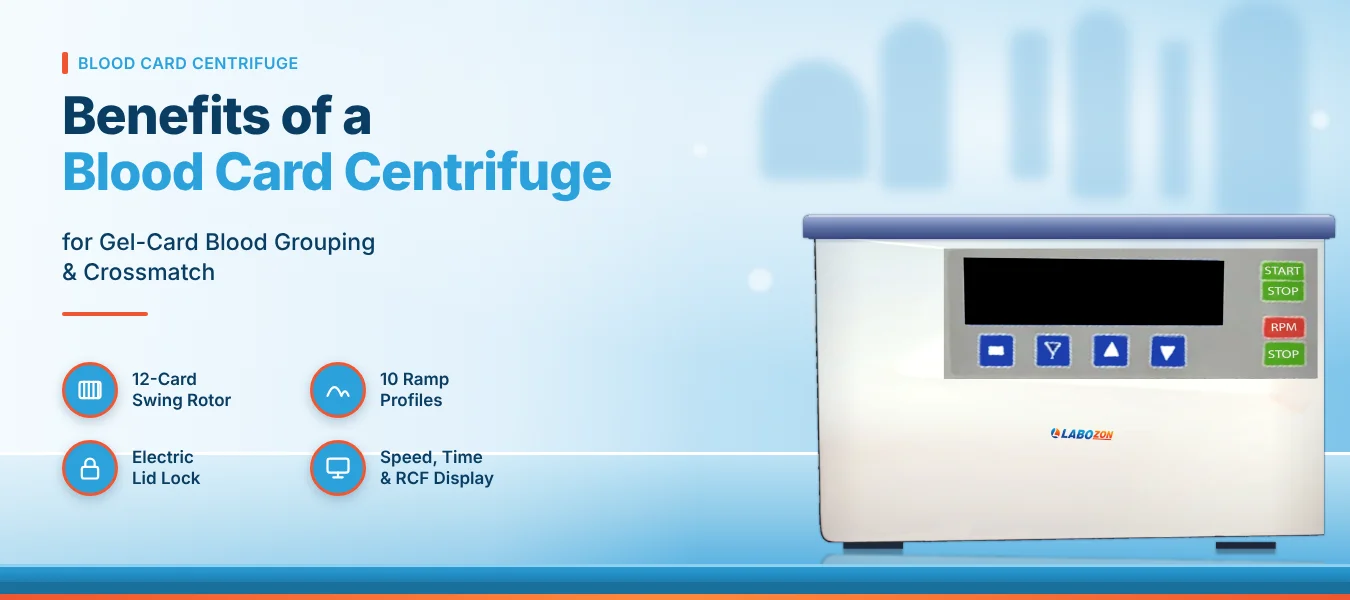
In a transfusion lab, an unclear result can delay care. After incubation, a gel card must spin at a controlled speed for a controlled time, and that step belongs to a blood card centrifuge. This guide explains how it works, where it is used, and what to check when choosing the Blood Card Centrifuge LZ-BCC-A100-12.
Why Gel Cards Need a Dedicated Spin
A gel card holds small micro-columns filled with reagent gel. Red cells and plasma are added, and spinning drives the cells through the gel. Cells that clump stay near the top, and free cells travel to the bottom, so the reaction becomes a pattern the eye can read.
A general blood centrifuge built for tubes cannot hold these cards. A blood card centrifuge device uses a swing rotor shaped for the card, so the force acts along the columns and the pattern forms cleanly.
Parts and Working Principle
A basic blood card centrifuge diagram shows a stainless steel chamber, a swing rotor, a brushless motor, a control panel and an electric lid lock. As the rotor spins, the swing buckets lift to a horizontal position and force pushes red cells down through the gel.
A microprocessor holds speed and time, then brakes the rotor when the run ends. Because this blood centrifuge machine is a compact benchtop centrifuge, it fits beside the incubator without special installation.
Blood Card Centrifuge Uses in the Blood Bank
Blood card centrifuge uses center on blood group serology, where a card shows how patient and donor cells react.
Blood Typing
Forward and reverse grouping of ABO and Rh antigens.
Antibody Screening
Detects unexpected antibodies in patient plasma.
Crossmatch
Checks donor red cells against patient plasma before transfusion.
Micro-Column Reading
Reads clumping patterns in the gel for immuno detection.
Pairing the Spin With Incubation
A Gel Card Centrifuge and incubator work as a pair. The incubator holds cards at the temperature the card maker requires, and the centrifuge then spins them. Placing both on one bench shortens the walk between steps, so cards move straight from warm incubation to spinning and handling time stays short.
That same bench rule applies to any laboratory centrifuge in a blood bank: keep the workflow in one line, from sample to incubation to spin to reading.
Specifications of the LZ-BCC-A100-12
The Labozon Blood Card Centrifuge LZ-BCC-A100-12 is a microprocessor-controlled unit with a soft touch panel. Its published details are below.
| Feature | Specification |
|---|---|
| Rotor | Swing rotor for 12 cards |
| Display | Digital panel for speed, time and relative force; RPM and force conversion |
| Timer | 0 to 99 minutes 59 seconds |
| Speed accuracy | ±20 rpm |
| Ramp profiles | 10 kinds of acceleration and deceleration |
| Safety | Automatic electric lid lock; over-speed and over-temperature control |
| Chamber and motor | Stainless steel chamber resistant to weak detergents and disinfectants; brushless motor |
| Noise | 55 dB or less |
| Programs | Settings stored automatically; programs for serum tests and blood gel cards |
| Size and weight | 485 × 320 × 250 mm; 17 kg |
Running a Card Cycle Step by Step
A blood card centrifuge how to use guide follows seven steps:
- Prepare the cards with reagent, plasma and cells, then incubate as the card maker directs.
- Load the swing rotor and keep the load balanced.
- Close the lid and wait for the lid lock to engage.
- Choose the program for gel cards.
- Start the run and let the rotor finish its time.
- Open the lid only after the rotor has stopped.
- Read the gel columns right away.
Selection Mistakes That Waste Time Later
- Choosing a blood card centrifuge machine by speed alone and ignoring card capacity, program memory and ramp profiles.
- Buying a tube centrifuge for gel cards, which cannot hold the card format.
- Overlooking lid safety and noise level in a busy blood bank.
- Forgetting bench space, since the unit must sit beside the incubator.
- Selecting a size that does not match daily card volume.
When two models look close, the laboratory centrifuge category page lets buyers read their specifications side by side before deciding.
User Tips and Recommended Practices
- Balance the rotor by filling both sides evenly with cards or dummy cards.
- Use the spin settings the card maker lists.
- Wipe spills right away with a mild detergent.
- Place the unit on a flat, firm bench.
- Never force the lid open during a run.
- Read cards soon after spinning.
- Inspect the rotor for wear on a regular schedule.
- Record date, program and operator for each batch.
Exploring the Wider Centrifuge Category
The LZ-BCC-A100-12 belongs to the laboratory centrifuge category, which groups benchtop, floor-standing, refrigerated, clinical and blood bank units. Buyers usually review rotor type, capacity, speed range, program memory, safety features and bench footprint.
The full Labozon laboratory centrifuge range shows these units together, and the Labozon home page opens the other laboratory equipment groups.
Name: Olivia Carter – Labozon
Specialty: Laboratory Equipment, Scientific Technology, and SEO Content Writing
Writing Style: Professional, informative, research-driven, and reader-friendly.
Bio: Olivia Carter is a content writer at Labozon, specializing in laboratory equipment, scientific technologies, and laboratory applications. She creates informative, SEO-focused blog articles that highlight product features, explain key benefits, and explore the practical uses of scientific instruments. Her goal is to present technical information in a clear, accurate, and accessible manner, helping laboratory professionals, researchers, and science enthusiasts make informed decisions.
See the full specification of the Blood Card Centrifuge LZ-BCC-A100-12.
Explore Blood Card CentrifugeRelated Products


Looking for blood card centrifuge?
Compare available models, review product specifications, and contact the Labozon team for assistance in identifying equipment that matches your laboratory requirements.