
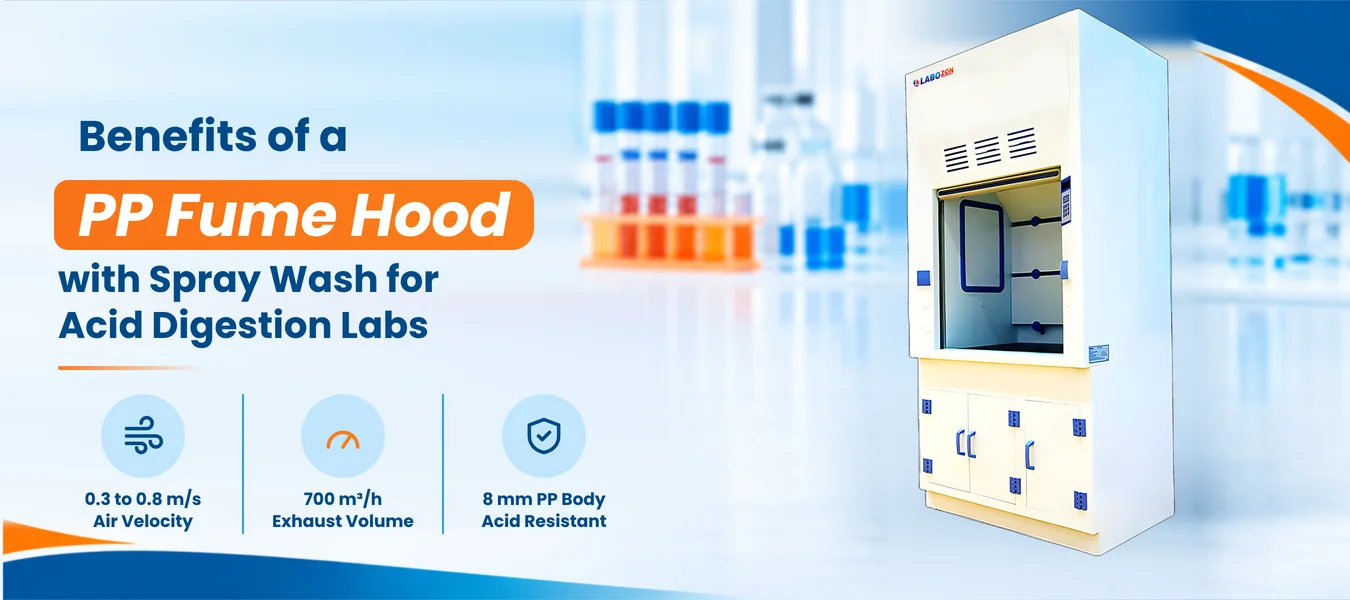
Acid digestion releases corrosive vapors that attack ordinary hood surfaces and can leave residue inside the duct. A PP spray fume hood is built for that job: polypropylene walls resist strong acids and alkalis, and a deflector spray system helps neutralize acid gases in the exhaust before discharge. This guide covers how it works, where it fits, and what to review before choosing one.
What Sets This Hood Apart
A fume hood draws air away from the operator and sends vapors out through an exhaust duct. A lab fume hood made of polypropylene (PP) adds chemical resistance, which matters when work involves hot, concentrated acids. In the spray version, the deflector spray system helps neutralize acid gases in the exhaust before discharge.
Many labs call this equipment a fume cupboard, and some compare it with a portable fume hood. The PP Spray Fume Hood LZ-PFH-A110 from Labozon is a larger floor-standing model, so it suits fixed acid digestion benches more than occasional use.
Acid Digestion Workflows
Acid digestion prepares samples for metal analysis, and it often runs at high temperature with strong acids. Typical work includes:
- Sample digestion with nitric, hydrochloric, or perchloric acids
- Heated acid work on digestion blocks
- Washing and rinsing acid-contaminated labware
- Preparing samples for trace metal testing
Many teams ask where and how a PP spray fume hood be used safely. The LZ-PFH-A110 page states that the PP spray fume hood helps reduce accumulation of perchloric acid residues that can contribute to hazardous reactions such as combustion, explosion, or heat generation. Always follow your site's rules for perchloric acid work.
Inside the Cabinet: Main Parts
A PP spray fume hood diagram usually shows the body, the front window, the deflector with spray nozzles, the work table, the blower, and the exhaust duct. In the LZ-PFH-A110, the circulating water system includes a water tank, a circulating pump, a water inlet and outlet structure, and a circulating water circuit. A 4.3 m PVC exhaust duct is located at the top.
Reading the diagram before purchase shows where utilities connect and where service access sits.
Why Digestion Labs Choose Spray Wash
Acid resistance
The page describes an 8 mm porcelain white PP body that resists strong acid and alkali.
Spray wash
The deflector spray system helps neutralize acid gases in the exhaust before discharge.
Controlled airflow
The page lists air velocity of 0.3 to 0.8 m/s with an adjustable speed blower.
Utility access
A PP sink, water tap, gas tap, waterproof sockets, and an easy-access utilities panel simplify setup and service.
Published Details of the LZ-PFH-A110
| Parameter | Details |
|---|---|
| Maximum opening | 740 mm |
| Air velocity | 0.3 to 0.8 m/s |
| Work surface height | 820 mm |
| Exhaust volume | 700 m3/h |
| Internal dimensions | 987 × 500 × 700 mm |
| Blower | Built-in PP centrifugal, speed adjustable, 300 W |
| Lamp | LED, 24 W |
| Noise | Up to 68 dB(A) |
| Operators | 1 to 2 |
| Electrical | 220 V, 50 or 60 Hz; 110 V, 60 Hz optional |
| Gross weight | 268 kg |
The listed work table is a chemical resistant solid core physical and chemical board, and PP, epoxy resin, or ceramic work tables are optional. The enquiry forms offer more voltages than the specification table, so confirm the table material and electrical setup with Labozon before ordering. Other optional items include a UV lamp and an electric glass door.
Common Selection Mistakes
Choosing on size alone is the most frequent error. Review work table material, airflow range, window design, spray and water systems, duct length, floor space, and electrical needs together. A unit matched to your acid types and daily workload helps avoid corrosion problems and downtime.
Other mistakes include ignoring duct routing, skipping water supply planning, and overlooking floor loading. If your work needs a different hood format, review the wider fume hood range before deciding. When reviewing PP spray fume hood manufacturers, look at service support and spare part availability too.
User Tips and Recommended Practices
- Train operators on acid handling, spray use, and emergency steps before first use.
- Keep the sash window at the working height and avoid blocking the airflow slots.
- Start the blower and spray before opening acid containers.
- Place large items toward the back of the work area.
- Rinse the sink and work surface after each digestion session.
- Check the water tank level, pump, and spray before each shift.
- Inspect the duct and PP surfaces for wear or residue on a schedule.
- Record airflow checks and cleaning dates in a maintenance log.
Explore the Fume Hood Category
The PP Spray Fume Hood LZ-PFH-A110 belongs to a wider group of fume hoods that includes ducted, ductless, and corrosion-resistant models. Buyers usually compare body material, airflow range, work table, filtration or spray systems, and floor footprint. To see the full range, browse the fume hood category.
Labozon supplies scientific equipment across many disciplines, and the rest of its catalog is reachable from the Labozon home page.
Related Products

Looking for pp spray fume hood?
Compare available models, review product specifications, and contact the Labozon team for assistance in identifying equipment that matches your laboratory requirements.