
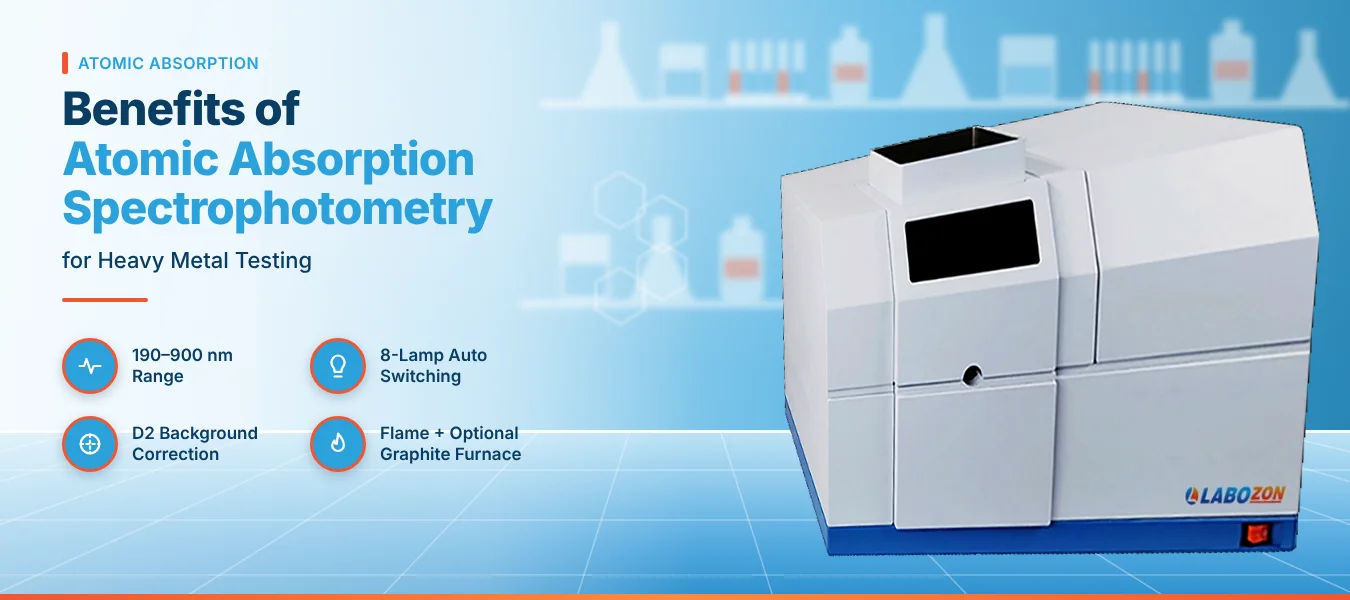
Lead in drinking water, cadmium in rice, nickel in a pharmaceutical ingredient: heavy metal testing sits behind many routine laboratory decisions. An atomic absorption spectrophotometer measures one metal at a time by reading how much light its free atoms absorb. This guide explains how it works, where it fits and what to check when evaluating the Atomic Absorption Spectrophotometer LZ-AAS-A100.
The Principle Behind the Reading
A hollow cathode lamp emits light at the exact wavelength a chosen metal absorbs. The sample is turned into a mist and sent into a flame, where metal atoms become free atoms that absorb part of the lamp light.
Absorbance rises with concentration, so a set of known-concentration references builds a calibration curve and the sample reading converts to a concentration. An absorption spectrometer and an AAS spectrometer both describe this one-element-at-a-time measurement, which keeps results specific to the metal under test.
Main Parts of the Instrument
Atomic absorption spectroscopy equipment follows a common layout: a lamp, an atomizer, a monochromator, a detector and control software. Each part has a clear job in the light path.
The LZ-AAS-A100 is described as a flame system with an optional graphite furnace, eight lamp positions with automatic switching and pre-heating, and a deuterium lamp for background correction.
Why Labs Choose This Method
Four traits explain its long use in trace metal work.
Specificity
One lamp per metal limits interference.
Sensitivity
Low levels of lead, cadmium and nickel are measurable.
Speed
Flame readings take seconds after calibration.
Flexibility
Change the lamp to change the metal.
Routine Laboratory Use Cases
Typical atomic absorption spectrophotometer uses include drinking and wastewater monitoring, soil and plant analysis, food and beverage testing, clinical sample screening and metal checks in industrial materials. The product page lists environmental, food, pharmaceutical, clinical and industrial samples.
One common atomic absorption spectrophotometer application is checking lead and cadmium in water and food against internal limits. Another is zinc and iron in feed and fertilizer. Hospital and research labs also measure calcium, magnesium, sodium and potassium in clinical samples, and an atomic absorption spectro run is quick enough to fit a daily batch.
Flame or Graphite Furnace?
Flame atomization suits metals present at milligram-per-liter levels and gives fast, repeatable readings. A graphite furnace heats a tiny sample in a tube and reaches much lower concentrations, which matters for trace cadmium or lead.
The product page lists a graphite furnace as an optional accessory and notes that flame and furnace can operate together. Labs that work at higher levels may start with flame, while labs chasing ultra-trace results should plan for the furnace.
Specifications of the LZ-AAS-A100
The Labozon Atomic Absorption Spectrophotometer LZ-AAS-A100 is a PC-controlled flame instrument with an integrated floating optical platform. Its published details are below.
| Feature | Specification |
|---|---|
| Wavelength range | 190 to 900 nm |
| Wavelength accuracy | ±0.15 nm or better |
| Bandwidth settings | 0.1, 0.2, 0.4, 1.0 and 2.0 nm |
| Lamps | 8, automatic switching with pre-heating |
| Background correction | Deuterium lamp |
| Precision | 0.5% or better |
| Copper detection limit | Below 0.01 µg/ml |
| Burner | All-metal titanium, acetylene and air |
| Safety | Gas cut-off on low pressure, power loss, flame-out or burner change |
| Data | More than 500 stored data sets; Excel export; printed output |
| Optional graphite furnace | Up to 3000 °C |
| Power supply | 220 V, 50 Hz |
Flame, Furnace and Plasma Compared
The table below sets three common routes to a metal result.
| Factor | Flame AAS | Graphite Furnace AAS | Plasma-Based Methods |
|---|---|---|---|
| Typical level | Milligram per liter | Microgram per liter and below | Wide range |
| Elements per run | One | One | Many |
| Speed per sample | Seconds | Minutes | Fast, multi-element |
| Setup effort | Low | Moderate | High |
Selection Mistakes That Cause Rework
- Buying for flame only when the work needs trace levels.
- Overlooking the lamp list for the metals actually tested.
- Forgetting gas, compressed air and fume extraction needs.
- Skipping a check of voltage and frequency at the bench.
- Ignoring background correction when samples are complex.
Buyers who want to compare related instruments can start with the spectrophotometer category before shortlisting.
User Tips and Recommended Practices
- Prepare a fresh blank and calibration references on each testing day.
- Use acid-washed glassware to avoid metal carryover.
- Let the hollow cathode lamp warm up before calibrating.
- Check burner alignment and flame color before the first reading.
- Match sample acidity to the calibration references.
- Run a quality control sample after each group of readings.
- Dilute samples that read above the calibration range.
- Keep the nebulizer and burner slot clean between runs.
- Record lamp, wavelength and flame conditions with each result.
Exploring Wider Spectroscopy Instruments
The LZ-AAS-A100 belongs to the spectrophotometer category, which groups instruments that measure how samples absorb or emit light, including UV-Vis, near-infrared, fluorescence and atomic absorption models. Buyers usually compare wavelength range, sensitivity, optical design, software and sample handling.
The full Labozon spectrophotometer range shows these instruments together, and the Labozon home page opens the other laboratory equipment groups.
See the full specification of the Atomic Absorption Spectrophotometer LZ-AAS-A100.
Explore Atomic Absorption SpectrophotometerRelated Products


Looking for atomic absorption spectrophotometer?
Compare available models, review product specifications, and contact the Labozon team for assistance in identifying equipment that matches your laboratory requirements.