
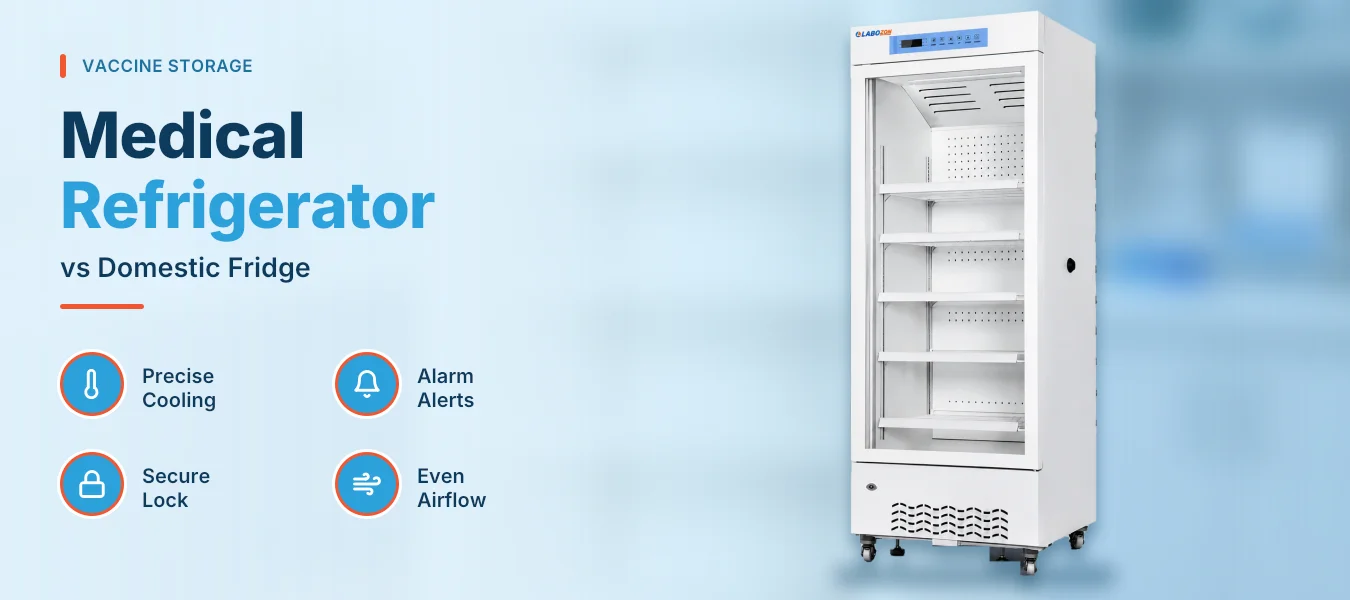
A kitchen appliance keeps food cool. A medical refrigerator holds a narrow range for temperature-sensitive stock, watches its own performance, and warns staff when conditions drift. Here is what that difference means in daily practice.
The Hidden Risk in Household Cooling
Vaccines, medications, and biological samples need to stay inside a tight cold band, commonly from two to eight degrees Celsius. A domestic fridge was designed around groceries, where a few degrees of drift rarely matter. Vials are less forgiving, and damage from warm or frozen storage cannot be seen by eye, so problems are often discovered late.
Uneven Shelves
Cold pockets form near the freezer compartment or back wall, while door bins warm each time the door opens.
Silent Drift
Without alarms, a failing compressor or an ajar door can go unnoticed through a whole weekend.
Open Access
Anyone can open the door, and nothing records or restricts who handles the stock.
Facilities use many names for the alternative: a medical fridge, a medicine fridge, a medicine refrigerator, or vaccine fridges. The names differ, but each describes a cabinet organized around controlled, monitored cold.
How Controlled Cold Actually Works
A medical refrigerator treats temperature as a managed process instead of a dial setting. A microprocessor controller reads the internal temperature and keeps it within tolerance. Fans move air through the cabinet in a forced-draft pattern so shelves share the same conditions. Thick polyurethane foam insulation slows heat gain, and a copper tube evaporator embedded in that foam layer resists corrosion. When something moves out of range, the controller raises an alert.
Airflow and alert path inside a purpose-built cabinet
Side-by-Side Differences
The table below sets a household unit against a cabinet like the Medical Refrigerator LZ-MR-A100 across the points that matter for vaccine handling.
| Feature | Domestic Fridge | Medical Refrigerator |
|---|---|---|
| Temperature control | Basic dial with wide swings | Microprocessor controller with readings to a tenth of a degree |
| Air movement | Passive, with cold and warm pockets | Fan-driven, forced-draft circulation |
| Alerts | Usually none | Power failure, sensor failure, high and low temperature, door open |
| Door and seal | Single door that lets cold air spill | Inner door plus automatic magnetic seal |
| Access | Open to anyone | Mechanical lock and password protection |
| Display | Dial setting only | Real-time temperature, date, time, minimum, and maximum |
A Closer Look at the LZ-MR-A10
The Medical Refrigerator LZ-MR-A100 offers three hundred ten liters of upright storage across five adjustable shelves. It operates from two to eight degrees Celsius with stability of plus or minus one point five degrees, which keeps stock inside the intended band during normal use.
Its surfaces are antibacterial powdered finishes over plastic-coated galvanized steel, and the fluorine-free hydrocarbon refrigerant is eco-friendly.
Microprocessor Control
The controller shows real-time temperature and alarm codes, with date, time, minimum, and maximum readings on the display.
Alarm Coverage
Alarms cover power failure, sensor failure, high and low temperature, and open doors. A rechargeable battery keeps alarms and temperature on display during outages.
Secure Access
A built-in mechanical lock pairs with password protection to limit who can reach the stock.
Uniform Airflow
Inner fan-driven, forced-draft circulation supports temperature uniformity from top shelf to bottom.
Insulated Walls
Polyurethane foam insulation, eighty millimeters thick, surrounds a copper tube evaporator embedded in the foam layer.
Easy Handling
A wide double-layer window permits checks without opening the cabinet, while castors and automatic defrost ease positioning and upkeep.
Medical Refrigerator Uses Across Facilities
Medical refrigerator uses center on holding vaccines, medications, and biological samples at precise temperatures so they remain effective and safe. The setting changes the priorities.
- Clinics and hospital wards keep immunization stock close to the point of care, where quick visual checks through the glass door matter.
- Dispensing counters hold prescription items that need cold conditions, and teams focused on that workflow often review a dedicated pharmacy refrigerator category as well.
- Research laboratories store biological samples, where steady conditions keep experiments comparable from one day to the next.
- Facilities that also handle blood components can look at blood bank refrigerator models alongside general vaccine storage.
Good Practices for Daily Handling
Even a purpose-built cabinet performs only as well as the habits around it. These user tips protect vaccine stock from day to day.
- Let the unit stabilize first. Confirm the display holds the target range before loading any vaccine.
- Keep vials on the shelves rather than in the door area, where circulating air keeps temperature even.
- Leave gaps between vials and walls so forced-draft airflow has room to move.
- Record minimum and maximum readings at the same time each day.
- Use the glass door to check stock visually instead of opening the cabinet.
- Use the lock and password so only trained staff handle vaccines.
- Test the door open and temperature alarms routinely, and confirm the battery-backed display works.
- Keep food, drinks, and unrelated items out of the cabinet.
- Place the unit away from heat sources and direct sunlight, with room around it for ventilation.
- Rotate stock so vials with the earliest expiry are used first.
Selection Mistakes to Avoid
Choosing cold storage on appearance or capacity alone is a frequent error. Comparing units across the wider laboratory refrigerators range makes these gaps easier to spot.
Judging by Size Alone
Volume matters, but shelf layout, airflow, and how much room remains for air gaps decide whether stock stays uniform.
Overlooking Alarm Depth
Check whether alerts extend beyond high temperature to sensor failure, power failure, and open doors.
Ignoring Outage Behavior
Ask what the display and alarms do when mains power is lost, since that is when monitoring matters most.
Skipping Access Control
A cabinet without a lock or password leaves handling open to anyone in the building.
Where This Cabinet Fits in the Wider Range
The Medical Refrigerator LZ-MR-A100 belongs to Labozon's laboratory refrigerators category, which brings together medical, pharmacy, blood bank, ice lined, portable, and explosion proof cabinets. Teams evaluating options in this group usually compare capacity, cabinet type, temperature range and stability, alarm coverage, access control, and ease of movement.
The full range is listed on the laboratory refrigerators category page, and the Labozon home page opens the wider catalog of laboratory equipment.
The Takeaway
Vaccine storage rewards equipment that holds a tight range, spreads cold evenly, limits who can open the door, and speaks up when something changes. A household fridge offers none of that by design, which is why a purpose-built cabinet is the sounder choice for any facility that handles vaccine stock.
Name: Olivia Carter – Labozon
Specialty: Laboratory Equipment, Scientific Technology, and SEO Content Writing
Writing Style: Professional, informative, research-driven, and reader-friendly.
Bio: Olivia Carter is a content writer at Labozon, specializing in laboratory equipment, scientific technologies, and laboratory applications. She creates informative, SEO-focused blog articles that highlight product features, explain key benefits, and explore the practical uses of scientific instruments. Her goal is to present technical information in a clear, accurate, and accessible manner, helping laboratory professionals, researchers, and science enthusiasts make informed decisions.
Related Products
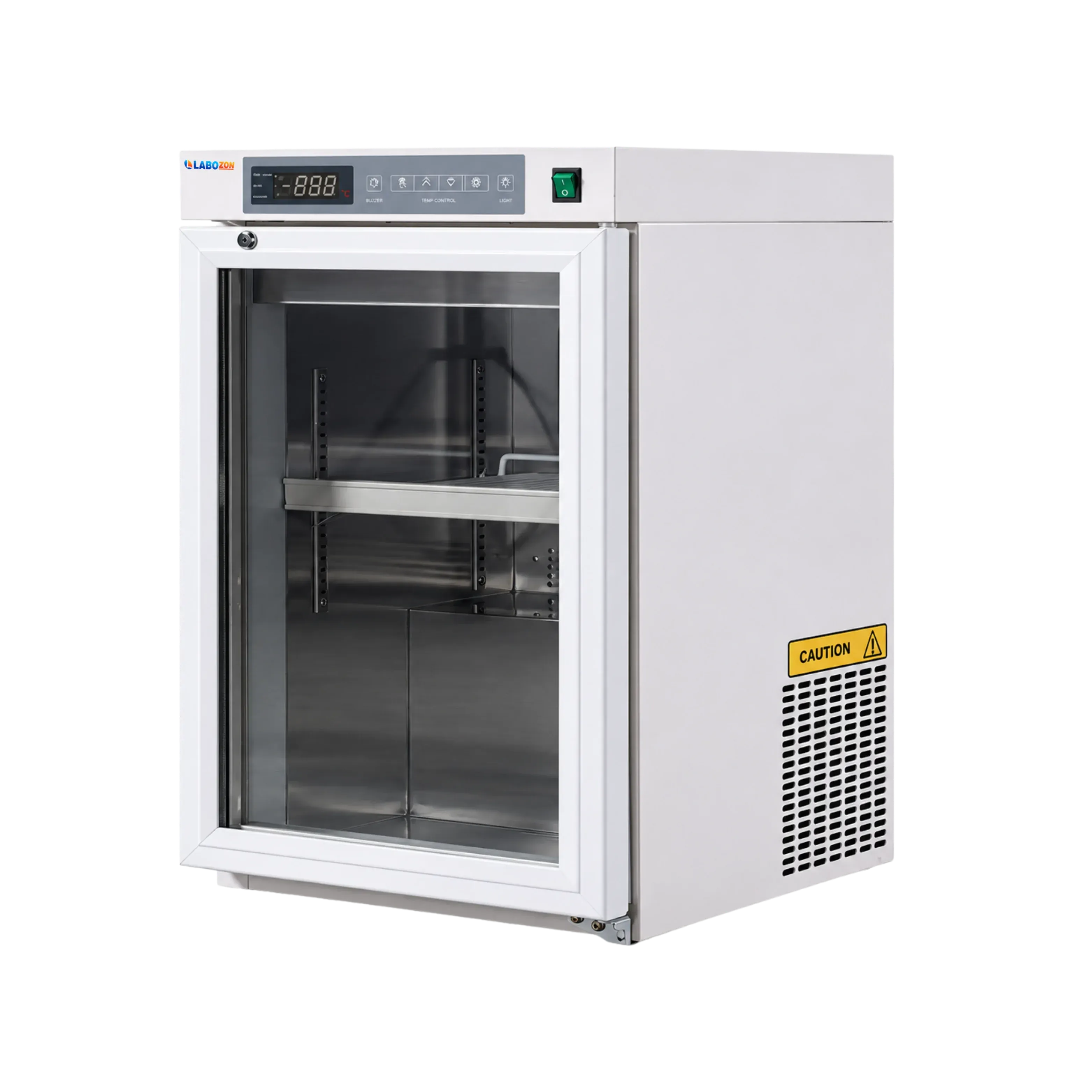


Looking for Medical Refrigerator?
Compare available models, review product specifications, and contact the Labozon team for assistance in identifying equipment that matches your laboratory requirements.